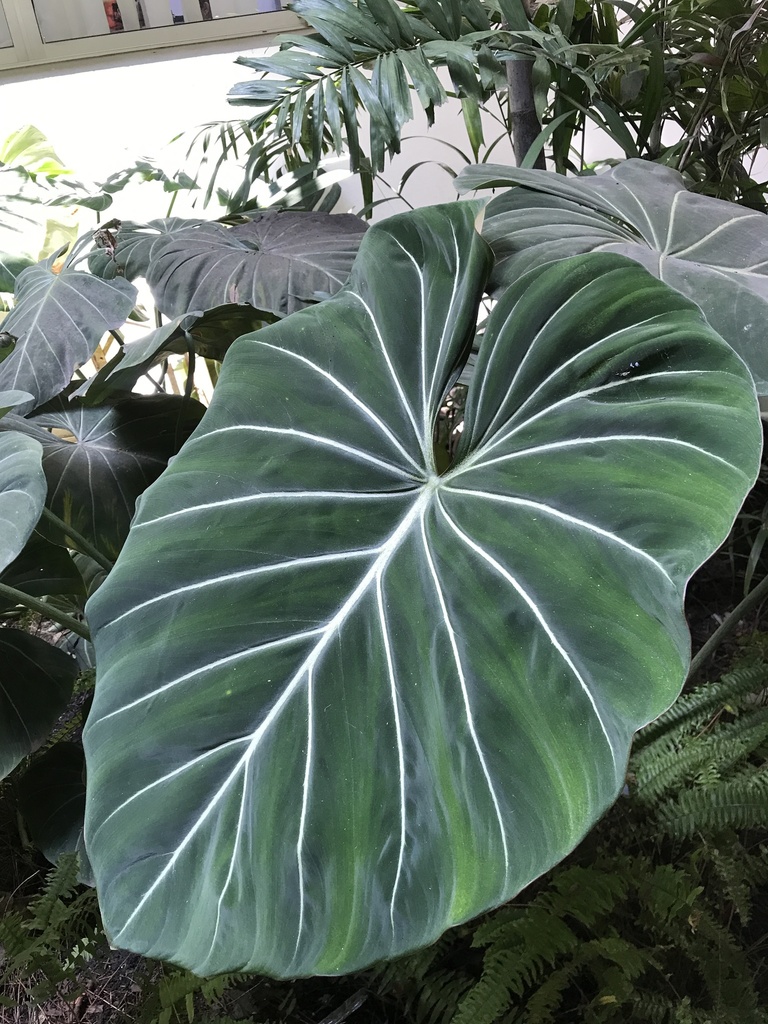
A friend in Quezon City keeps a stock plant he calls Lola. She is an Anthurium magnificum that came to him in 2014 from a grower who got her, supposedly, from a Lindeman cutting traded out of the Netherlands in the late nineties. Lola throws leaves the color of wet slate, with veins so wide and white they look painted on with house paint. Cuttings off her — basal pups, mostly, sometimes a top cut when she gets leggy — sell for roughly twice what a seed-grown magnificum of equivalent size goes for in the same Manila market. Buyers fly in. They photograph the mother before they pay.
To someone outside the hobby this is absurd. The species is the species. A magnificum is a magnificum. But every serious collector knows the trade runs on something more particular than species, and more honest than hype: the line. Whose mother. Which cut. How many steps from the original import. The plant in front of you is a snapshot of a genome that has been moving through hands and greenhouses for thirty years, and the people willing to pay double are paying for what those thirty years prove.
What a clone actually is
In horticulture, a clone is a population of genetically identical plants propagated vegetatively from a single individual — cuttings, divisions, tissue culture, the occasional air layer. Every leaf on every plant in that population traces back, cell by cell, to one seedling that someone, somewhere, decided was worth keeping. The original individual is the mother. Everything downstream is, in the strict sense, the same plant.
This matters because aroids are wildly variable from seed. Cross two Philodendron gloriosum and you will get offspring that range from narrow-leafed and dull to enormous and chalk-veined. The species description tolerates that variation; the market does not. Collectors want the chalk-veined one. Once a grower finds it, the only way to reproduce it faithfully is vegetatively. Seed-grown siblings are a lottery. A cutting is a copy.
So when someone says they have a gloriosum from the Dean McDowell line, or a verrucosum from Equagenera's old stock, or an Anthurium warocqueanum from the so-called Dark Form that circulated out of Ecuador in the 2000s, they are naming the mother — not the species. The species tells you what genus key it belongs in. The line tells you what it will look like in your living room in four years.
A heritage clone is not a better plant in the abstract. It is a known plant — and in a market built on photographs, known is the rarest thing of all.
Why the same species splits in price
Take Anthurium luxurians. The species is real, narrowly endemic to a pocket of the Chocó in Colombia, and almost never legally exported. Most luxurians in private collections trace to a small number of plants brought into Europe and the United States before strict CITES enforcement, plus a handful of more recent, properly papered imports. The leaves are bullate to the point of looking quilted, deep green, almost metallic on a good clone.
Here is the catch: not every plant sold as luxurians is luxurians. The species hybridizes readily, and the market is full of luxurians × dressleri and luxurians × radicans crosses that look close enough to fool a casual buyer and even some experienced ones until the plant matures and the leaf shape drifts. A confirmed clone from a known mother — one that has been grown out for a decade, photographed at maturity, and verified against the type — is therefore worth a real premium over a seedling of uncertain parentage sold under the same name.
Doubling is not unusual. I have seen a 4-inch potted cutting from a documented heritage luxurians sell for $1,200 in a private sale while nursery seedlings labeled the same species moved for $500 to $600 on Etsy the same week. The buyer of the $1,200 plant was not stupid. He was buying certainty.
Provenance, the collector's word for paperwork
Provenance in the plant world is a thinner thing than in art. There is no certificate of authenticity, no auction house catalog. What you have instead is a chain of photographs, screenshots of old forum posts, sales receipts, and the memory of growers who were around when the import landed. For the best-documented lines — the Philodendron spiritus-sancti stock that came out of Brazil through specific Dutch and Florida nurseries, say — that chain is robust enough to argue in court.
For most lines it is gossip with timestamps. Collectors keep mental ledgers: this Philodendron billietiae with the unusually wide leaves is from the original Croat collection number; that Anthurium papillilaminum with the perfectly pendant leaves is from the Tom B. line out of Panama; this Monstera obliqua is one of maybe forty true Peru-form plants in private hands worldwide, propagated almost entirely from a single stock in Florida.
The paperwork, such as it is, lives in DMs and group chats. When a mother dies — and they die, from root rot, from a freak heater failure, from a thrips outbreak that nobody caught in time — the line either survives in cuttings already distributed or it does not. Some lines have gone extinct in cultivation that way. The plants exist in herbaria. The clone is gone.
Tissue culture and the flattening of lines
Tissue culture changes the math. A lab in Thailand or the Netherlands can take a single growing tip from a heritage mother and turn it into ten thousand genetically identical plantlets in eighteen months. In principle, this democratizes the line: the McDowell gloriosum that used to cost $400 for a single node becomes a $35 plug at the big-box store.
In practice, it complicates the line. Tissue culture introduces somaclonal variation — small genetic and epigenetic drifts that accumulate as cells divide in flasks. Most TC plants come out true to the mother. A small percentage do not. They throw odd leaves, lose variegation, revert, or just look wrong in ways that are hard to name. Anyone who bought a TC Philodendron pink princess in 2020 and watched it come out solid green knows the feeling.
Serious collectors therefore distinguish between division plants — physically cut from the original mother or one generation removed — and TC plants from the same genetic stock. They are clones in the strict sense. They are not equivalent in the market. A division Anthurium forgetii from a known mother trades for several times what a TC liner of the same line costs, and the gap reflects a real risk premium, not just snobbery.
How to read a listing
A serious listing will tell you what the seller knows and, more importantly, what they don't. "Cutting from my personal Philodendron verrucosum, purchased 2019 from [named grower], grown under my conditions for four years, photo of mother plant attached" is a strong claim. It can be checked. The named grower either confirms or doesn't. The mother photo either matches a known phenotype or doesn't.
Weak listings hide behind species names. "Rare Anthurium magnificum, hard to find, $450." That tells you nothing. It might be a seedling from a Florida wholesaler, perfectly nice, worth $200. It might be a division off a 1990s import worth $800. Without the lineage, you are buying a name on a tag.
The discipline of asking — politely, specifically — where a plant came from is the single most useful habit a collector can develop. Most honest sellers welcome the question. The ones who get defensive are telling you something too.
What lineage is not
Heritage doesn't make a plant grow better in your apartment. A division from a famous mother will sulk in low humidity exactly like a Home Depot seedling will. Provenance is not magic. It is information. It tells you what the mature leaf is likely to look like, how the petiole will hold, whether the variegation is stable, what diseases the line has historically resisted or succumbed to. It does not tell you that you, personally, will keep the plant alive.
There is also a real risk of fetishism. Collectors can become so fixated on lines that they ignore obviously beautiful seed-grown plants in front of them. Some of the most striking Philodendron I have seen in the last five years are F2 seedlings from hobbyist crosses with no pedigree at all — they are just gorgeous, and they cost a fraction of the heritage stock because nobody has built a story around them yet. In ten years, if they prove out, somebody will have.
That is, in the end, how lines begin. Somebody buys a cheap seedling, grows it for a decade, takes good photographs, names the mother, and gives cuttings to friends who give cuttings to friends. Thirty years later a man in Quezon City has a plant called Lola, and her children cost twice what the species should.