Most begonias want what you'd expect: shade, moisture, a peat-heavy mix that never quite dries, a bathroom shelf near a steamy shower. Begonia venosa wants none of that. It comes from the caatinga, the seasonally dry scrubland of northeastern Brazil, where the soil is thin and gritty, the dry season is genuinely dry, and a plant that holds water in its leaves is a plant that survives. The leaves are thick, almost succulent, and the surface is covered in a dense white indumentum — a felt of fine hairs so uniform it looks manufactured. The stipules are papery and persistent, broad enough to catch attention, unlike the small deciduous scales most begonia growers never notice. This is not a maidenhair fern situation. This is a plant that looks like it wandered in from another genus entirely.
The hobby mostly treats it as a curiosity, a one-off you grow to say you've grown it. That's a mistake. Begonia venosa is genuinely strange — botanically, ecologically, aesthetically — and understanding why it is the way it is opens up a part of the genus that most collectors haven't bothered to explore. The cane-and-shrub begonias of xeric Brazil are a coherent group with their own logic, their own care requirements, and their own rewards. B. venosa is just the most legible entry point.
Caatinga, Not Cloud Forest
The genus Begonia is enormous — around 2,000 accepted species, with new ones described every year — and it spans an almost absurd range of habitats. Most of the species that collectors grow come from humid montane forest or tropical lowland jungle: cloud forest begonias, rainforest floor begonias, the species clinging to wet cliff faces in Yunnan or Borneo. The care logic most hobbyists carry around — high humidity, filtered light, consistent moisture, excellent drainage but never bone dry — is built from those plants. It's good logic, for those plants.
The caatinga is something else. It covers roughly a million square kilometers in northeastern Brazil, making it the largest dry tropical forest in the world. The dry season can last six months or more. The soils are often rocky and calcareous. Plants that live there are, by necessity, adapted to water stress: they store water in stems or leaves, they reduce transpiration with dense hair coverings, they drop leaves or go semi-dormant when conditions demand it. Begonia venosa fits squarely into that ecology. The white felt on its leaves reflects excess light and reduces water loss. The thick, succulent leaf tissue stores what moisture the plant takes up. The papery stipules — stiff, cream-colored, sometimes two centimeters or more across — are persistent in a way that's unusual for the genus, and may function partly in protecting new growth from desiccation.
None of this is what begonia growers expect. That gap between expectation and reality is where most cultivation failures with B. venosa happen.
A begonia that holds water in its leaves and sheds a proper dry season is a plant built around a completely different set of problems.
What the Felt Actually Does
Trichomes — the individual cells that make up plant hair — do a lot of different things across the plant kingdom. In many begonias, fine stem and leaf hairs help channel water toward the roots, or protect young tissue from insects. In B. venosa, the indumentum is dense enough and reflective enough that its primary role appears to be thermoregulation and water retention: bouncing back a portion of incident light before it can drive transpiration, creating a thin boundary layer of still air at the leaf surface that slows moisture loss.
The practical upshot for growers is that this plant does not need or want the misting routine you might apply to a Begonia luxurians or a rex hybrid. Misting a B. venosa leaf does almost nothing useful and, if the water sits, can encourage the kind of fungal spotting that ruins the silvery look entirely. The felt is not decorative in the horticultural sense — it's not there for you. It's there because the plant evolved in a place where every gram of water had to be hoarded carefully, and that function continues in cultivation whether or not you appreciate it aesthetically.
That said, the indumentum is genuinely beautiful in the way that functional things often are. Under a loupe or a strong sidelight, the individual hairs are stellate — star-shaped — and packed so tightly they overlap. The effect in ordinary light is a matte silver-white that makes the plant look almost artificial, like something pressed from felt or cast from pewter.
Stipules as Signal
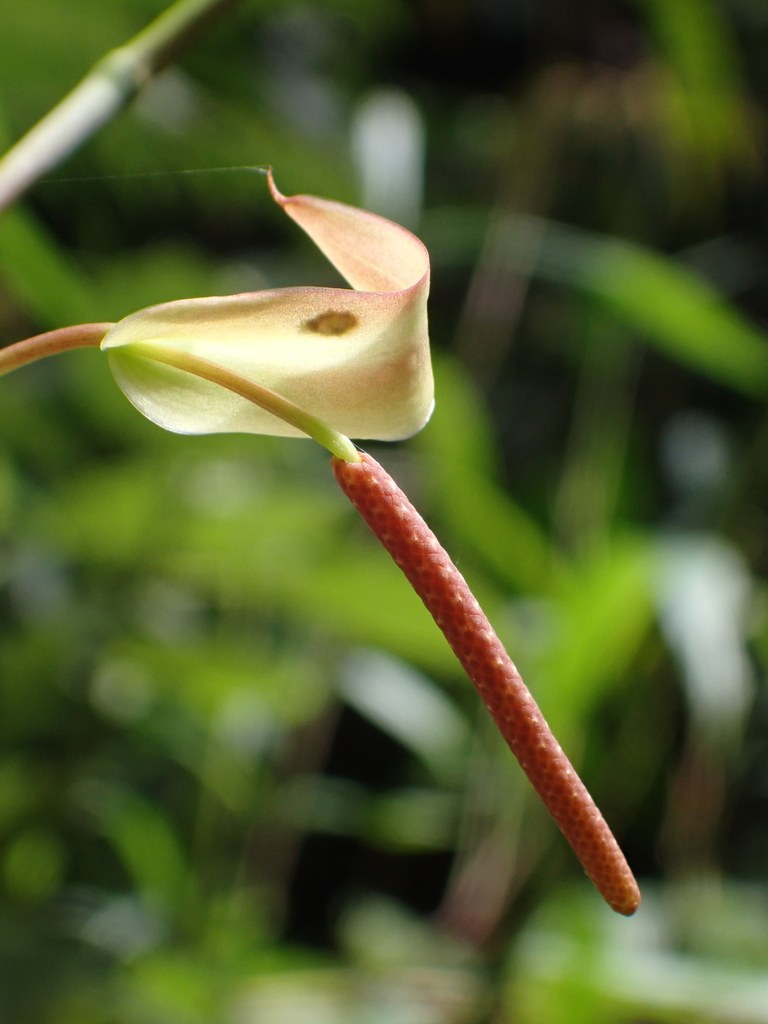
Stipules are small paired appendages at the base of a leaf stalk, present in many plant families but often vestigial or quickly shed. In begonias they're sometimes used as a taxonomic character — shape, persistence, size — but most hobbyists ignore them entirely. In B. venosa, they're impossible to ignore. They're large, stiff, and they persist on the stem long after the leaf above them has matured, giving older stems a layered, almost architectural look.
Their exact function in this species isn't definitively settled, but the leading explanation is protection of the apical meristem — the growing tip — during the dry season, when the plant may slow or pause growth. A set of stiff, papery bracts wrapped around the shoot tip would reduce desiccation of the most metabolically active tissue. It's analogous, in a loose way, to the papery sheaths that protect bulb scales or the bud scales that seal a horse chestnut through winter. Form following function, in a plant that had to solve a specific problem.
For collectors, stipule condition is actually a useful health indicator in this species. Fresh, firm, cream-colored stipules at the growing tip mean the plant is actively pushing. Brown, shriveled stipules at the tip — as opposed to the naturally dry older ones lower on the stem — can mean the plant is under water stress or root-bound. It's the kind of reading-the-plant skill that makes growing unusual species more satisfying than growing something that just wants consistent watering.
The Care Inversion
Growing B. venosa well requires consciously overriding most begonia instinct. The substrate should be gritty and fast-draining: a mix of pumice or perlite, coarse sand, and a small proportion of something organic — bark, coir — is more appropriate than a peat-dominated blend. The plant should be allowed to dry meaningfully between waterings, not just surface-dry but several centimeters down. In its native range it experiences genuine drought; occasional dryness in cultivation is not stress, it's normalcy.
Light should be bright — brighter than you'd give most begonias. In a window, a south or west exposure with some direct sun in morning or late afternoon suits it well. Under grow lights, something in the range of 200–400 PPFD is probably appropriate, but the plant can handle more. It won't bleach the way a shade-adapted B. melanobullata or a maculata would. If the leaves start elongating and the felt looks less dense, the plant is reaching for more light.
Humidity is less critical here than in almost any other begonia you'd grow. Normal indoor humidity — 40 to 50 percent — is fine. The plant is not going to suffer in a dry living room the way a Begonia goegoensis or a rhizomatous miniature would. This makes it genuinely useful for collectors who want a showpiece begonia in a space where maintaining high humidity isn't practical.
Propagation and Its Limits
Begonia venosa is a shrubby cane type that propagates readily from stem cuttings, which is the main reason it has circulated through the hobby as widely as it has. A cutting with two or three nodes, the lower leaves removed, callused briefly and then placed in pumice or perlite with moderate moisture, roots within a few weeks under warm conditions. The process is uncomplicated.
What's less straightforward is producing a plant that looks like the specimens you see in photographs — dense, compact, heavily felted, with that characteristic architectural structure of overlapping stipules and thick silvery leaves. Young cuttings go through a phase where the leaves are smaller and the indumentum less impressive; the plant looks like a somewhat plain small shrub. Patience and the right light level are the variables. As the plant matures and the light is bright enough, leaf size and felt density both increase. A plant that looks underwhelming at six months can be genuinely striking at two years.
Seed is the other option, and B. venosa sets seed relatively easily if you have two plants to cross-pollinate or can access pollen. Growing from seed is slower but produces plants with more genetic variation, which is worth considering if you have an interest in the species beyond a single specimen. Some seed-grown plants show slightly different leaf texture or stipule size, and the range of variation within the species in habitat is considerable.
What Else Is Out There
Begonia venosa is the most commonly grown representative of Brazil's xeric begonias, but it's not the only one worth knowing. Begonia sericoneura, another species with significant leaf indumentum, comes from similarly dry habitats and has been in cultivation long enough to appear occasionally in specialist collections. Begonia credneri — a hybrid of uncertain exact parentage but with probable caatinga-adapted ancestry — is more widely available and has similar care needs, though its leaves are less dramatically felted and more conventionally begonia-shaped.
Further afield, Begonia dregei from South Africa occupies a somewhat analogous ecological niche — a semi-xeric, caudex-forming species that experiences a real dry season — and responds to similar care logic: bright light, well-draining substrate, controlled drying. It's not a Brazilian caatinga plant, but it's another data point suggesting that the dry-adapted begonia is a coherent horticultural category with transferable care principles, not just a collection of unrelated exceptions.
The broader point is that the genus is wide enough to contain multiple distinct ecological strategies, and growing only the humidity-loving, shade-adapted types means missing a significant slice of what the genus actually is. B. venosa is an argument, made in silver felt and papery stipules, for paying attention to where a plant comes from before deciding how to care for it.
Why It Stays Marginal, and Why That Might Change
Part of the reason B. venosa hasn't become a standard in the hobby is that it confounds expectations at every stage. The care is counterintuitive. The seedling phase is unglamorous. The plant doesn't do the things people grow begonias for — it doesn't have the wing-spotted gloss of a B. maculata, the jewel-box miniaturism of a B. darthvaderiana, the vivid leaf patterning of a rex. What it has is structural weirdness and ecological specificity, which are harder to sell in a cutting swap.
But collector taste does shift. The same arc that moved hoyas from grandmother's-plant status to something people spend serious money on, or that turned Begonia pavonina from an oddity to a genuinely sought species, could plausibly run through the xeric Brazilian begonias. The interest in understanding plant origins — in knowing not just how to grow something but why it grows that way — seems to be increasing among serious hobbyists.
Begonia venosa rewards that kind of attention. It's a plant that makes you think about the caatinga when you look at it, about what a dry season means for a leaf, about the engineering behind a hair. That's not a common quality in a houseplant, and it's worth more than its current niche status suggests.