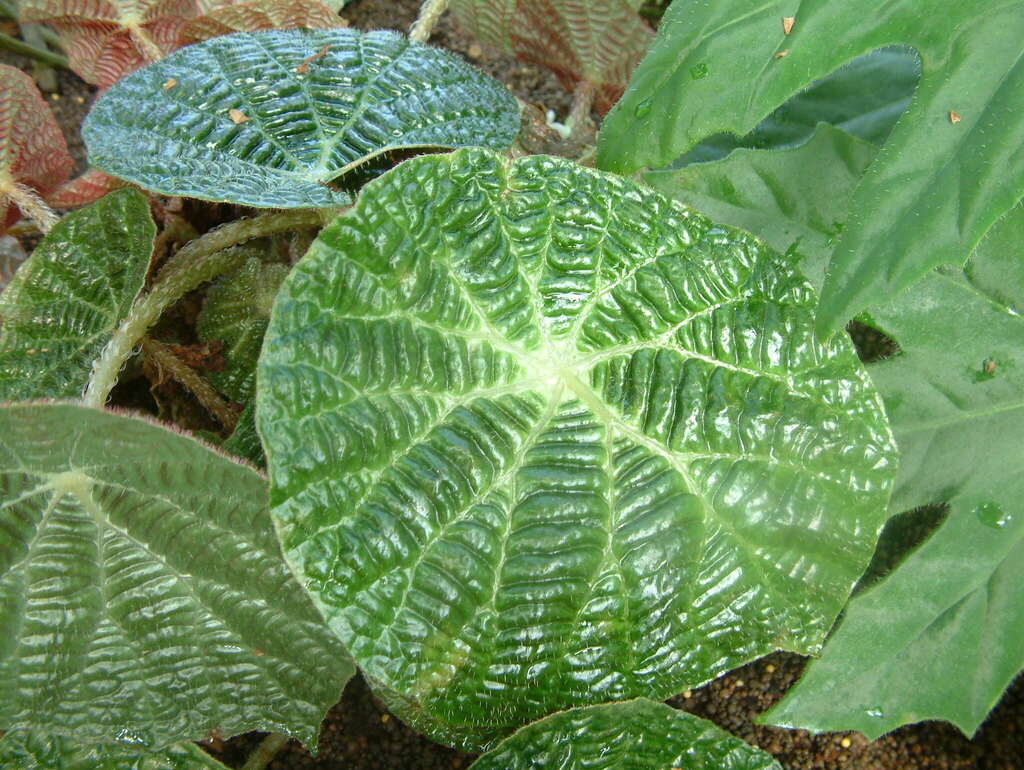
There is a begonia sitting on a shelf in a collector's spare room in São Paulo — or Portland, or a flat in East London — that looks, in low light, like it was pressed from green vinyl. The leaves pucker between their veins, rising and falling in tight pleats, catching light at the ridges and dropping into shadow at the valleys. Run a finger across the surface and the texture pushes back. This is not the Rex hybrid your grandmother kept on a windowsill, grown for painted leaf patterns in shades of burgundy and silver. This is something more architectural, more committed to structure. This is a bullate begonia, and once you have grown one, flat leaves start to look like a failure of imagination.
The species in question — Begonia seersucker, a Brazilian native with deeply puckered, high-gloss foliage and a ruffled margin that appears almost hand-finished — has been circulating among serious growers for a few years now, but it is only recently reaching the kind of collector attention that drives waitlists and careful tissue-culture programs. Its timing is not accidental. Something has shifted in what people who grow begonias actually want, and texture, specifically the kind you can feel, is at the center of it.
What Bullate Actually Means
Bullate is a botanical term for a surface that blisters or puckers between veins, as though the lamina expanded faster than the vascular scaffolding could contain it. The tissue buckles upward in domes or pleats, and the result can range from gently quilted, the way Begonia pavonina shows a slight undulation, to dramatically corrugated, the kind of surface you see on Hosta 'Empress Wu' or on the most heavily puckered Anthurium papillilaminum clones. B. seersucker sits toward the dramatic end. Its bullation is consistent across the leaf, not concentrated near the midrib, and in a mature specimen the pleating is dense enough to throw visible shadows at midday.
The ruffled margin adds a second layer of three-dimensionality. Where most cane and rhizomatous begonias end their leaves in a clean or gently toothed edge, seersucker finishes with a wave — an undulation that echoes the surface texture and prevents the leaf from ever reading as flat from any angle. Combined with the high gloss of the upper surface, which reflects rather than diffuses light, the effect in a well-lit space is somewhere between wet rubber and hammered metal. Neither description sounds appealing written down. In person, the leaf is riveting.
Understanding why the bullation forms helps with care. The puckering is driven by differential growth rates between the veins and the interveinal tissue, and it is most pronounced in conditions where the leaf expands slowly under steady, moderate light. Push the plant into very high light and growth accelerates unevenly, sometimes flattening the texture partially. Grow it too dim and the new leaves emerge smaller, with less tension in the lamina. The sweet spot — consistent bright indirect light, moderate humidity, unhurried growth — is also just good begonia culture.
Flat leaves start to look like a failure of imagination once you have grown something that pushes back when you touch it.
Brazil's Contribution to the Genus
Brazil is home to somewhere between 350 and 400 begonia species depending on how recent the monograph you are reading is, and the Atlantic Forest biome alone accounts for a disproportionate share of the most structurally interesting ones. Begonia seersucker comes from the same broad zone that produced Begonia luxurians, the palm-leaf begonia with its whorled, deeply cut foliage that looks nothing like what most people picture when they say 'begonia,' and Begonia venosa, the feltry, succulent-tending species with thick silver-white trichomes on every surface. These are not plants selected for floriculture. They are forest-floor survivors from a biome under considerable pressure, adapted to dappled canopy light, humid air, and the kind of loamy, well-drained substrate that builds up at the base of Atlantic Forest trees.
B. seersucker is a rhizomatous species, which means it spreads by a thick horizontal stem that creeps across the surface of the substrate or just below it. This growth habit makes it a natural candidate for wide, shallow containers rather than deep pots. The rhizome stores water and starches, giving the plant some buffer against missed waterings, but it also means that a pot that stays wet at the base for too long will begin to rot from underneath before the leaves show any distress. A mix of fine bark, perlite, and a small proportion of coco coir — airy, fast-draining, with just enough moisture retention — is closer to what it evolved in than any peat-heavy commercial mix.
The Atlantic Forest connection matters to collectors for reasons beyond botany. It is a region with genuine conservation concerns, and a meaningful portion of the collector interest in rare Brazilian begonias now comes attached to an awareness of provenance. Plants in legitimate circulation arrived through botanical gardens, permitted collection, or established tissue-culture programs. The ones that didn't are a problem for the whole hobby. Knowing where your seersucker came from has become part of what it means to collect carefully.
The Texture Shift in Collector Taste
For most of its horticultural history, the begonia world was organized around two things: flower and color. Rex hybrids were bred for leaf patterns — spiraling zones of silver, green, burgundy, and near-black, the more complex the better. Tuberous hybrids were selected for enormous blooms in colors a rose grower would envy. Cane begonias, the 'angel wing' types, were kept for their spotted foliage and reliable flowering. Texture was incidental, occasionally interesting, rarely the point.
What changed is partly the arrival of aroid culture into the mainstream collector consciousness. A generation of growers who spent years chasing velvet-leaved philodendrons — Philodendron gloriosum, P. melanochrysum, the entire pastazanum group — trained themselves to read leaves the way a furniture maker reads grain. They learned to notice surface quality, to prioritize tactile interest over color complexity. When those collectors turned toward begonias, they brought that eye with them, and they found a genus that had been sitting on genuinely extraordinary textural range without anyone making much noise about it.
Species like Begonia bowerae and its cultivars showed what variation in surface patterning could do, but the bullate species opened a different door entirely. Begonia 'Escargot', the spiral-patterned Rex with its pinwheel leaf, had been popular for years, but its appeal was still primarily graphic. The bullate begonias — seersucker, the less-available B. stipulacea with its angled, corrugated leaves, the deeply puckered forms of some B. rajah clones — offer something the aroid collectors recognized: foliage that rewards close attention, that changes depending on the light angle, that looks different from six inches away than from across the room.
Growing It Without Killing It
Rhizomatous begonias have a reputation for being forgiving, and in relative terms that is not wrong. B. seersucker is more tolerant of imperfect conditions than most of the Anthurium clarinervium-adjacent plants that have captured the same audience. But forgiving is not the same as indestructible, and the failure modes are specific enough to be worth knowing.
The most common is overwatering, and specifically watering before the top centimeter of the substrate has dried. The rhizome's water storage means the plant can hold more than you expect, and wet substrate in a pot without excellent drainage is a rot vector. Water thoroughly, then wait. In a humid growing space — 60 percent or above — the interval between waterings will be longer than it looks like it should be. In a drier room, shorter. Use your finger rather than a schedule.
Temperature matters more than most sources acknowledge. B. seersucker originates from an Atlantic Forest zone where temperatures rarely drop below 15°C even at night, and cold drafts — from an air conditioning vent, from a single-pane window in winter — will show up as brown leaf margins or, in a severe case, as sudden collapse of new growth. Keep it away from anything that produces cold moving air. On the upper end, it handles warmth well into the low 30s Celsius as long as humidity stays adequate and it is not in direct sun. Direct sun will bleach the gloss from the upper surface and flatten the bullation in the affected areas, and that loss is not recoverable in the existing leaf.
Propagation is satisfying and straightforward. A section of rhizome with at least one node, laid on the surface of moist substrate in a humid enclosure, will produce roots and new growth within three to six weeks. Leaf-petiole cuttings also work, though plantlets from rhizome sections are typically more vigorous. Neither method requires bottom heat, though warmth above 22°C speeds things considerably.
What the Flowers Do (and Don't) Do
Collectors who come to B. seersucker from the aroid world sometimes treat the flowers as irrelevant, which is fair in the sense that nobody is growing this plant for bloom. The flowers are small, white, and held on thin peduncles above the foliage — pretty in the way that honest flowers are pretty, not showy. They do not compete with the leaves and they are not trying to.
What the flowers do offer is a signal about overall plant health. A rhizomatous begonia that is comfortable in its conditions will flower seasonally without much provocation. A plant that is stressed — rootbound, underlit, running too dry between waterings — tends to withhold flowers or produce them weakly. Think of flowering as a second opinion on your care rather than the goal. If the plant blooms on its own rhythm, you are probably doing it right.
The Species Worth Knowing Beside It
If B. seersucker is the entry point into bullate begonias, the species adjacent to it are worth mapping. Begonia thiemei, a Brazilian species with elongated, asymmetric leaves and a pronounced quilted texture, is less commonly circulated but shows up in specialty sales and is worth acquiring if you encounter a reputable source. It grows on a slightly more upright rhizome than seersucker and wants similar conditions.
Begonia 'Raspberry Swirl', a hybrid rather than a species, has achieved some collector attention for its deeply puckered, dark-margined leaves — less glossy than seersucker but with stronger color contrast between the bullate ridges and valleys. It is a reasonable second plant for someone who wants to understand how much variation the texture variable alone can produce. Begonia stipulacea is a different structural proposition: the leaves are narrower, more angular, with a corrugation that runs more uniformly across the surface, and it handles somewhat lower humidity than most of the Brazilian forest begonias, making it useful in mixed collections where growing conditions are a compromise.
What unites these species as a category is not a taxonomic relationship but a collector orientation. They are plants chosen for what the leaf does in three dimensions, for how the surface interacts with light, for the particular satisfaction of a plant that rewards the same close attention you would give a well-made object. That is a different way of valuing a begonia than the hobby has historically asked for, and it is clearly not going away.
A Plant That Asks You to Look Closely
There is something instructive about what bullate begonias ask of the collector. The pattern-first Rex hybrids — the spiral of 'Escargot,' the silver-painted zones of 'Fireworks' — reward distance. You need a few feet between you and the leaf for the pattern to resolve properly. The bullate species work the other way. The texture becomes more interesting the closer you get, and at very close range, with raking light from the side, a mature leaf of B. seersucker reads like a landscape — ridge and valley, shadow and gloss, the vein structure visible beneath the puckering like the bones of the thing.
That quality — the reward of sustained attention — is not incidental to why these plants are finding a more serious collector audience now. The people who grow rare aroids, who keep Anthurium regale in a converted grow tent and check their Philodendron gloriosum cuttings for root development twice a week, are already practiced in the close observation of plants. They have spent years learning to read leaves. A bullate begonia meets them exactly where they are.
The moment for texture-first begonias is not a trend in the way a color or a variegation pattern is a trend — a thing that spikes and fades as novelty exhausts itself. It is a maturation: a broadening of what the collector community recognizes as worth growing, worth paying attention to, worth caring for carefully. Begonia seersucker is not the only plant in that conversation, but it is a good one to start with. Put it somewhere it gets consistent bright indirect light, water it less often than you think it needs, and then actually look at it.