There is a particular moment, early in a begonia obsession, when you stop looking at the hybrids. It usually happens in front of something unassuming — a four-inch pot, a plain label, a leaf no wider than your palm — and then the light shifts and you see it: the midrib running like a chalk line through dark green velvet, the lateral veins branching off at acute angles in a herringbone so precise it looks drafted. The plant is Begonia pavonina, or B. chlorosticta, or one of a hundred other species with no trade name and no Instagram moment to its credit. It has been growing this way in the cloud forests of Borneo or the lowland slopes of Brazil since long before anyone thought to cross it with anything. And it is, without qualification, more beautiful than almost everything that has been bred from it.
The collector community has spent the last decade running hard toward named hybrids — toward 'Beleaf Kinabalu', toward tissue-cultured selections with proprietary tags, toward plants whose parentage is either undisclosed or frankly uncertain. That energy is understandable; hybrids can concentrate desirable traits and make difficult species more tractable. But something is lost in the translation. The species carries a logic the hybrid does not: every feature of its leaf — the iridescence, the stripe, the texture, the angle of each vein — evolved in response to a specific place, a specific light regime, a specific wet season. Growing a species begonia is, in a quiet way, growing an argument. This essay is about why that argument deserves to win.
The Stripe and What It Does
The bright midrib — cream, silver, or pale green against a field of deep olive or near-black — is the defining mark of the cane and rhizomatous species most collectors chase. In Begonia listada, a Brazilian species that remains one of the most graphic plants in the genus, it is a stark white chevron running the full length of a dark, slightly hairy leaf. The effect is so deliberate-looking that new growers sometimes ask if it is painted. It is not. The stripe is simply a concentration of reflective epidermal cells directly over the midrib, a structural feature that appears across dozens of unrelated begonia lineages and probably functions as a signal — to pollinators, possibly, or as a mechanism for managing the angle of light absorption in a forest understory where direct sun arrives only in brief, unpredictable flashes.
In Begonia chlorosticta, native to Sarawak, the midrib logic extends further: the surface is covered in red or pink spots — chlorosticta means 'green-spotted' but the reverse is true in the most sought-after forms — set against a leaf that shifts from dark olive in bright conditions to an almost blue-green in deep shade. This phenotypic plasticity, the leaf's ability to read and respond to its light environment, is one of the things hybrids frequently lose. Cross chlorosticta with a faster-growing, more vigorous species and you may get a tougher plant; you rarely get one that is still paying attention to the light.
The herringbone venation pattern — lateral veins running outward from the midrib at angles between 30 and 60 degrees, each one slightly raised and catchable by raking light — is what gives these leaves their texture. On a mature Begonia rajah, a Sumatran species with a leaf surface that looks hammered from inside, the venation creates actual three-dimensional relief. Photographed under a single light source at the right angle, it looks like aerial topography. Grown under flat fluorescents in a grow tent, it looks like a competent but unremarkable plant. The species rewards the grower who is willing to experiment with light angle, not just light intensity.
Every feature of a species leaf evolved in response to a specific place — the hybrid carries no such logic.
Iridescence: The Borneo Phenomenon
Begonia pavonina is the species that converts people. It is native to the montane forests of Peninsular Malaysia, grows in the deep shade beneath the canopy, and has evolved a leaf surface so structurally unusual that it was the subject of a 2016 paper in Nature Plants. The cells of the upper epidermis contain modified chloroplasts — iridoplasts — arranged in layers thin enough to produce thin-film optical interference. The result is a leaf that appears deep blue or blue-green in diffuse light and shifts toward green as the angle of illumination changes. This is not pigment. It is physics.
What the Nature Plants study demonstrated, and what growers have observed empirically for years, is that the iridescence is a functional adaptation to extreme shade. The layered iridoplasts capture photons more efficiently under low light than conventional chloroplasts would, allowing the plant to photosynthesize in conditions that would leave most species struggling. This is why pavonina sulks when placed in bright indirect light alongside your monstera collection: it is a deep-understory specialist, and it wants something closer to 50–100 foot-candles than 500. A north-facing windowsill in a cool room is closer to correct than a well-lit shelf. Growing it well requires reading the plant rather than following a general begonia care template.
This kind of specificity — a species with hard requirements rooted in a particular ecology — is exactly what gets lost in hybrid breeding. The crosses that combine pavonina with more amenable species can sometimes preserve a ghost of the iridescence, but the structural layering that produces it is diluted. You end up with a plant that is easier to grow and less interesting to look at, which is, depending on your priorities, either a fair trade or no trade at all.
Brazilian Canes and the Stripe's Other Form
The iridescent Bornean species are one lineage; the graphic Brazilian canes are another, and they represent the stripe at its most legible. Begonia listada — native to Mato Grosso do Sul state, growing in the shadow of gallery forest along river margins — is a cane-type with leaves dark enough to read as black in low light, each one bisected by that clean white midrib stripe and edged with a thin margin of the same pale tone. It is a small plant, rarely exceeding 30 centimeters in cultivation, and it is nowhere near as widely grown as its visual impact would justify.
Part of the reason is that listada is particular about humidity and airflow simultaneously — conditions that are easy to describe and harder to maintain. It wants 60–70% relative humidity, good air circulation to prevent the botrytis that haunts many begonias at those humidity levels, and a substrate that holds some moisture without staying wet. A mix of coco coir, perlite, and a small proportion of fine orchid bark, in roughly 2:1:1 proportions, gets close. It does not want to sit in a closed terrarium with stagnant air, and it does not want to dry out fully between waterings. The margin is narrower than for a rex hybrid, and the plant will tell you when you've missed it.
What listada offers in exchange is a leaf that looks better the more carefully you look at it: fine hairs on the upper surface catch light differently than the smooth portions, the red undersides flare when backlit, and the white stripe stays sharply defined even on older leaves. It does not blur or mottle with age the way some variegated begonias do. The pattern is structural, not incidental.
Why Species Parentage Matters
Most collector-grade begonia hybrids have parentage that is either undisclosed by the originator or lost to successive crosses over decades. When a nursery lists a plant as a 'hybrid begonia' with a cultivar name but no species names, you are buying a visual outcome with no ecological or botanical context. That is sometimes fine — some hybrids are genuinely excellent — but it means you cannot reason backward from the plant's appearance to its needs. You cannot look at the leaf architecture and guess where in the world a similar plant grew, what the wet season looks like there, or what light regime the leaf evolved under.
Species plants give you that chain of inference. Begonia dregei, a South African tuberous species with small, deeply lobed leaves and a swollen caudex, wants a dry rest period in winter because its native habitat in KwaZulu-Natal has a pronounced dry season. That is not a quirk of the individual plant you bought; it is a feature of the species' entire evolutionary history. Knowing the species name means knowing something real about the plant's requirements, not just the requirements of this particular clone grown in this particular nursery.
The practical implication is that species begonias are more predictable, not less, once you have done the work of understanding their origin. The reputation for difficulty that many species carry is largely a product of being grown under inappropriate conditions because their ecology was not considered. Begonia amphioxus, a Bornean species with spotted, elongated leaves and slender petioles, is routinely killed by overwatering in standard potting mixes. Grown in a near-inert mix of perlite and long-fiber sphagnum, with water applied only when the top inch is dry, it is stable and, eventually, generous with new growth.
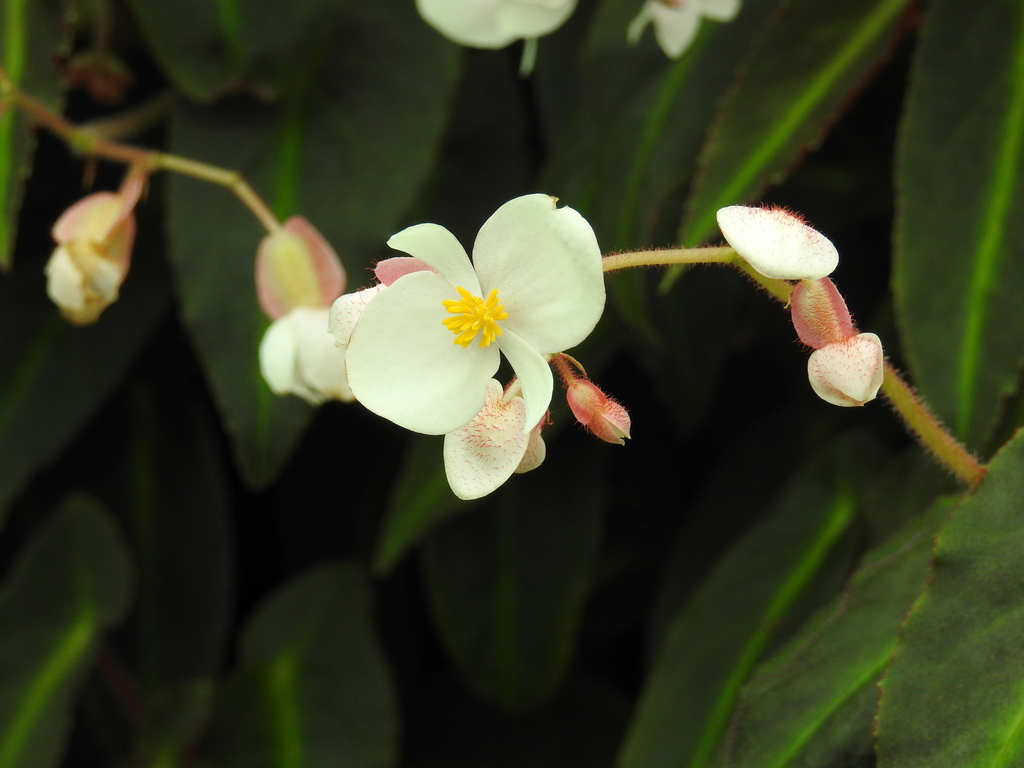
The Texture Argument
Collectors talk about velvet the way wine people talk about tannins: as a shorthand for a quality that is real and significant but difficult to reduce to a single variable. In begonias, the velvet quality comes from a combination of factors — dense trichomes on the leaf surface, the slightly matte finish of the cuticle, and the three-dimensional relief of the venation. Begonia rajah has all three. So does Begonia U551, a species-level plant from Sabah whose formal name remains in taxonomic limbo but whose leaf surface is one of the more extraordinary things in cultivation: olive-green with bronze zones, hammered texture, red undersides, and lateral veins so pronounced they cast visible shadows in diffuse afternoon light.
The hybrids that attempt to replicate this texture sometimes succeed in concentrating the trichome density but lose the venation relief, or vice versa. The two traits are controlled by different genetic mechanisms, and breeding for one does not automatically preserve the other. A species that evolved with both did so because both features conferred advantages — shade capture, possibly pest deterrence, possibly thermoregulation — in a single coherent ecological context. The hybrid is working from a different brief.
This is not a sentimental argument for species purity. Hybrids exist, many are beautiful, and some are genuinely superior for cultivation in conditions far removed from any tropical forest. The argument is narrower: for the specific quality of leaf that most collectors are actually chasing — the deep color, the graphic stripe, the herringbone relief, the surface that changes under different light — the species is usually the better bet. It is the source document, and most copies, however skillful, leave something out.
Growing the Real Thing
A collection built primarily on species requires a different kind of patience than one built on hybrids. The plants are sometimes slower, the suppliers fewer, and the information thinner — a species described in a 1990 monograph may have a care profile reconstructed from habitat data and trial and error rather than a well-developed community consensus. But the work is more interesting, and the plants are more legible once you understand them.
For the iridescent Bornean species — pavonina, chlorosticta, and their close relatives — the key variables are low light intensity, high humidity (70% or above), and excellent airflow. These are cloud forest plants; they want cool, moist, moving air, not the warm stagnant conditions of a sealed terrarium. A small USB fan running on a timer, moving air across the foliage for twelve hours a day, will prevent the botrytis and mildew that kill more of these plants than any other single factor.
For the Brazilian cane species, the priorities shift toward substrate drainage and light quality. Listada and its relatives want bright, indirect light — not the deep shade that suits pavonina — and a substrate that cycles between moist and approaching-dry without ever reaching either extreme. Feeding lightly with a balanced fertilizer at quarter-strength, applied every two to three weeks during active growth, keeps the color saturated. Heavy feeding pushes etiolated growth and dilutes the stripe.
The rhizomatous species, including rajah and amphioxus, tolerate the longest dry periods and the most neglect without significant damage. They are the entry point for collectors new to species begonias: slow enough that mistakes do not compound quickly, architecturally dramatic enough to reward close attention, and with enough published habitat data that their requirements can be reasoned out rather than guessed at. Start there, pay attention to the light angle, and the more demanding species will make more sense.
The Quiet Argument
There is no polemic here against hybrid breeding. The people who cross begonias are often serious botanists and skilled horticulturists, and some of the plants they produce are genuinely outstanding. But the market pressure toward hybrids — toward novelty, toward proprietary names, toward plants that can be tissue-cultured and sold at scale — has a cost. It directs attention away from a genus of roughly two thousand wild species, many of them poorly documented, some of them in habitats under significant pressure, almost all of them more interesting than the plants most begonia sections of most nurseries carry.
Begonia pavonina produces blue light through a mechanism that took evolution millions of years to develop and scientists years to fully explain. Begonia listada draws a white stripe down a black leaf in a gallery forest in central Brazil. Begonia rajah hammers its leaf surface into relief so that it reads differently at every hour of the day as the light angle changes. These are not approximations of something better. They are the thing itself, and they are available to anyone patient enough to find them and honest enough to meet them on their own terms.
The velvet chevron is not a design. It is a record — of a forest, a light regime, a wet season, an evolutionary pressure that no hybrid committee ever sat down to replicate. Grow the species, and you grow the record.
Where to Find Them
Species begonias circulate primarily through specialty growers, collector sales, and the swap tables at society events — the American Begonia Society holds regional shows where unlabeled species divisions sometimes change hands for less than a named hybrid would cost at a box store. Online, a small network of importers and hobbyist growers maintains availability of the Bornean species in particular; quality and accuracy of identification vary, so prioritizing sellers who can cite a collection number or accession source is worthwhile.
Begonia listada appears occasionally in specialist begonia nurseries and is stable enough in cultivation that it moves through collector networks with some regularity. Begonia pavonina is less common and tends to move as cuttings or divisions rather than rooted plants. Begonia rajah has broader availability than either, partly because it grows more vigorously and propagates easily from leaf sections placed on barely moist substrate.
The investment is not primarily financial. It is attentional. Species begonias ask you to understand them rather than simply accommodate them, and that distinction — between a plant you manage and a plant you actually learn — is, for collectors at a certain level of seriousness, the whole point.