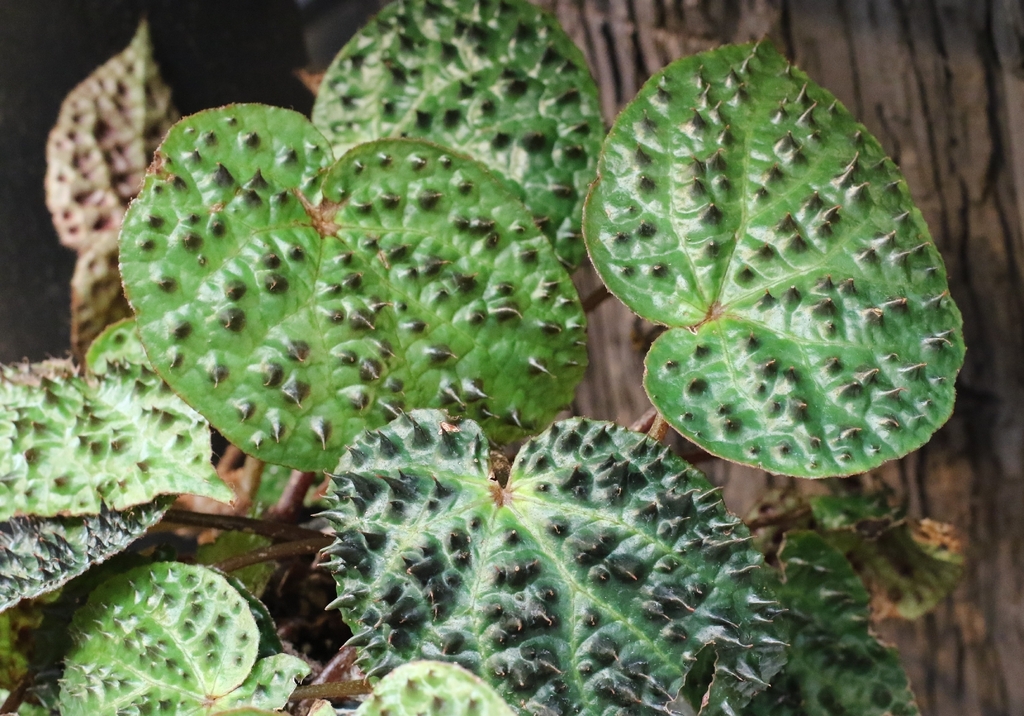
There is a begonia that looks like it was assembled by someone with a grudge. The leaves are deeply bullate — puckered between the veins into tight blisters — and from each blister tip rises a short, rigid hair capped in black. Not brown. Not translucent. Black, like a period at the end of a sentence. Seen under a loupe, the surface resembles chainmail designed by something that lives under a log and resents the light.
This is Begonia ferox, described formally in 2015 from specimens collected in Guangxi, the mountainous province in southern China that sits above Vietnam and feeds the Pearl River. It is, by any reasonable account, a shockingly recent discovery — not a plant known for centuries to local cultivation and only lately named by science, but genuinely new to human record when Barack Obama was in his second term. Yet it has already established itself as one of the most coveted begonias in serious collections, the kind of species that gets screen-printed on tote bags and tattooed on forearms. The question of why tells you something about what collectors are actually looking for.
Where It Comes From and Why That Matters
Guangxi is one of those provinces that keeps producing remarkable begonias — karst limestone topography, subtropical moisture, dense forest canopy creating the bright-indirect light conditions that the genus has exploited for tens of millions of years. Begonia ferox was collected on shaded, humid cliffs at moderate elevation, the kind of microhabitat that stays cool and damp even in summer. Understanding that origin isn't an academic exercise. It's the reason the plant sulks when night temperatures stay above 22°C for weeks on end, and why growers in Florida report more struggle than growers in the Pacific Northwest.
The formal description appeared in the journal PhytoKeys — a paper by Yan Liu and colleagues that placed the species in section Platycentrum alongside a handful of other Chinese cane-adjacent begonias. The name ferox is Latin for fierce or ferocious, and it was chosen without irony. The authors noted the indumentum — the covering of surface hairs — as immediately distinguishing, since no other described begonia in that section produced the same blackened, bulbous-tipped trichomes on such a dramatically textured lamina.
What that means practically is that you can identify ferox from across a greenhouse bench. There is no equivalent. Some collectors have tried to explain it as convergent with certain African species that produce glandular hairs, but the structural similarity ends quickly under examination. The black tips are melanized, not sticky. They do not trap insects. Their function remains somewhat debated, though the leading hypothesis is that they deter herbivores — an argument the plant makes with considerable conviction.
The spines aren't ornament — they're argument. A Begonia ferox leaf insists on being read at close range.
The Taxonomy of Wanting
Collector desire is rarely straightforward, but it tends to cluster around a few reliable axes: rarity, challenge, and what you might call visual argument — the quality of making an immediate, unambiguous case for itself. Begonia ferox hits all three, but the visual argument is the deepest hook.
Most prized begonias are beautiful in a way that requires some knowledge to fully appreciate. The red undersides of Begonia pavonina shift to iridescent blue-green in the right light due to specialized chloroplasts — you have to know to look. The intricate silver spotting of Begonia masoniana rewards close attention. But ferox announces itself. The texture is so extreme that photographs of it routinely get accused of digital manipulation, even among people who grow begonias. First-time viewers assume post-processing. That quality — the plant that looks fake until you touch it — creates a particular kind of desire.
There's also something honest about a plant that looks defended. A lot of the current enthusiasm for rare aroids leans on color and pattern: variegation, fenestrations, iridescence. These are passive beauties. Ferox is active. It presents itself as something that made a decision, structurally speaking, about how to exist in the world. Collectors who keep both aroids and begonias often describe the ferox as the one non-aroid plant that holds its own aesthetically in a collection of Philodendron gloriosum and Anthurium warocqueanum. That's a meaningful compliment in the current moment.
Growing It Without Losing It
Begonia ferox is not a beginner's plant, though it's not the most demanding begonia either. The key variables are substrate, humidity, and temperature ceiling. Get those three right and the plant rewards you steadily. Get them wrong and it sits, looking reproachful, making no new growth for months before quietly expiring.
Substrate first: it wants something that holds a little moisture but never stays wet. A mix of fine orchid bark, perlite, and a small amount of coco coir — roughly 40/40/20 — works well. Some growers add a portion of pumice to increase aeration further. The roots are fine and exploratory rather than thick and storage-oriented, which means they suffocate quickly in anything dense. Terracotta pots help buffer moisture. Plastic pots require much more careful watering.
Humidity above 60% is the working minimum; 70–80% produces faster growth and fuller bullation. The spines on leaves grown at lower humidity tend to be less pronounced, which defeats much of the purpose. A grow tent or enclosed cabinet is the most reliable delivery method for most North American growers. Open-shelf cultivation works in genuinely humid climates — the Pacific Northwest in winter, coastal Florida in summer — but requires honesty about your ambient conditions.
The temperature ceiling matters more than most care guides acknowledge. Ferox can handle summer warmth but begins to stall above roughly 28°C sustained. Cool nights — dropping to 16–18°C — appear to accelerate growth and deepen the bullation. Some growers deliberately move the plant to a cooler room in summer rather than trying to air-condition a grow tent, which is a sensible approach if you have the space. This is a plant that remembers where it evolved.
Propagation and the Ethics of Supply
Begonia ferox propagates readily from stem cuttings and, with more patience, from leaf cuttings taken with a portion of the petiole intact. The stem cutting route is faster: a node with one or two leaves, placed in moist sphagnum or directly into the established substrate, typically roots within three to four weeks under humid conditions. The plant does not need rooting hormone, though it doesn't object to it.
Leaf cuttings are slower but produce more offspring from a single node and are therefore the method of choice when a collector wants to scale up from a single plant without sacrificing growing stems. The technique is the same as for rex begonias: score the major veins on the underside of a mature leaf, pin it flat against moist sphagnum, and wait. Plantlets emerge at the vein cuts. It takes time and requires consistent humidity, but it works.
The ethical dimension of supply has become a real conversation in the ferox community. Early specimens in Western cultivation appear to have arrived through channels that bypassed standard phytosanitary protocols — a common story with newly described Chinese species that generate collector interest faster than legal export pathways can accommodate. The current supply, several years on, is largely nursery-propagated material moving through legitimate vendors. Buying tissue-cultured or nursery-propagated plants is straightforward due diligence. It also tends to produce healthier plants than smuggled specimens, which often arrive carrying pathogens from informal storage conditions.
What Bullation Actually Is
The term appears constantly in ferox discussions, often without explanation. Bullation refers to the blistered or puckered texture of a leaf surface caused by differential growth rates between the upper and lower epidermis. Where the upper epidermis grows faster than the lower, the lamina buckles upward between the veins, creating the raised, blister-like domes that give ferox its armored character.
In ferox, the effect is extreme enough that each dome is individually distinct, separated by deeply impressed vein channels. The black-tipped trichomes emerge from the apex of each dome, which means the spination pattern maps directly onto the venation pattern — a structural elegance that becomes apparent only when you look closely. The leaves feel like nothing else in the begonia genus. Most textured begonias produce a rough or matte surface; ferox produces something closer to topography.
Bullation is found across the genus but rarely to this degree. Begonia masoniana, the well-known iron cross begonia, is moderately bullate. Begonia listada has a corrugated quality along its midrib. But ferox operates at a different scale, one that makes those species look comparatively smooth. It's a useful reminder that the genus Begonia, with over two thousand described species, contains more morphological range than most plant families taken whole.
A Species at the Right Moment
Begonia ferox arrived in collector awareness at an interesting inflection point — just as the rare plant market was expanding rapidly and a new generation of growers was looking for anchor species that rewarded serious cultivation rather than just auction-floor spending. The timing helped. So did the photographs, which circulate relentlessly because the plant is genuinely photogenic in a way that requires no special lighting setup or macro lens skill. Point a phone at a mature ferox leaf and the image looks intentional.
This has created some tension between long-term begonia collectors — many of whom had been growing the species for years before it became broadly known — and newer arrivals drawn primarily by social media circulation. The tension is familiar from aroid collecting and from every plant community that experiences a sudden influx of interest. It resolves the same way it always does: the collectors who grow the plant well stay; the ones who bought it as a status marker lose it to rot within a season and move on.
What remains is a community of growers who can tell you, with some precision, how the bullation changes across a leaf's ontogeny, which vendors produce the cleanest stock, and why a plant grown at 75% humidity looks fundamentally different from the same clone grown at 55%. That specificity is where the real interest lives. The spikes are the introduction. The plant's requirements, its origins, its place in a genus of staggering depth — those are the conversation.
Why the Armored Ones Last
There's a durability to plants that look like Begonia ferox — not in the care sense, but in the collector's attention. Variegation trends cycle. The Monstera that commanded four-figure prices five years ago now moves for nursery prices. But texture has a different relationship with time. You don't become accustomed to ferox the way you become accustomed to a splash-pattern begonia. The spines remain strange. The bullation remains extreme. It continues to read as unlikely.
Part of this is because the plant's visual character is physiological rather than pigment-based. Variegation is a mutation, sometimes unstable, always subject to reversion or to the market's shifting sense of which pattern is most desirable. The ferox surface is structural — it is what the species is, expressed in every growing condition that approximates its native range. You cannot breed it out by accident or watch it fade in winter light. It is stubbornly itself.
The best plant collections tend to include at least one species that visitors cannot immediately place — something that requires explanation, that sits outside easy category. Begonia ferox fills that role reliably. It sits on a shelf next to Philodendron mamei and Anthurium crystallinum and holds the eye just as long. For a begonia — a genus that gets less respect than it deserves — that's a notable achievement. The spines earn it.