The first mature Anthurium veitchii I mounted came down on a Tuesday. I know it was Tuesday because I'd watered Monday night, and by morning the whole rig — plant, slab, four lag bolts — was lying in a wet arc across the floor of the spare room, the longest leaf folded like a closed fan against the baseboard. The cork hadn't failed. The wall anchor hadn't failed. The plant had simply gotten heavier than I'd planned for, and the moment of failure was the moment the moss took on its full saturated weight at four in the morning.
I tell this story to anyone who asks about mounting, because the romance of the practice — the slab of weathered hardwood, the velvet leaf cantilevered into the room — collapses the instant you weigh a soaked sphagnum pillow holding a fifteen-pound root mass. Mounting mature aroids is not decoration. It is a small engineering problem with a living component, and the rig has to outlive the plant's next two years of growth.
Why mount at all
The honest answer is that some aroids resent pots. Pendant anthuriums — veitchii, warocqueanum, the longer clones of vittarifolium — want their crown above the root zone and their roots in air, not in compacted bark. Hemiepiphytic philodendrons like gloriosum and mcdowell creep horizontally; a pot forces them to circle. Climbers in the Rhaphidophora and larger Monstera camp will tolerate a pole forever but only show adult morphology when they're climbing something they can actually grip into.
There is also the matter of disease. A well-mounted aroid dries between waterings in a way no potted plant in peat-heavy mix ever will. I have not lost a mounted Anthurium to root rot in four years. I have lost three potted ones in the same window, two of them expensive.
None of this is an argument that mounting is better. It is an argument that for certain plants, at a certain size, the mount stops being a stylistic choice and starts being the only honest answer to what the plant is asking for.
A mount is not a decision you make once. It is a contract you renew every time the plant doubles in mass.
What the slab is actually doing
Most beginners think of the slab as a surface. It is not. It is a substrate the roots will eventually colonize, an anchor that has to hold the plant's wet weight plus a safety factor, and a moisture buffer that influences how often you water. Picking the wrong material isn't an aesthetic mistake — it changes the care regimen entirely.
Cork bark, the thick virgin kind from Quercus suber, is the default for good reasons: it's light, it resists rot for years in a humid room, and roots fuse to its fissured surface within a season. The trouble with cork is that it's expensive in the sizes you need for a mature plant, and the thickest pieces still flex under load. A 24-inch cork slab with a soaked moss pad and a fifteen-pound veitchii will bow visibly. Bow means stress at the mounting points. Stress at the mounting points means the failure I described above.
Tree fern slabs hold moisture longer and feel sturdier, but the good ones — from Dicksonia and Cyathea species — are essentially unavailable now in the US, and the imported substitutes vary wildly. I've had panels that lasted six years and panels that turned to wet pulp in eighteen months. Hardwood — cedar, redwood, mopane, grapewood — lasts longest and supports the most weight, but roots take longer to attach and the wood itself holds no moisture, so the moss pad does all the hydraulic work.
The rig that earned its place
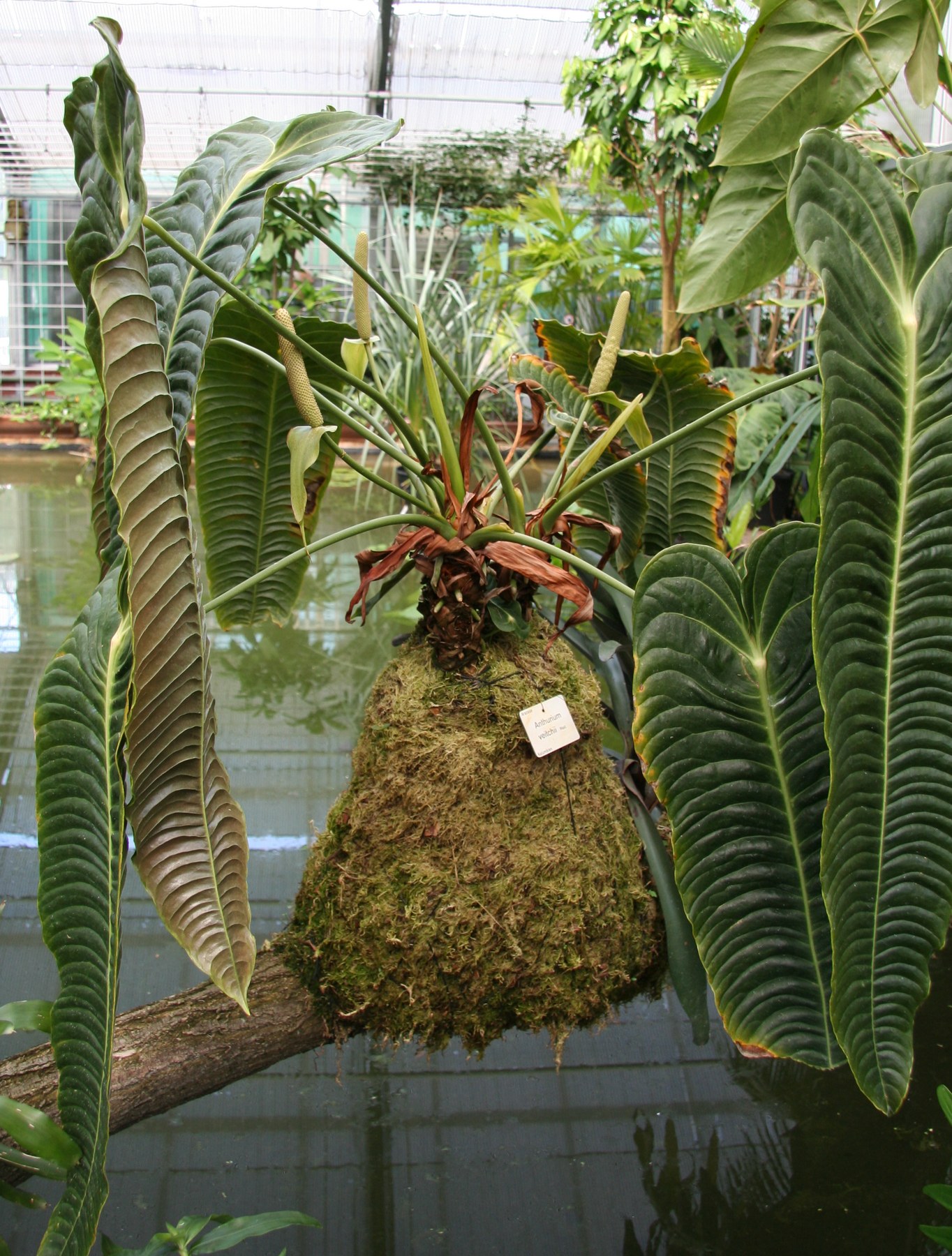
After the veitchii incident I rebuilt with a sandwich: a 3/4-inch cedar backer board lag-bolted into wall studs, then a 1.5-inch slab of virgin cork attached to the cedar with stainless screws and fender washers from behind. The cedar takes the structural load. The cork is the substrate the roots see. Between them, where the screws come through, I leave a small air gap so the cork can dry independently.
The plant sits on a pad of long-fiber sphagnum about two inches thick, bounded by a low fence of coated aluminum wire — the same wire florists use for bouquets, but in the heavier 16-gauge. The wire is not holding the plant. The wire is holding the moss. The plant is held by fishing line, 50-pound monofilament, looped over the petiole bases and tied to small eye screws set into the cedar, not the cork. This matters. Anything anchored only to cork will eventually tear out as the cork softens around the screw.
I water the moss pad with a hand sprayer twice a week in winter, every other day in summer, and I check the monofilament every time I water. Roots have grown across the cork in a pale net, but I do not trust them as structure. The line stays.
What fails, and when
Hot glue fails. I cannot say this clearly enough. Every few months someone on a forum will post a beautiful mount with the rhizome glued to driftwood, and every few months someone else will post the same plant on the floor. Hot glue does not bond to wet bark, and aroid bark is wet within a week of mounting. It buys you four months, maybe six.
Zip ties fail in two directions. The cheap nylon ones go brittle in UV and snap; the UV-stable ones don't snap but they girdle. I've cut zip ties off mature philodendron petioles and found the tissue underneath crushed flat, vascular bundles compressed, the leaf above already in slow decline. If you must use them, use the wide landscape-grade ones and check every three months.
Jute and cotton twine fail predictably and that's actually their virtue — they rot through in about a season, which is roughly the time a healthy aroid needs to attach its own roots. The catch is that a stressed plant won't attach in that window, and you'll find the twine gone and the plant held up only by hope.
The slowest failure, and the one that catches experienced growers, is the slab itself. Cork compresses around fasteners over years. A mount that was rock-solid in year one will have visible play in year four. Pull every screw and reset it, or accept that you're rebuilding the whole rig on a schedule.
Species that reward the effort
Anthurium veitchii is the obvious case. Mounted, the strap leaves hang vertically as the plant intends; potted, they kink at the petiole and never quite recover. A mature mounted specimen with leaves past four feet is one of the genuinely arresting sights in cultivation, and you do not get there in a pot.
Philodendron gloriosum and P. mcdowell are less obvious but more practical. Both want to crawl. A horizontal mount — a long shallow board, mossed across its length — lets the rhizome do what it wants and produces leaves at full adult size without the cycle of repotting that horizontal growers force on you in containers.
Among the climbers, Rhaphidophora decursiva and the larger Monstera — M. dubia shingling, mature M. deliciosa throwing fenestrated three-foot leaves — earn the wall space. Monstera dubia in particular needs a flat substrate it can press its juvenile leaves against; a pole gives you the adult form too quickly and you lose the shingled stage entirely. Cork board, vertical, well-watered: that's the trick.
The thing nobody tells you
A mount changes how you live with the plant. You can't move it for a photograph. You can't rotate it for even light. When the leaves get dusty — and they will, because nothing dries dust like a mounted leaf in low airflow — you clean them where they hang, with a soft brush and a spray bottle, standing on a stool.
Watering becomes a ritual rather than a chore. I water my mounted wall on Saturday mornings with a one-gallon pump sprayer and it takes the better part of an hour. In that hour I see every plant up close: the new leaf unfurling on the warocqueanum, the spent inflorescence on the veitchii, the spider mite I would have missed for another week if the plant were across the room in a pot.
This is, I think, the actual argument for mounting mature aroids. Not that it's better horticulture, though sometimes it is. Not that it looks better, though it does. It's that the rig forces a kind of attention the pot never demanded, and the plants — being plants, and noticing everything — respond to being noticed.