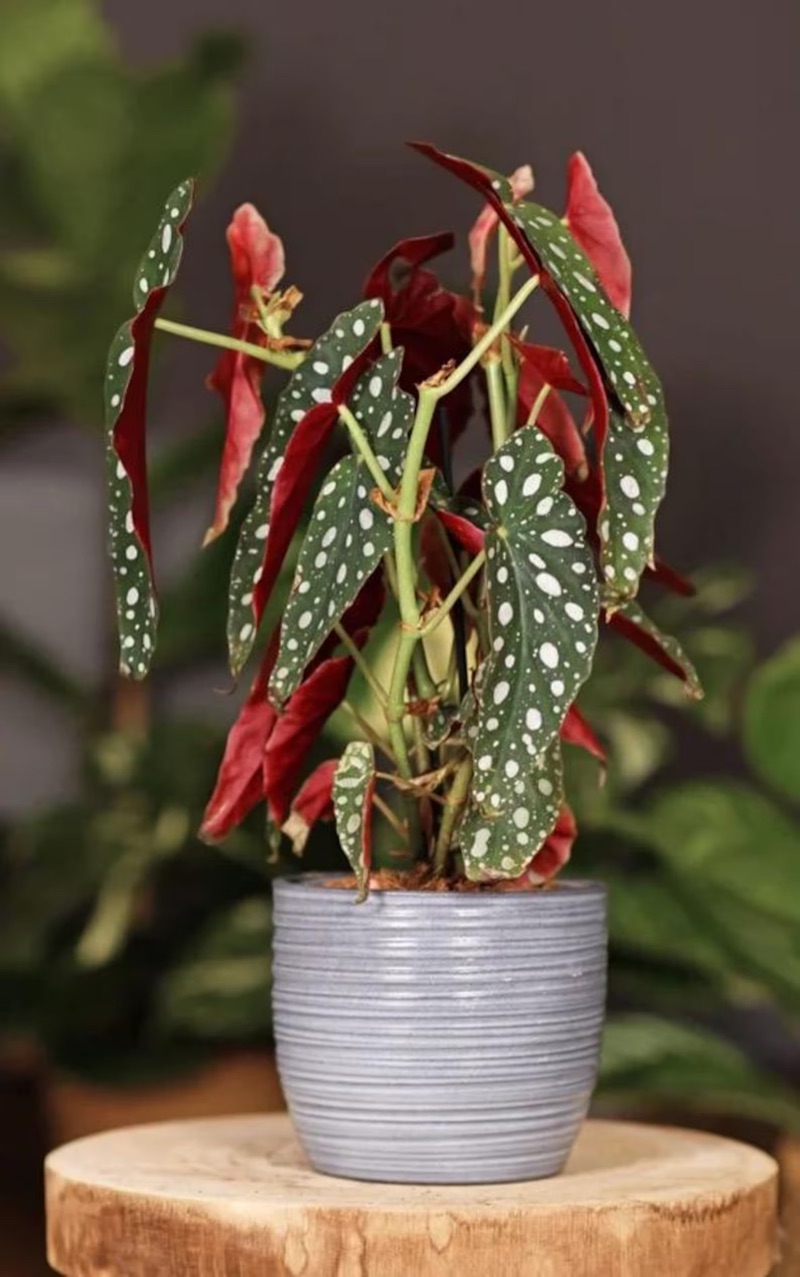
Sometime around 2018, a photograph started circulating. A begonia — gangly, architectural, its dark olive leaves punched through with white polka dots and flipped to reveal a deep oxblood underside — appeared in enough feeds that people who had never owned a houseplant began searching for one. The plant was Begonia maculata, a Brazilian cane begonia that had been growing in collections and conservatories for well over a century. It was not new. What was new was the audience.
The image had a logic to it. The spots read as designed, almost too deliberate for something that evolved in the Atlantic Forest of southeastern Brazil. Paired with the right ceramics and a white wall, maculata looked like it had been art-directed. It probably had been. But behind the composition was a real plant with real requirements — and a lineage of relatives that most of the people suddenly desperate to own one knew nothing about.
What Makes a Cane Begonia a Cane Begonia
The name comes from the stem. Cane begonias grow in upright, bamboo-like segments — hollow internodes separated by swollen nodes, sometimes reaching two meters under glass if you let them. Begonia maculata is one of maybe a dozen species in this informal group that collectors actually chase, but the category itself runs wider than that. B. aconitifolia, B. dichotoma, B. corallina — all cane types, all with the same basic architecture, all capable of turning a windowsill into something closer to a jungle margin than a shelf of succulents.
Begonia corallina is the parent that matters most to the cultivated history of the group. In 1892 in California, a woman named Françoise Tamatea crossed corallina with something from Brazil — the records are incomplete — and produced what eventually entered trade as Begonia × corallina 'Lucerna,' a large-leafed, coral-flowered cane that became the backbone of a century's worth of amateur hybridizing. The angel-wing name came later, from the leaf shape: paired lobes sweeping back like flight feathers, nothing like the symmetrical roundness of a wax begonia or the ruffly complexity of a rex.
Maculata itself was described scientifically in 1820 by Heinrich Wilhelm Schott, an Austrian botanist working through material collected in Rio de Janeiro. It was never rare in botanical terms — it grows in the shaded margins of Atlantic Forest understory, often on rocky slopes, at elevations where the air is humid but the drainage is immediate. What made it rare in cultivation was simply fashion: for most of the twentieth century, cane begonias were the kind of thing you found in a grandmother's sunroom, not a design-forward apartment.
The spots read as designed, almost too deliberate for something that evolved in the Atlantic Forest of southeastern Brazil.
The Cultivar Everyone Actually Bought
Most of the maculata plants that moved through Instagram and into mainstream garden centers were labeled 'Wightii.' The cultivar name appears frequently but without consistent documentation of its origin — it may derive from a selected clone that circulated through European nurseries in the early twentieth century, or it may be a name that accrued to a particularly vigorous, heavy-spotted form in trade. Either way, 'Wightii' is now so thoroughly synonymous with maculata in commercial horticulture that the two names are used interchangeably on most retail tags, accurately or not.
What distinguishes a good 'Wightii' from a weak one is spot density and underside color. The silvery-white polka dots should be numerous and relatively uniform, covering most of the adaxial surface without clustering toward the margins. The abaxial surface should be a saturated wine-red — not pink, not rust, but deep red. Plants propagated from cuttings of genuinely vigorous mother stock hold these traits reliably. Plants grown from seed, or from cuttings taken from stressed or etiolated parents, often don't.
There are other spotted canes worth knowing. Begonia 'Sophie Cecile' carries similar spotting on larger, more pendulous leaves and blooms more freely in lower light. Begonia 'Cracklin' Rosie' is a compact hybrid with tight internodes — useful if you want the aesthetic without the height. Neither of these circulated widely during the maculata moment, which is a small shame, because the wider gene pool of spotted cane begonias is genuinely interesting and most of it has been sitting in specialty collections for decades, ignored.
The Atlantic Forest on a Windowsill
Understanding where maculata actually grows explains most of what it wants from you. The Atlantic Forest — Mata Atlântica — is one of the most biodiverse and most fragmented biomes on earth, stretching along Brazil's eastern coast from Ceará south to Rio Grande do Sul. Where maculata grows, the canopy is broken enough to let in bright, shifting light, but the air retains high humidity even through dry seasons because the forest holds moisture. Temperatures rarely drop below 15°C even in winter. The substrate is rocky, fast-draining, rich in organic matter but never waterlogged.
A spare bedroom or south-facing window in a temperate city is not the Atlantic Forest. But you can get closer than you might think. Bright indirect light — within a meter of an east or south window, or under a grow light set to 14-hour days — covers the luminosity side. For humidity, a consistent 50–60 percent matters more than misting, which does almost nothing for the plant and invites powdery mildew onto the leaves if water sits. A small fan running on low creates the air movement the plant expects in a forest margin where breezes move through.
Substrate is where most people go wrong. Maculata in a peat-heavy commercial mix stays wet too long at the root zone, and the cane begonia's root system — fibrous, relatively fine — rots faster than you expect. A mix that drains in seconds after watering: two parts perlite or pumice to one part quality coco coir or fine pine bark, with a handful of worm castings, is closer to right. The pot should be terracotta or unglazed ceramic if you can manage it. Roots want to breathe.
The Part Nobody Mentions
Maculata has a reputation — earned partly by the algorithm, partly by garden center marketing — for being a simple, forgiving plant. It is not. It is a plant with a clear set of preferences that, when met, grows with impressive speed and blooms reliably several times a year in loose clusters of white flowers with yellow stamens. When those preferences aren't met, it declines in ways that are slow to announce themselves and fast to become serious.
Root rot from overwatering is the most common failure mode, and it is insidious because the canes hold stored moisture and look fine for weeks after the roots have gone. By the time leaves yellow and drop, the damage is often past recovery. The fix is not a treatment; it is a habit: water thoroughly, then wait until the top two to three centimeters of substrate are dry before watering again. In winter, or in low light, that interval stretches considerably.
Powdery mildew is the second common problem, and it is essentially a cultural failure rather than a pest invasion — the fungal spores are everywhere, and they colonize when airflow is poor and humidity is high simultaneously. The solution is airflow, not fungicide. A fan is more effective than any spray on a sustained basis. Spider mites appear in low humidity; they colonize the abaxial leaf surface first, which is where you should look if the leaf color starts to look dull or stippled.
Scale insects will settle into the nodes — the swollen joints where the leaf petioles attach — and are genuinely difficult to clear once established. Inspect new plants in quarantine for at least two weeks, and check the nodes specifically, because that is where the colony establishes before it becomes visible elsewhere on the plant.
Pruning and the Question of Size
Left alone, a vigorous maculata will reach the ceiling. This is not a metaphor. In a warm room with adequate light, the canes extend 30 to 40 centimeters per season without particular effort, and a plant that started as a 15-centimeter cutting can clear a meter in two years. This surprises people who bought it for a small shelf.
The answer is hard pruning, which the plant tolerates and often rewards. Cutting a cane back to two or three nodes above the soil line will stimulate branching from dormant buds at the lower nodes, producing a shorter, bushier plant with more stems and — usually — more flower production. The cut sections root easily in water or moist perlite; this is how you make more plants, and how you maintain the mother plant in a size that actually works for your space.
Timing matters less than people think. Maculata can be cut back almost any time of year in a warm indoor environment, though spring and early summer — as day length increases — give the fastest regrowth. The cut ends will callous within a day or two; there is no need to treat them with anything before placing them in propagation medium.
What the Collector Grows Instead
The collectors who were already growing cane begonias before 2018 mostly watched the maculata moment with a mixture of pleasure and mild exasperation. Pleasure because anything that gets people interested in the genus is useful. Exasperation because the species that were actually interesting to them — the rarer, more demanding, weirder-looking canes — remained completely invisible to the broader market.
Begonia listada, from southern Brazil, grows as a ground-cover cane with dark green leaves striped in chartreuse along the midrib and veins — nothing like maculata, nothing like anything else in the genus. Begonia luxurians, the palm-leaf begonia, produces palmate compound leaves from cane stems in a way that reads more like a fatsia than anything recognizably begonia-like. Begonia venosa, a succulent-stemmed species from Bahia, covers its leaves and stems in a white felt of trichomes and survives drought in ways that mainstream tropical houseplants can't.
None of these went viral. None of them photograph as cleanly as polka dots on a dark leaf against a white wall. But they represent a genus with more than 2,000 described species, most of which are unknown outside a small network of specialist growers who trade cuttings through society auctions and postal exchanges that predate the internet by decades. The American Begonia Society maintains a database and a cutting exchange program; the British and Australian equivalents do the same. If maculata is the door, there is a great deal behind it.
A Plant That Earned Its Moment
It would be easy to be dismissive about a plant that became famous because an algorithm decided it looked good. But the algorithm did not invent maculata. Schott described it in 1820. Victorian conservatories grew it. Collectors in Françoise Tamatea's California circle knew cane begonias well enough to hybridize them seriously. The plant had a life before the photograph, and it will have a life after the trend cycle moves on.
What the moment revealed is that the appetite for genuinely strange-looking plants is larger than the houseplant industry had assumed. The spots are the hook, but what holds people who stay with maculata is the same thing that holds them with any plant that has real character: the sense that the organism has its own logic, that it is doing something specific for reasons that predate you. The oxblood underside reflects wavelengths the understory light skews toward. The spots may disrupt herbivore recognition, mimicking fungal damage. These are real hypotheses, not marketing copy.
Grow it well and it will bloom without much encouragement — small white flowers in branching cymes, nothing showy, exactly right. Let it get tall enough to need staking and then cut it back and watch it branch. It is not the easiest plant you will own. It is not the hardest. It is a plant that came from a place with rules, and if you learn the rules, it behaves accordingly.