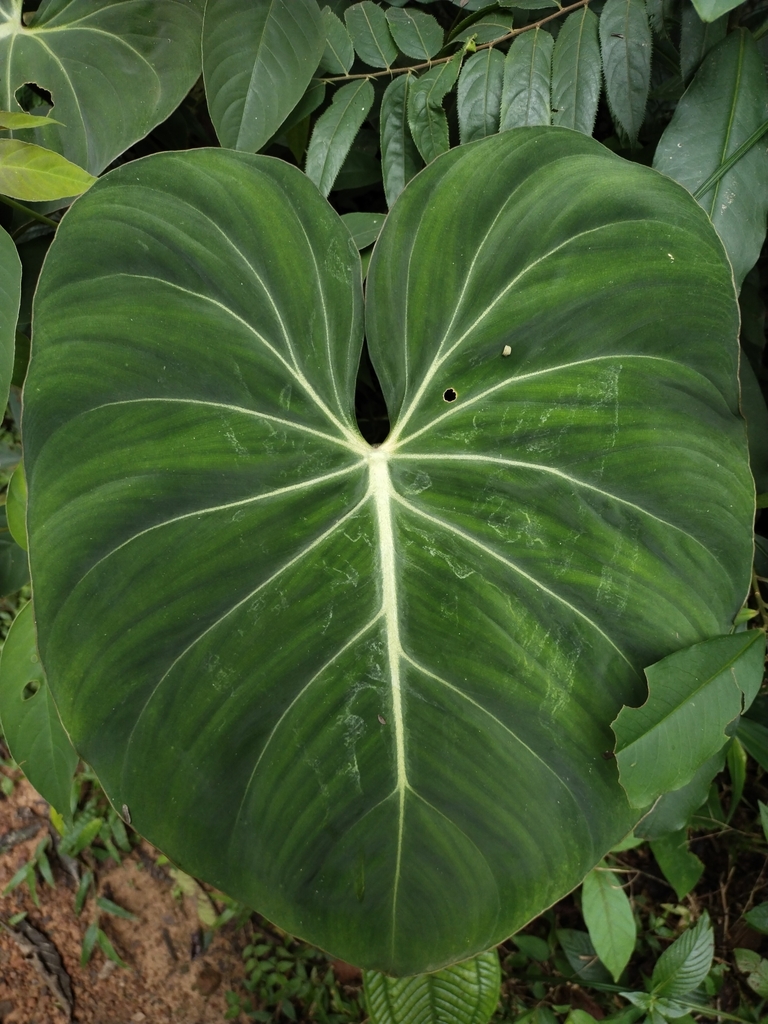
The new leaf on my Philodendron gloriosum hardened off on a Tuesday. By Wednesday I caught myself standing in front of it with a moisture meter in one hand and a bottle of dilute kelp in the other, willing the next cataphyll to swell. There was no cataphyll. There was a plant, recently finished with the considerable work of unfurling a fourteen-inch heart of green velvet, doing exactly what it should be doing, which was nothing.
This is the part of growing that nobody photographs. The flush is the photograph. The unfurl is the reel. What happens in the three, five, sometimes eight weeks afterward — when the petiole stiffens, the blade thickens, the roots quietly extend another inch into the bark — is the part that actually decides whether the next leaf will be bigger than the last, or a disappointing step backward into juvenile foliage. Most of the collectors I know, myself included, have lost more plants to impatience during the rest than to any pest or pathogen.
What a flush actually costs
A mature leaf is not free. To push a new blade, an aroid mobilizes stored carbohydrates from the rhizome or stem, draws on nitrogen and potassium reserves laid down over previous weeks, and commits a startling amount of water to turgor pressure in the expanding tissue. A Anthurium warocqueanum pushing a thirty-inch strap leaf is, in metabolic terms, running a marathon while holding its breath. The cataphyll is the starting gun; the hardened, glossy blade six weeks later is the finish line.
Once that leaf is out and flat, the plant is in deficit. Reserves are low. The new leaf is not yet photosynthetically mature — the cuticle is still thickening, the chloroplasts still organizing, the stomatal behavior still calibrating to the ambient humidity. For roughly the first two weeks after hardening, a new leaf is a net cost, not a net gain. It is a mouth, not a worker.
This is why a plant that pushes leaf after leaf with no pause is often, paradoxically, a plant in trouble. Stress flushing — the desperate sequential leaves of a philodendron whose roots are rotting, or a hoya that senses it's about to die — looks like vigor and is the opposite. Real vigor includes the rest.
The flush is the photograph. The rest is the plant deciding whether the next leaf will be larger than the last, or smaller.
The quiet weeks
If you watch a healthy Philodendron melanochrysum closely, you will notice that the period between a hardened leaf and the swell of the next cataphyll is not idle. The petiole continues to lignify. The blade darkens and the velvet sheen deepens as epidermal cells finish their structural work. New aerial roots probe the moss pole. Below the substrate, fine white root tips push outward in a flush of their own — root growth and leaf growth in most aroids are offset, not simultaneous.
I've started keeping notes on this interval. For my gloriosum, it runs about thirty-five days between hardened leaf and visible cataphyll, under stable conditions. For a young Anthurium clarinervium, closer to fifty. For a mature Monstera deliciosa in good light, sometimes as little as fourteen. The number itself doesn't matter much; what matters is that there is a number, and that it is consistent. A sudden shortening or lengthening of the interval is the earliest signal that something has changed — root health, light, temperature, or the grower's discipline.
The temptation to push
The post-flush rest is when collectors do damage. The leaf is beautiful. The plant looks vigorous. The grower wants more. So out comes the bottle of 20-20-20, the foliar spray, the upgrade to a larger pot, the move to brighter light. Each of these interventions, applied to a plant that is metabolically catching its breath, tends to produce a small disaster two months later: a stalled growth point, a smaller subsequent leaf, root tips burned by salts the plant wasn't actively drinking.
Fertilizer in particular is misunderstood here. Aroids absorb nutrients through active root tips, and active root tips are a feature of the growth phase, not the rest phase. Pouring fertilizer into the substrate of a resting plant is mostly pouring fertilizer into the substrate. It accumulates. When the next root flush arrives, those tender new tips meet a concentrated salt solution and respond accordingly.
The harder discipline, and the one that separates collectors who keep their plants for a decade from those who replace them annually, is to do less during the rest. Water when the substrate tells you to. Maintain humidity and airflow. Do not repot. Do not relocate. Do not upgrade the lights. Wait for the cataphyll.
Reading the cataphyll
The cataphyll is the plant's announcement that the rest is ending and a new cycle has begun. In Philodendron, it's typically a pale green sheath rising from the growth point; in some species, like P. billietiae, it's flushed with orange. In Anthurium, the new leaf often emerges directly from within the petiole base of the previous one, the cataphyll vestigial or absent. In Monstera, it's the unmistakable pale spear.
What I look for is not just the appearance of the cataphyll but its rate of swell. A cataphyll that emerges and then sits, unchanged, for two weeks is telling you something — usually that the roots aren't ready, or that conditions have shifted. A cataphyll that swells steadily, day by day, with the lower portion thickening before the tip extends, is a plant that used its rest well.
This is also the moment to resume light feeding, if you feed. A quarter-strength balanced fertilizer once the cataphyll is clearly active, increasing as the leaf expands, matches the plant's actual nutrient demand. Front-loading nutrition into the rest period does nothing useful.
What the rainforest does
It helps to remember where these plants evolved. A gloriosum creeping along the forest floor in the Chocó of Colombia is not on a fertilizer schedule. It experiences pulses — a rainstorm leaches organic matter past its roots, a howler monkey contributes nitrogen, leaf litter decomposes overhead, a dry week follows a wet one. Growth is episodic because the environment is episodic. The rest is not a bug in the plant's behavior; it is the plant's behavior.
Indoor growing tends to flatten this. Stable temperature, stable humidity, stable light, constant low-dose fertilizer — the conditions we provide are kinder than the rainforest in almost every measurable way, except that they remove the rhythm. Some growers I respect deliberately reintroduce variation: a cooler week in winter, a deliberate dry-down before a watering, a seasonal taper of fertilizer. The plants respond by resting more decisively and then flushing more strongly.
I'm not certain this is necessary for every species. A Monstera deliciosa will tolerate a metronome. A Anthurium dressleri, in my experience, will not — it wants the pause, and if you don't give it one it will take one anyway, in the form of a stalled growth point and a sulky six months.
A practical discipline
The post-flush rest is, in the end, a discipline of attention without intervention. I keep a simple log: date of cataphyll emergence, date of unfurl, date of hardening, date of next cataphyll. Four dates per leaf. After a year, you have a fingerprint of how a specific plant behaves in your specific conditions, and you can tell at a glance when something is off.
During the rest itself, the protocol is short. Water on the substrate's terms — for chunky aroid mixes, that usually means the top inch or two has dried and the pot has lost noticeable weight. Maintain humidity in whatever range you've settled on; do not chase it upward. Keep airflow constant. Wipe the new leaf gently once it's hardened, to clear the cuticle of mineral spotting. That is most of it.
The rest of the work is internal, on the grower's side. It is the discipline of looking at a beautiful, recently hardened leaf and not wanting the next one yet. The plant will get there. It is, right now, getting there, in ways you cannot see and should not interrupt. The pause is not the absence of growth. It is the part of growth that makes the next leaf possible.