Outside, it is February. The temperature in Minneapolis has been below zero for eleven days. Inside a spare bedroom on the third floor of a bungalow near Lake Harriet, a Philodendron gloriosum is unfurling a new leaf. The emerging lamina is already bigger than a man's hand, white veins threading across a matte green that looks almost hand-stitched. The grower, a pediatric nurse named Sara, has lined the walls with two layers of foam insulation and installed a secondary heating circuit so the room never drops below 68°F. She runs a humidifier that moves twelve gallons of water into the air each day. She checks the substrate temperature with a probe before every water. 'It doesn't know it's in Minnesota,' she says. That is precisely the point.
What Sara is doing — and what tens of thousands of collectors are doing in apartments in Chicago, converted garages in Denver, basement grow tents in Glasgow — is essentially an act of controlled deception. The plants, species that evolved in the cloud forests of Ecuador and Colombia, the lowland rainforests of Borneo, the tepuis of Venezuela, have no idea they are somewhere they were never meant to be. Their entire evolutionary history says: high humidity, stable warmth, dappled equatorial light, and a substrate that drains in seconds. The collector's job is to reproduce all four, simultaneously, in a structure designed for human beings. It is, by any objective measure, absurd. It is also, for those who do it, completely necessary.
The Baseline Problem
Start with what an equatorial aroid actually needs, stated plainly. Anthurium crystallinum, one of the most commonly chased velvet species, grows naturally in the cloud forests of Panama and northwestern Colombia at elevations between 300 and 1800 meters. Daytime temperatures there hover between 65°F and 80°F. Nighttime temperatures rarely drop below 60°F. Relative humidity runs from 75 to 95 percent almost continuously. The substrate is a loose assemblage of decomposed bark, moss, and organic debris — porous enough that roots get air as often as moisture. The light filtering through a canopy two stories above never resolves into a direct beam.
Now consider a grow tent in a Phoenix apartment. Ambient outdoor humidity in July is around 10 percent. The air conditioning that keeps the apartment livable drops interior humidity further. Phoenix tap water has an EC that would alarm a hydroponics grower. The nearest thing to cloud forest dappling is a southeast-facing window covered with 20% shade cloth. None of this is inherently fatal — collectors make it work — but every variable requires active management. The margin for error in a climate-controlled enclosure is narrow. Skip one humidifier refill during a heat dome, and the substrate desiccates in hours. Forget one oscillating fan, and the stagnant warmth that feels like rainforest becomes a petri dish for bacterial rot.
This is the baseline problem: the plants are not fragile, exactly, but they are specific. They will tolerate imperfect conditions right up until the moment they won't. Learning where that line is — for each species, in each microclimate, in each season — is most of what serious collecting actually involves.
The plant doesn't know it's in Minnesota. Reproducing that ignorance — maintaining it, season after season — is the entire project.
What Collectors Actually Build
The infrastructure that serious growers assemble over time would look, to an outsider, somewhere between a science lab and a very humid closet. IKEA greenhouse cabinets retrofitted with secondary polycarbonate panels and foam gaskets. Converted wardrobes with PVC pipe manifolds running ultrasonic misters at fifteen-minute intervals. Dedicated rooms with dehumidistat-controlled humidifiers on one wall and a clip-on hygrometer every three feet so you can map the humidity gradient and find the cold corners. Full-spectrum LED bars mounted on adjustable tracks, because the distance matters — 200 PPFD at the canopy is not the same as 200 PPFD at the pot.
Substrate is its own area of obsessive refinement. The standard mix that serious collectors have largely converged on — though argue over endlessly — is something in the range of orchid bark, perlite, and long-fiber sphagnum in roughly equal thirds, sometimes with a layer of leca at the base to hold moisture just below root level without waterlogging the crown. Semi-hydro setups in leca-only vessels have their advocates, particularly for species like Hoya kerrii and compact Anthurium hybrids where consistent moisture matters more than aeration. For creeping terrestrials like P. gloriosum or P. plowmanii, a shallower, wider tray setup mimics the way the rhizome moves through forest floor debris — it sounds fussy, and it is, but the results are visible in the quality of successive leaves.
The energy costs are real and rarely discussed. A 4×4 grow tent running two LED panels, a humidifier, a dehumidifier for overflow control, a small fan, and a heat mat under the trays draws somewhere around 800 to 1200 watts continuously. In cold climates, that tent is also heating the room it sits in, which complicates HVAC calculations. Some collectors run dedicated circuits. Some have negotiated their electricity bills into their housing budgets the way other people calculate car payments.
Light Is the Variable Nobody Warns You About
Humidity gets most of the attention, because humidity is dramatic — you can feel it when you walk into the room, and low humidity produces visible damage quickly. But light is the variable that separates plants that survive from plants that genuinely thrive, and it is harder to get right because its effects are slower and more subtle.
Anthurium warocqueanum, the queen anthurium, will grow under low light. It will produce leaves. Those leaves will be soft, poorly ribbed, and they will be narrower than they should be — the species is capable of blades exceeding 1.2 meters in ideal conditions, but under inadequate light in a grow tent, even a mature plant may produce leaves half that size with vein definition that barely registers. Bump the PPFD to 250–300 at the leaf surface, maintain 12-hour days on a consistent timer, and the next flush will tell you immediately. The difference is not cosmetic. It is the difference between a plant marking time and a plant performing.
The same principle applies to hoyas, where insufficient light delays or eliminates flowering entirely. Hoya latifolia — the large-leafed Bornean species often mislabeled as H. latifolia from Thailand — requires bright, consistent light to initiate peduncle development. Collectors in northern latitudes often supplement aggressively through the winter months, not because the plant is actively growing, but because letting it experience a six-hour light day in December can set back flowering by an entire season. The lamp stays on.
Species That Punish Arrogance
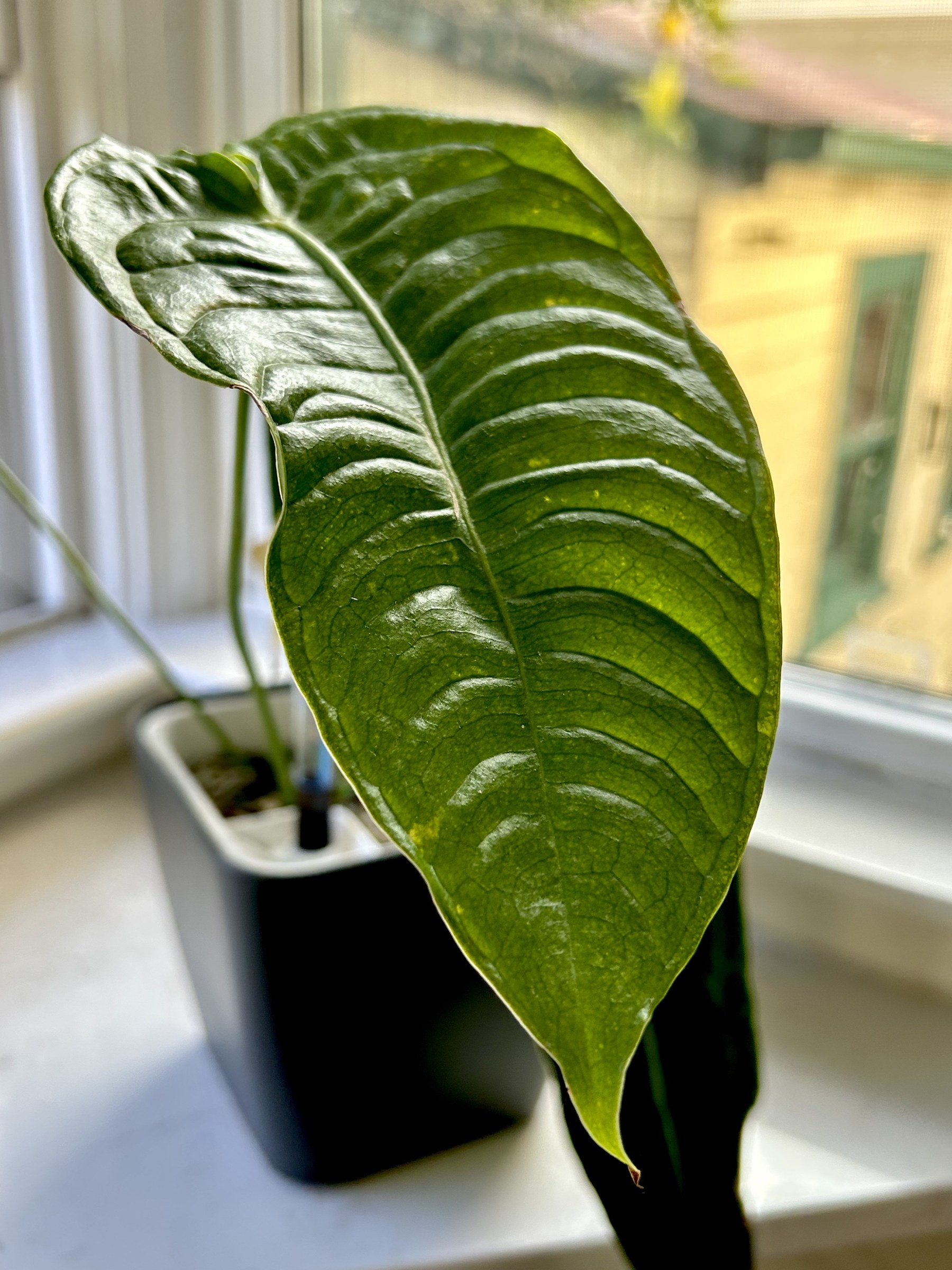
There is a category of plant in collector culture that functions as a kind of benchmark: species that are grown successfully by skilled growers and killed reliably by everyone else. Philodendron insigne is one. So is Anthurium dressleri, the Panamanian velvet that has become something of a white whale for collectors chasing velvets with field-collected provenance. Hoya bordenii, the Philippines species with waxy, corrugated leaves, has a reputation for sulking through its first six months in any new environment before it decides whether it will cooperate. These plants are not evil. They are simply exacting.
Anthurium dressleri in particular illustrates how specific environmental demands can be. It grows in lowland forests in Darién province, Panama — hot, genuinely humid, with very stable temperatures. Growers who have succeeded with it in North America typically report that the key is avoiding the temperature fluctuations that are almost unavoidable in the average home, even with a dedicated grow space. A single night at 58°F in a drafty basement can set the plant back by months. Its roots are sensitive to both overwatering and underwatering in a narrower band than most collectors are used to managing. It rewards experience and punishes the assumption that what works for crystallinum will work here.
What these difficult species produce, in collectors who persist with them, is a kind of calibrated patience that changes how you grow everything else. You start reading your plants differently. You notice when a petiole angle shifts before a leaf unfurls. You know what healthy new root tips look like in your particular bark mix. The hard species are not a detour from the hobby. They are the education.
The Seasonality Nobody Talks About
Equatorial species don't experience seasons in any meaningful sense at their origins — day length varies by only about forty minutes across the year at the equator, and temperature swings are measured in single digits. But they are growing inside houses in places where the ambient environment shifts dramatically across seasons, and those shifts penetrate even well-insulated grow spaces.
In practice, most growers in temperate climates see slower growth through winter not because they have changed anything, but because the humidity in the surrounding building drops as heating systems run, because light from nearby windows shifts in angle and duration, because the temperature of the room the tent sits in falls three or four degrees and the tent's heater runs more. These small changes compound. The plants slow. A Monstera thai constellation that was pushing a new leaf every eighteen days in September may take thirty-five days in January. This is not failure. It is the climate bleeding through.
The practical response is to treat late fall as a maintenance and assessment window rather than a growth season. Repot in September, before the slowdown. Prune and propagate before you lose the growth momentum of summer. Adjust humidifier output upward by October, before you notice the humidity has dropped. Seasonal care isn't about mimicking seasons — it's about compensating for them.
What the Obsession Actually Costs
The financial accounting of serious aroid collection is something growers discuss in private and understate in public. A well-rooted cutting of a proven Philodendron gloriosum from a reputable seller runs $40 to $80 on the low end of the current market; rarer selections or unusually large clones go considerably higher. A confirmed Anthurium dressleri with documented provenance can be $200 to $400, and the number of vendors selling accurately identified stock is small enough that you learn their names. The infrastructure discussed above — tents, panels, humidifiers, probes, fans — represents several thousand dollars assembled over time, often disguised in a household budget as a series of individually reasonable purchases.
But there is another kind of cost that doesn't show up in any ledger, which is the cognitive overhead of maintaining a living system that requires daily attention. Vacation is a logistics problem. A power outage during a heat wave is an emergency. Moving apartments involves planning that rivals a military operation — which plants travel in the car, which go in climate-controlled boxes, what goes into temporary boarding with another collector. This is not a hobby that runs in the background. It runs in the foreground, and it does so continuously.
Collectors who have done this for more than a few years tend to arrive at a pragmatic relationship with all of it. You get better at triage — which plants are irreplaceable and which are not, which failures teach you something and which were just bad luck. You build relationships with other growers because redundancy matters: someone else has a backup cutting of your best warocqueanum. The obsession becomes a network, and the network makes the obsession sustainable.
Why Nobody Stops
Ask a collector why they do it, and you get answers that circle the same few things without quite landing on one. The plants are genuinely beautiful — not in a generic decorative sense, but specifically, technically beautiful in ways that reward knowing what you're looking at. The silver primary veins of a mature crystallinum leaf are oriented to maximize the scattering of low-angle light through a forest understory. The velvety indumentum on a P. melanochrysum serves a function in water management. The corrugated surface of Anthurium papillilaminum affects how air moves across the lamina. Understanding why the leaf looks the way it looks deepens what you see every time you look at it.
There is also the satisfaction of a maintained system — something that is illegible to anyone who hasn't done it. Keeping a dressleri alive through a Minnesota winter is an ongoing technical achievement. It requires sustained attention, accumulated knowledge, and the willingness to make adjustments based on evidence you've learned to read. It is, in the most literal sense, skilled work.
And underneath all of it is something harder to articulate: the fact that the plant doesn't know it's in Minneapolis, and that maintaining that ignorance — season after season, through ice storms and heat domes and power flickers and the slow creep of drafts through imperfect walls — is the entire project. You are not decorating a room. You are sustaining a small piece of a climate that exists thousands of miles away, inside a structure that was built for something else entirely. That it works at all is, if you think about it too hard, remarkable.