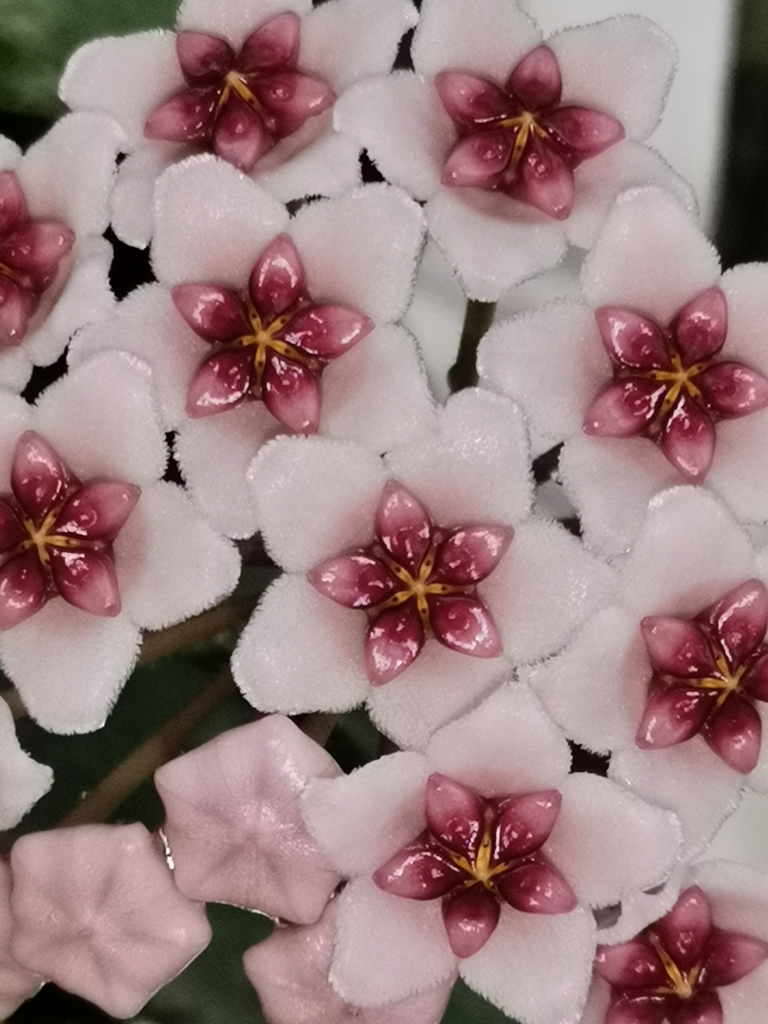
There is a moment, familiar to anyone who has kept hoyas for long, when a plant you have essentially ignored for months does something extraordinary. The peduncle — that stubby, recurved spur you were told never to remove — produces a tight umbel of waxy stars, and overnight the room smells faintly of chocolate and warm sugar. For an embarrassingly large number of collectors, that moment happened with Hoya carnosa. The round, splashed leaves, the forgiving constitution, the flowers that appear on a schedule you eventually learn to anticipate: this is the species that opens the door.
What follows the door-opening is well documented. Within a season the collector has acquired H. kerrii cuttings (usually useless single nodes), a H. pubicalyx in a hanging basket, and a rooted tip of H. macrophylla 'Albomarginata' that cost more than it should have. The hoya shelf expands. The grow tent appears. But carnosa stays — sometimes in a slightly embarrassing terracotta pot by the kitchen window, sometimes in a place of deliberate honor — because it earned that position. Understanding why it works as well as it does is worth the time.
What You're Actually Growing
Hoya carnosa is native to a broad arc running through southern China, Vietnam, and across much of insular Southeast Asia, with naturalized populations established in Australia and scattered Pacific islands largely through the horticultural trade. It is a hemiepiphyte — in habitat it climbs trees using aerial roots, positioning its leaves to intercept filtered canopy light, rarely sitting in wet soil for long. That origin explains almost everything about how to keep one alive in a flat in Minneapolis or a terrarium shelf in Portland.
The species has been in Western cultivation since the late eighteenth century; the genus itself is named for Thomas Hoy, head gardener to the Duke of Northumberland in the 1780s. This means carnosa has had roughly two and a half centuries to accumulate cultivars, sports, and regional variants. The plant on your windowsill may be structurally identical to one that flowered in a Victorian conservatory. That continuity is part of what gives the species its odd gravitational pull.
The leaf form is what most collectors notice first: thick, succulent, dark green ovals, typically between five and eight centimeters long, with a high-gloss surface and — in the most coveted forms — silver or white flecking caused by air pockets just beneath the epidermis. That flecking is not chlorophyll variation; it is structural. The cells beneath the cuticle trap air, scattering light. In some clones the flecking is dense and dramatic; in others it is almost absent. Collectors learn to distinguish these forms quickly, though taxonomy rarely gives them formal names.
The peduncle produces a tight umbel of waxy stars, and overnight the room smells faintly of chocolate and warm sugar.
The Cultivar Problem (and Pleasure)
Naming carnosa cultivars is a semi-organized chaos that rewards patience. 'Krimson Queen' has cream-to-white margins on green centers; 'Krimson Princess' reverses that, putting the cream at the center and green at the margin. 'Compacta' — sometimes sold as 'Hindu Rope' — produces tightly bunched, recurved leaves on a slow-growing vine that flowers reluctantly but spectacularly when it finally does. 'Chelsea' has rounder, cupped leaves with heavier silver flecking than the standard species type. 'Snowball' produces unusually large, densely packed umbels. None of these names are enforced by any international registry with real teeth, so the same plant may appear under two different names at two different vendors.
This is annoying if you are trying to build a methodical collection. It is interesting if you treat the inconsistency as a feature: buying from small specialist growers and comparing clones side by side is one of the low-key pleasures of keeping hoyas. A 'Krimson Queen' from a nursery stock block grown under fluorescents looks measurably different from one that has spent three years in someone's east-facing bay window. Light history shows in the leaf.
The variegated forms — both 'Krimson Queen' and 'Krimson Princess' — are slower than the straight species and require more light to maintain their patterning without reverting or producing entirely albino growth that cannot sustain itself. All-white or mostly-white leaves are photosynthetically non-functional; on a plant that is otherwise vigorous, occasional albino leaves are tolerable. On a cutting that is already struggling, they are a liability. This is not a reason to avoid variegated carnosa, but it is a reason to give them a proper bright window rather than a dim corner.
Care That Matches the Plant's Actual Biology
The single most common mistake with carnosa is overwatering, which is strange given the plant's reputation for toughness. The thick leaves store water; the aerial root system, adapted to cling to bark and intercept humid air rather than to absorb from saturated soil, is vulnerable to prolonged wetness. A well-draining mix — perlite and coco coir in roughly equal parts, or a commercial aroid mix cut with thirty percent perlite — and a pot with genuine drainage will prevent most problems. Clay or terracotta helps further by wicking excess moisture from the medium.
Light is the other variable that separates a carnosa that blooms from one that just sits there. Bright indirect light — the kind you get within a meter or two of an unobstructed east or south window — produces the compact internodes, rich leaf color, and flower production that make the species worth growing. Under lower light the vine extends rapidly, internodes stretch, and the silver flecking fades. The plant survives, but it does not perform.
Humidity matters less than it does for velvet-leaf anthuriums or thin-leaved begonias, but carnosa does grow faster and roots cuttings more readily above fifty percent relative humidity. Temperature is rarely a limiting factor for most growers — the species tolerates a range from around ten to thirty-five degrees Celsius, though it will slow dramatically below fifteen and prefers nights on the cooler side of that range during winter if you want to encourage spring flowering. Fertilize lightly through the growing season; heavy nitrogen pushes vegetative growth at the expense of flower production.
The Peduncle Doctrine
Every experienced hoya grower will tell the new one: do not remove the peduncles. This advice is correct and worth understanding in detail. Hoya carnosa flowers from a persistent spur — a short, woody structure that remains on the vine after each bloom cycle and produces subsequent umbels from the same point, season after season, often for the life of the plant. Removing that spur eliminates a future flowering site. It will not kill the plant; new spurs eventually develop elsewhere on the vine. But you are deleting several seasons of potential bloom from a location that may have taken years to establish.
A mature carnosa with a dozen or more active peduncles is a different experience from a young cutting with none. Each umbel contains anywhere from ten to thirty individual florets, depending on clone and conditions, and the cluster opens over several days, the fragrance intensifying as more florets unfurl. In still air the scent can be disorienting — sweet, slightly waxy, with a depth that cheap synthetic fragrances cannot approximate. Growers who leave windows open in summer sometimes notice the smell before they notice the flowers.
The practical implication of the peduncle doctrine is that carnosa rewards long tenure. A plant you keep for a decade in the same location, with established roots and a mature vine network, is not the same plant as the one you bought from a supermarket rack. The decade-old plant is an argument for commitment.
Why It Converts People
The plants that turn hobbyists into collectors usually have a particular structure: accessible enough to keep alive without expertise, but complex enough to reward closer attention. Hoya carnosa has exactly this quality. The beginner keeps one alive without understanding what they are doing right. Then the flowers appear. Then the collector starts asking questions — about the peduncle, about the cultivar names, about what the plant is doing when it drops a leaf versus when it merely pauses — and those questions lead to other hoyas.
Hoya australis, which shares some of carnosa's forgiving quality but has a slightly different leaf texture and an even more intense floral fragrance, usually comes next. Then something with texture: H. latifolia (formerly H. mitrata) or H. pachyclada, both compact and structural. Then the thin-leaved species — H. linearis, which is genuinely challenging and rewards controlled humidity and airflow — and eventually something genuinely difficult, like H. undulata or one of the miniature species from Borneo. The trajectory is consistent enough that experienced collectors can trace it in hindsight, and carnosa is almost always the first step.
None of this is to say that carnosa is a placeholder species, a beginner plant to be traded away once you have acquired enough skill to grow the difficult ones. Plenty of growers with a hundred-species collection keep a mature carnosa on a high shelf and regard it with something like respect. The flowers still arrive. The smell still stops them in the hallway. The plant that unlocked the obsession turns out to have been worth keeping all along.
Propagation and Patience
Hoya carnosa roots from tip or single-node cuttings with reasonable reliability, which is part of why it circulates so freely through the collector community. A tip cutting with two to three nodes, the lower leaves removed, placed in a mix of perlite and sphagnum moss and kept above sixty percent humidity, will typically show root development within three to five weeks under adequate light. Rooting in water works too, though plants transitioned from water to soil sometimes stall while they replace their water roots with soil-adapted ones.
Single-node cuttings — one leaf, one node — will root and survive but rarely thrive unless the node itself contains an active growth point. A cutting that is just a leaf and a short section of stem may sit unchanged for a year. This is not dead; it is merely waiting. Carnosa in general is a patient plant, content to hold its position through winter, through a dry week, through an imperfect season. That patience is the quality that made it a houseplant to begin with, and the quality that makes it worth having when everything else in the collection is demanding attention.
A Plant That Earns Its Keep
There is a version of this essay that treats H. carnosa as a sentimental object — the grandmother's plant, the thing hanging in the dentist's waiting room, the species too common to take seriously. That version is wrong. The species' ubiquity is a consequence of genuine fitness: it survives suboptimal conditions, it flowers under indoor light levels that would stall most hoyas, and it produces those flowers reliably year after year from the same points on the vine. These are not trivial accomplishments.
What makes carnosa the gateway species is not that it is easy. It is that it is responsive. Improve the light and the leaves compact and the flecking intensifies. Get the watering right and the roots fill the pot in a single season. Allow a mature vine to develop and the flowering becomes a seasonal event rather than a surprise. The plant gives you clear feedback and rewards adjustment. That feedback loop is what makes a gardener into a grower, and a grower into a collector. Hoya carnosa has been starting that process for two and a half centuries, and it shows no sign of stopping.