There is a particular snobbery in plant collecting that treats accessibility as a defect. If a thing roots in a glass of water, blooms reliably, and tolerates a missed watering without theatrical collapse, it gets filed under beginner and left there, never reconsidered. Hoya australis 'Lisa' has lived in that folder for years — priced at twenty dollars in garden centers, sold alongside pothos and snake plants, recommended to people who've just killed their first succulent. The classification is not wrong, exactly. 'Lisa' is forgiving. But forgiving and unremarkable are not synonyms, and treating them as such means a lot of collectors are sleeping on one of the most satisfying hoyas you can grow.
The case for 'Lisa' is not that it punches above its class. It's that the class assignment was wrong to begin with. This is a fast-growing, heavily variegated, reliably blooming hoya with foliage that shifts from cream to gold to pale green depending on light intensity and leaf age — and it does all of this without demanding a climate-controlled grow tent or a precisely buffered substrate. The argument isn't that 'Lisa' is underrated in the way that word usually operates in plant media, meaning secret or obscure. Everyone knows it. The argument is that knowing it and actually looking at it are two different things.
What 'Lisa' Actually Is
Hoya australis is a vigorous species native to coastal and rainforest margins across much of Australia and extending into Papua New Guinea and parts of Southeast Asia. It is one of the larger-leaved hoyas in cultivation, with a semi-succulent, waxy texture suited to the intermittent rainfall of its native range. The species produces umbels of small white flowers with a red-pink corona — sweetly fragrant, especially in the evening — and it blooms young relative to many of its genus-mates. In the wild it is a scrambling climber, working through shrubs and up tree trunks, and that aggressive habit carries directly into cultivation.
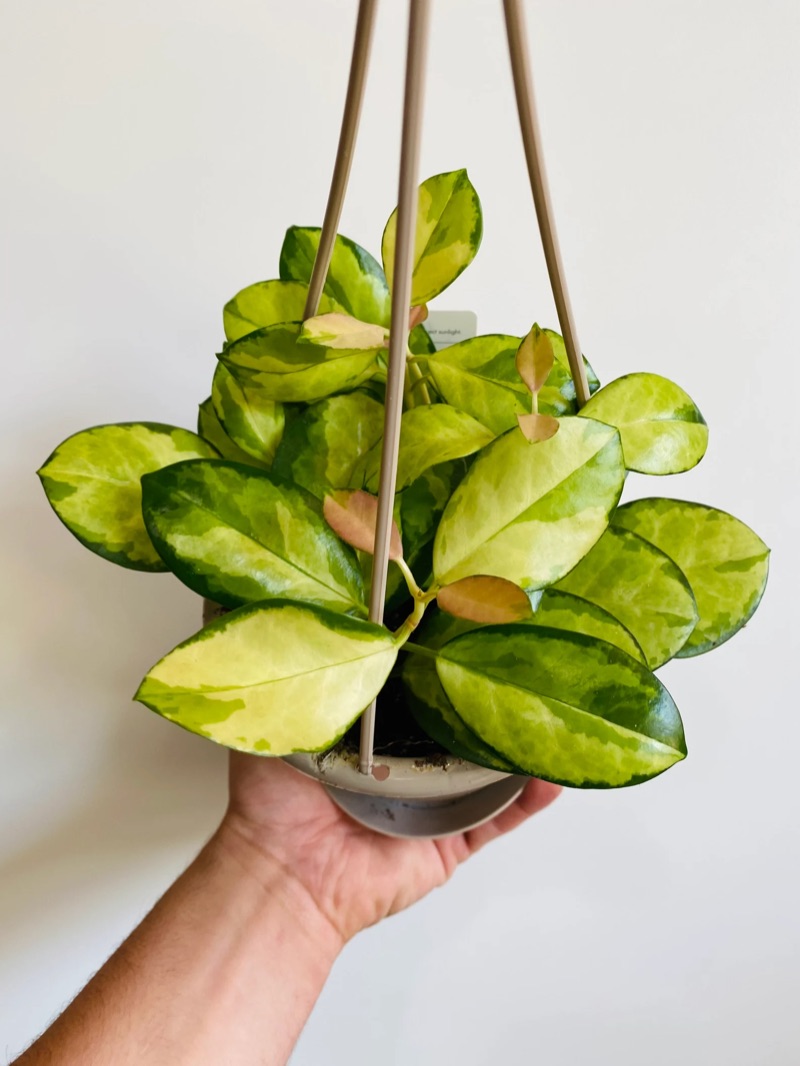
'Lisa' is a variegated selection, the exact origin of which is not precisely documented in the way that, say, a tissue-cultured cultivar with a known breeder might be. What's clear is that its variegation runs in a tricolor pattern: dark green at the leaf margins, a midzone of lighter green, and a broad central splash of cream to yellow. Young leaves emerge closer to gold, sometimes nearly white at the center, and mature toward deeper cream as chlorophyll develops. The pattern is not consistent from leaf to leaf, which keeps things visually interesting in a way that a more uniform variegation wouldn't. Some leaves are mostly green with a small central flare. Others are sixty percent cream and look almost bleached. The variation within a single vine is part of what makes a mature specimen worth looking at.
It is not a chimeric variegation of the fragile sort that makes Hoya linearis variegata or some carnosa sports so difficult to stabilize. 'Lisa' propagates true and easily, which is part of why it's so widely available. That reproducibility is treated as a strike against it by collectors who prize rarity for its own sake. It shouldn't be.
Forgiving and unremarkable are not synonyms — and treating them as such means a lot of collectors are sleeping on one of the most satisfying hoyas in the genus.
Growth Rate as a Feature, Not a Footnote
The trait that separates 'Lisa' from most of the hoyas in serious collections is the speed at which it moves. In active growing conditions — temperatures between 65 and 85°F, bright indirect light, consistently moist but never waterlogged substrate — a healthy 'Lisa' will push new growth almost continuously through spring and summer. A single node cutting taken in April can be a trailing vine with six to eight leaves by August. That rate of growth is unusual in the genus, where species like Hoya kerrii or Hoya latifolia move with a kind of geological patience.
That speed matters for a few reasons beyond simple impatience. Fast growth means faster feedback on your conditions. If you adjust your watering frequency or move the plant closer to a light source, 'Lisa' will tell you within a week or two whether that was the right call — either by pushing vigorous new growth or by protesting with yellowing or crispy leaf edges. For someone developing their intuition for hoya culture generally, this responsiveness is genuinely useful. You are running experiments with a fast feedback loop instead of waiting six months to discover you've been underwatering a Hoya meliflua the entire time.
Fast growth also means usable cuttings, and usable cuttings mean you can be generous. There is something to be said for a plant that lets you gift a node to everyone who visits your growing space without feeling like you've given away something irreplaceable. That generosity changes your relationship to the plant.
Light and Variegation: A Specific Relationship
Because a significant percentage of 'Lisa's' leaf area lacks chlorophyll, the plant needs more light than the standard hoya care recommendation of 'bright indirect' might suggest. In low light, two things happen: the variegated sections stay pale and interesting, but the overall plant slows dramatically and vines stretch between nodes, producing smaller leaves with less pronounced patterning. More critically, the fully green portions of heavily variegated leaves are doing all the photosynthetic work, which means the plant is effectively running at reduced efficiency even under ideal conditions. You compensate with intensity.
An east-facing window with several hours of direct morning sun is close to ideal. South-facing works well through most of the year in the northern hemisphere if you have a sheer curtain to knock the edge off afternoon intensity in midsummer. Supplemental LED lighting — something in the 3000–4000K range positioned twelve to eighteen inches above the canopy — produces excellent results year-round and tends to intensify the golden tones in new growth noticeably. Under strong light, the cream centers warm toward amber before they mature, and the overall plant takes on a luminosity that photographs poorly and looks better in person, which is the best thing you can say about any foliage.
What you're calibrating is not just growth rate but the ratio of gold to green in the leaves. More light pulls more yellow. Less light produces leaves that trend greener as the plant compensates. Neither is wrong, but understanding that relationship lets you choose rather than just accept what you get.
Substrate, Watering, and the Semi-Succulent Question
Hoya australis has semi-succulent leaves — not as thickly padded as Hoya obovata or Hoya kerrii, but meaningfully more water-retentive than thin-leaved species like Hoya linearis. That succulence is a storage adaptation, and it means 'Lisa' handles a missed watering or two without the immediate drama that a thinner-leaved hoya might display. It does not mean the plant wants to dry out completely between waterings, which is a common misapplication of the semi-succulent label.
A chunky, airy mix is the right substrate regardless of how succulent the leaves are. Coco coir or peat as a base, amended with perlite at forty to fifty percent by volume, with some orchid bark chunked in for structure, gives the roots the drainage they need while retaining enough moisture for consistent uptake. Hoyas are epiphytic or hemi-epiphytic in their natural habitats, which means they evolved root systems designed for excellent aeration, not for sitting in dense, moisture-retaining soil. Water thoroughly, let the top inch or two dry before watering again, and don't let the pot sit in a saucer of standing water. That's the whole watering protocol.
Fertilize lightly and consistently during active growth rather than heavily and occasionally. A balanced liquid fertilizer at half the recommended concentration every two to three waterings keeps the plant fed without pushing the salt buildup that can damage roots in a container setting. Stop supplemental feeding in winter unless you're running grow lights and the plant is still actively growing.
On the Flowers
'Lisa' blooms from peduncles — the small woody spurs that emerge from the nodes and persist on the plant from season to season. This is why you never cut a peduncle off a hoya, even after the umbel has finished: the plant will rebloom from the same spur the following season. It is one of the most consistently misunderstood aspects of hoya culture, and 'Lisa' is a good plant on which to learn the lesson because it produces peduncles young and readily.
The flowers are small, star-shaped, and white with a pale pink to red corona — structurally very close to the H. australis species type. They cluster in dome-shaped umbels of fifteen to thirty individual florets, and they are fragrant in the way that good vanilla is fragrant: warm, sweet, not sharp. The fragrance intensifies in the evening and can fill a room if you have a plant in active bloom. 'Lisa' is not a once-a-year bloomer with careful management; a mature specimen in good conditions will push multiple umbels across a season without much prompting beyond adequate light and letting the roots get appropriately snug in the pot.
Where It Sits in a Serious Collection
The honest answer to where 'Lisa' belongs in a collection built around harder-to-source material is: wherever there is a bright spot that needs filling. It is not going to elicit the same response as a rooted cutting of Hoya sp. Chimanimani or a blooming Hoya mappigera. Collectors who visit your space will walk past it to look at something rarer. That's fine. It is not competing for that attention, and the people who dismiss it because of its availability are the same people who would dismiss a well-grown specimen of any common species.
The more interesting question is what 'Lisa' teaches you while you're growing everything else. Its fast feedback loop calibrates your intuition for watering timing. Its response to light intensity shows you the direct relationship between photon availability and variegation expression that applies across all variegated hoyas. Its peduncle behavior demonstrates bloom mechanics that matter for Hoya kerrii, Hoya multiflora, Hoya wayetii — any species that blooms from persistent spurs. It is, in this sense, a genuinely useful plant to have in a collection, not only an attractive one.
None of which is the main argument. The main argument is simpler: on a summer morning with the light coming in at a low angle, new growth unfurling gold at the tip of a long trailing vine, the thing is beautiful. Not beginner beautiful. Just beautiful.
The Taxonomy of Underestimation
Plant collecting has a valuation problem that runs adjacent to the price-driven speculation of the pandemic-era market but is not exactly the same thing. Price speculation was about scarcity and money. What's happening with plants like 'Lisa' is about prestige — about the idea that a plant's worth scales with its difficulty and its rarity, and that anything widely available must therefore be unworthy of serious attention.
That framework produces odd results when you apply it consistently. Monstera deliciosa is the most available aroid in the world, sold at every hardware store, and it is also a genuinely extraordinary plant with a complex leaf development strategy that takes years to fully express. Common does not mean boring. Available does not mean not worth growing well. The collectors who've internalized this tend to have spaces that are more interesting, not less — because they're making decisions based on what actually looks good and grows well rather than what's difficult to source.
'Lisa' is not a beginner plant. It's a hoya that's been miscategorized because it's easy to propagate and hard to kill. Those are virtues. Grow it in good light, give it an appropriate substrate, don't cut the peduncles, and wait for a summer morning with the right angle of sun. The folder it belongs in is not beginner. It's just: worth growing.