There is a moment, if you grow Philodendron gigas long enough, when you stop thinking of it as a houseplant. The leaves that emerged six months ago as burnished copper ovals, soft under a fingertip like brushed suede, have by now darkened to something close to black-green, each one wider than your forearm is long, veins pale and emphatic against the velvet surface. The plant is climbing — if you've given it anything worth climbing — and the stem below is thick enough that you'd hesitate before calling it a stem at all. It looks, in the controlled chaos of a spare bedroom grow room, like something that is merely tolerating your company.
Philodendron gigas comes from Panama, from the wet forests of the Darién and the lowland humid zones where the genus sprawls without apology. It was formally described in 1997 by Thomas Croat, the Missouri Botanical Garden botanist who has spent decades untangling Araceae taxonomy in the field. The name is not poetic flourish — gigas simply means giant, and the plant earns it. In habitat, mature specimens produce leaves that exceed a meter in length. In cultivation, under serious care, you can get within striking distance of that. Most people, though, never find out, because they treat it like a standard velvet philodendron and wonder why it sulks.
What Copper to Black Actually Means
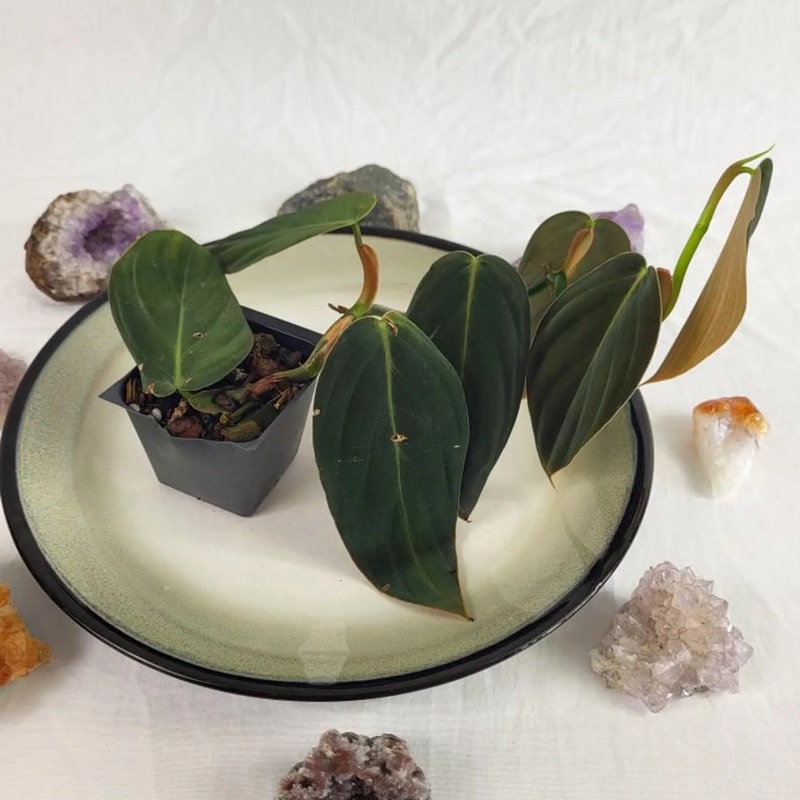
The color progression is the most discussed feature of gigas, and it is worth understanding what drives it rather than simply admiring it. New growth emerges with a distinctly coppery or bronze cast, occasionally tipping toward terracotta on the undersides. This is not a sign of stress or mineral deficiency — it reflects the ratio of chlorophyll to anthocyanins in juvenile leaf tissue. As the leaf expands and matures over weeks, chlorophyll production ramps up and the green deepens progressively, eventually settling into a dark, almost blue-green that reads as near-black in low ambient light.
The velvet texture, meanwhile, comes from microscopic epidermal hairs — trichomes — that diffuse reflected light across the leaf surface. This is a structural property of many collector-favorite velvets: Philodendron melanochrysum, P. gloriosum, P. splendid (the natural hybrid of melanochrysum and gloriosum). What distinguishes gigas from that group is scale. Melanochrysum leaves are elegant, reaching 60–90 cm on strong climbing specimens. Gigas aims past that. The petiole alone on a mature indoor specimen can run 40 cm, and the blade it carries is proportionally enormous, with primary lateral veins spaced far enough apart that the leaf reads as architectural rather than decorative.
That transition from copper to dark velvet is also why gigas photographs differently at different stages. Collectors who share images of juvenile plants are sometimes accused of mislabeling — the coppery juvenile doesn't look much like the near-black adult. Both are the same plant. Both stages are worth watching closely.
The leaves that opened copper six months ago have darkened to something close to obsidian — and the plant is climbing like it has somewhere to be.
The Darién Baseline
Knowing where a plant comes from is not trivia. It is a care manual written in geography. The Darién lowlands receive somewhere between 2,500 and 3,500 mm of rain annually, distributed across a pattern that has a shorter dry period rather than a true drought. Temperatures are stable — 24–30°C through most of the year, rarely dropping below 20°C even at night. Humidity stays above 80% for most of the growing season. The forest understory where gigas climbs receives bright, diffuse light filtered through a canopy that can run to 30 meters overhead.
This baseline tells you something immediately: gigas is not a plant that evolved to handle cold nights, dry air, or the kind of light fluctuations that happen near a drafty north window in a northern winter. It wants warmth, consistent warmth, with a nighttime low that doesn't often breach below 18°C indoors. It wants humidity that a standard room cannot provide without intervention. And it wants light that is genuinely bright — not the soft ambient light that keeps a Pothos alive, but the kind of bright indirect exposure that drives real photosynthesis.
Collectors who try to grow gigas in a standard living room with a humidifier parked next to the pot tend to get technically alive plants that produce one or two leaves a year, each smaller than the last. That is a plant that is surviving, not growing. The Darién baseline pushes you toward a dedicated space: a grow tent, a greenhouse cabinet, an enclosed room with supplemental lighting and a system that keeps humidity above 70%.
Substrate and Roots
Philodendron gigas is a hemiepiphyte. In the forest it begins in soil and climbs, its roots anchoring to bark and pulling moisture from humid air as much as from the ground. This means its root system expects two things simultaneously: reliable moisture and aggressive aeration. The failure mode in cultivation is almost always a substrate that holds too much water against the root crown — a standard peat-heavy mix that stays wet for ten days after watering. Roots in that environment rot at the tips first, and by the time you notice decline in the leaves, the damage is significant.
A substrate worth using for gigas combines a chunky base — orchid bark at 40–50%, perlite at 20–30% — with a smaller fraction of a moisture-retaining component like coco coir or a quality peat substitute. The goal is a mix that drains immediately but retains enough moisture that the roots in the lower third of the pot stay faintly damp for two to three days before the medium approaches dryness. Watering frequency in this setup depends on pot size, ambient temperature, and light intensity — which is exactly the point. There is no universal schedule. You learn to read the medium.
Pot choice matters more with a large climber than with compact growers. Gigas does not need an enormous container — its roots prefer to be moderately contained rather than swimming in excess medium. A well-draining nursery pot or a terracotta pot one size up from snug is more useful than a cavernous decorative planter. Report when you see roots circling the base or emerging from drainage holes with some density, not before.
Light: The Non-Negotiable
In the filtered understory of a Panamanian forest, gigas receives what measuring instruments record as bright indirect light — ambient levels that can reach 10,000–15,000 lux on a clear day under a full canopy. Most indoor environments top out at 3,000–5,000 lux even near a well-oriented window. This gap is the single biggest limiter on indoor gigas growth rates, leaf size, and the quality of that velvet surface texture.
Supplemental lighting changes the calculation. A pair of quality full-spectrum grow lights — positioned 30–45 cm above the canopy of the plant and running 12–14 hours per day — can push ambient levels to the range gigas wants. The result is not just faster growth; it's structurally better growth. Leaves that develop under adequate light are thicker, darker, and hold the velvet texture more consistently than leaves grown in marginal light, which tend to be thinner and more matte.
Direct sun through glass will scorch the velvet surface. The trichomes that give the leaf its texture also make it more susceptible to rapid moisture loss under intense direct radiation. Bright indirect, or diffused supplemental light, is the target. This is not a difficult distinction to manage, but it is one that requires actual attention to where the light falls at different times of day.
The Climb Is Not Optional
Gigas is a climbing philodendron. This is a functional statement, not a styling preference. When a climbing philodendron cannot climb — when it is left to trail or left without a support — it produces progressively smaller leaves and arrests the natural progression toward mature morphology. The plant reverts toward what botanists call the juvenile form: smaller blades, shorter internodes, growth that looks nothing like what the species is capable of.
A moss pole works. A coco coir pole works better for some growers because it maintains moisture along its length, giving aerial roots something to actively engage with rather than a dry surface they eventually ignore. Some collectors use untreated cedar planks or tree fern fiber boards. The material matters less than its surface texture and moisture retention — the roots need something to grip and draw moisture from. A bare bamboo stake is better than nothing and worse than almost everything else.
Size the support to the plant's ambition, not its current height. A gigas that is today producing 30 cm leaves will, with proper conditions, be producing leaves twice that size in 18 months. A 60 cm moss pole is a short-term solution. Plan for a meter and a half at minimum, or be prepared to splice extensions as the plant climbs — which is manageable but disruptive.
What You Are Actually Signing Up For
A healthy, seriously grown gigas in peak growth season will push a new leaf every three to five weeks under good conditions. Each leaf is larger than the last for a period, then levels off as the plant reaches the upper range of what your environment can support. The plant will need its support checked, its roots inspected, its substrate refreshed every 18–24 months. It will, eventually, become too large for the space you gave it — not as a complaint but as a consequence of having done everything right.
Propagation is straightforward: a stem cutting with at least one node, ideally two, placed in moist sphagnum or water until roots develop to several centimeters, then transferred to a chunky mix. The coppery new growth on a fresh cutting from a mature plant is one of the more visually satisfying things in the hobby. Sharing cuttings with other collectors is, practically speaking, how the plant spreads — tissue culture production exists but is inconsistent in quality relative to cuttings from a known, well-grown mother plant.
None of this is simple. Gigas is not a plant for a windowsill, not a plant for someone who travels often and waters opportunistically, not a plant that forgives a heating system failure in January. What it gives back — those near-black leaves, that velvet surface, the scale that makes visitors stop mid-sentence — is in direct proportion to the seriousness of the conditions you build for it. That exchange is the whole logic of the hobby.