There is a moment, familiar to anyone who has spent real time with aroids, when you stop looking at the leaf. The blade is what everyone photographs — the velvet, the fenestrations, the silver venation that catches light like hammered foil — but the leaf is also the part most likely to deceive you. Leaves change shape as a plant matures. They change under different light levels, humidity, and substrate. A juvenile Philodendron gloriosum grown in a bright, dry room looks almost nothing like one allowed to mature in deep shade and eighty-percent humidity. If you want to know what you actually have, you look at the petiole.
The petiole is the stalk connecting the blade to the node. It has no photosynthetic ambition. It is not trying to attract a pollinator or impress a buyer. It just holds the leaf out into the light, doing its structural job, and in doing so it encodes a remarkable amount of taxonomic information — cross-section, texture, wing geometry, color, and pubescence — that remains far more stable across growing conditions than blade morphology alone. Collectors who can read a petiole fluently catch misidentified plants before money changes hands. They separate a true Philodendron melanochrysum from a P. micans with a glance. They know the difference between a dressleri and a verrucosum hybrid before the seller finishes the pitch. This is that skill, built out.
Cross-Section: The First Cut
Slice a petiole cleanly — a fresh razor, not scissors, which crush rather than cut — and look at the exposed face. This cross-section is the single most diagnostic feature available to a collector without a microscope. In the gloriosum versus crystallinum debate, which surfaces constantly in online sales groups and at every aroid meet, the petiole cross-section is often decisive. P. gloriosum carries a deeply channeled, flattened adaxial face — a broad, open groove along the top — while P. crystallinum tends toward a more rounded, less dramatically winged profile. Both are velvet-leafed crawlers from western South America, and juvenile blades can overlap frustratingly in appearance. The cross-section does not overlap.
The D-shape versus O-shape distinction matters across genera too. Many Anthurium species — particularly those in the Cardiolonchium section, which includes the collector-beloved A. clarinervium and A. crystallinum — carry a pronounced D-shaped petiole, flat on the adaxial side, rounded on the abaxial. The angle and depth of that flat face varies between species and offers a check when venation alone is ambiguous. A rounded, nearly terete petiole on what someone is selling as a clarinervium is worth questioning out loud.
Some collectors make cross-section photographs a standard part of their documentation practice — one image of the blade, one of the abaxial surface, one clean petiole cut. It takes thirty seconds. It creates a record that holds up better than a top-down glamour shot when you are trying to verify identity six months later, or when a cutting goes to someone else and they want provenance.
The leaf is what everyone photographs. The petiole is what tells the truth about the plant you actually have.
Wings and Flanges: Geometry Under Pressure
The winged petiole is one of the most misunderstood structures in aroid collecting. A wing — the thin laminar extension running along the petiole's edge — is not simply an aesthetic flourish. Its width, rigidity, whether it is continuous or interrupted, and how it terminates at the node and at the pulvinus all carry species-level information. In Philodendron plowmanii, the heavily ruffled, undulating wings are so pronounced and structurally distinctive that the species is essentially self-identifying even in a bad photograph. No other commonly cultivated velvet philodendron produces that creped, almost quilted wing geometry. If you are offered a plowmanii with flat, narrow, unremarkable wings, you are being offered something else.
P. mamei provides a useful contrast. Its petioles carry wings that are present but comparatively modest, and the petiole surface is often marked with pale, irregular blotches — a kind of mottled variegation of the stalk itself that mirrors, faintly, the silvery patterning on the blade. This mottling is stable across growing conditions in a way that blade patterning is not, which makes it a reliable confirming feature. A mamei without any petiole mottling is not automatically wrong, but it warrants a closer look at everything else.
In Monstera, wing structures appear less dramatically but the ribbing and texture of the petiole geniculum — the thickened, often darker section just below the blade — differs meaningfully between deliciosa, borsigiana, and siltepecana. Collectors chasing a true deliciosa rather than the smaller-statured borsigiana that dominates the trade have learned to examine geniculum prominence alongside internode length. Neither feature alone is conclusive; together they build a case.
Pubescence: Reading the Hair
Run a finger along a Philodendron verrucosum petiole. The bristle-like trichomes — dense, often reddish or pale depending on the collection locality — are unmistakable. Verrucosum from higher-elevation Ecuadorian populations tends toward longer, more abundant pubescence and a richer red-violet coloration on the abaxial blade surface than plants sourced from lower Colombian collections. The petiole hair does not lie about altitude, exactly, but it does hint at it, and collectors who work with multiple verrucosum lines have learned to read that gradient.
Philodendron sodiroi offers a contrasting case: its petioles are essentially glabrous, smooth and slightly waxy, which separates it cleanly from the hairy-petioled velvets even when a juvenile blade's silver patterning might momentarily suggest a relationship. P. luxurians, another velvet crawler drawing serious collector attention from its range in the Chocó, has petioles that are pubescent but shorter-haired than verrucosum, with a texture closer to fine velvet than bristle. The distinction is tactile before it is visual.
Anthurium collectors deal with pubescence questions most acutely around the metallicum complex and the velvety species in section Cardiolonchium. A. forgetii — the pendent-leafed species without a sinus — has smooth petioles; some of the rarer highland species being circulated have fine pubescence that is partly diagnostic. Photographs rarely capture this. It is a reason to handle plants before purchase when possible, and to ask sellers directly whether they have touched the petiole, not just photographed the blade.
Color and Pigmentation: More Than Aesthetics
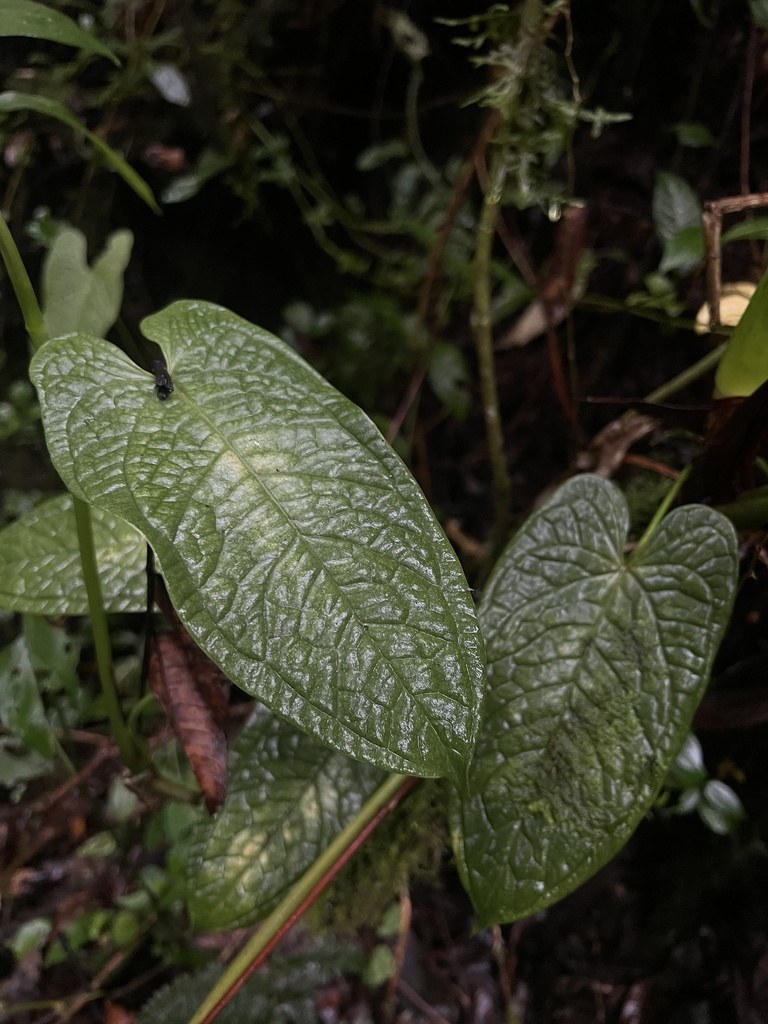
Petiole color is not cosmetic. The deep burgundy-violet of a healthy verrucosum petiole is anthocyanin expression that correlates with appropriate light and, in some populations, is genetically fixed at a higher intensity. A washed-out, greenish petiole on a plant sold as a premium dark-form verrucosum suggests either a different collection locality, a lower-light growing environment, or — sometimes — a hybrid. None of those possibilities are necessarily disqualifying, but a buyer deserves to know which one they are getting.
In the Hoya world, where petiole taxonomy is less systematized but equally real, pigmentation offers clues about whether a splash-pattern Hoya is a stable natural variant or a stress response. Hoya kerrii with dark, almost mahogany petioles under normal conditions is often expressing a different physiological state than one with pale green petioles. In H. latifolia — large-leafed, with substantial petioles relative to the genus — the color shifts from green toward red-purple under higher light exposure, which also tracks with the plant's honest preference for bright conditions that many growers underestimate.
The practical application is simple: photograph the petiole in natural light, not just the blade. A saturated blade shot under a grow light tells you almost nothing about ambient pigmentation. A petiole photographed in diffuse daylight tells you something real about the plant's current state and possibly its genetic identity.
What Hybrids Do to the Signal
Hybrids are where petiole reading gets genuinely difficult, and also where it becomes most important. A first-generation hybrid between two species with strongly differentiated petioles will often — not always, but often — produce an intermediate petiole character that is itself diagnostic of hybrid status. A cross between P. gloriosum and P. melanochrysum, which circulates under various informal names, tends to produce a petiole that is less deeply channeled than a true gloriosum but more flattened than a clean melanochrysum. Neither wing geometry resolves cleanly. The cross-section sits awkwardly between the parents.
This matters because hybrids are increasingly present in the trade, sometimes labeled honestly, sometimes not, and often at prices that assume species-purity. A collector paying for a true P. gloriosum clone of documented Peruvian provenance is buying something different from an unverified plant with a pretty leaf. The petiole cannot prove provenance — only documentation and trusted sourcing can do that — but it can raise enough doubt to make the question worth asking before a bank transfer goes through.
The Anthurium hybrid situation is more acute. The number of undisclosed crosses circulating as named species in the regale, magnificum, and crystallinum complex is significant. Petiole characters in this group — D-section depth, wing presence, surface texture, overall girth relative to blade size — do not resolve species identity with certainty, but a petiole that doesn't match any described feature of the claimed species is a reasonable flag for further scrutiny.
Building the Habit
Petiole literacy is not a talent. It is a practice built from deliberate comparison. The most useful thing a collector can do is grow known-good specimens alongside unknowns and handle them regularly — not just photographing but touching, cross-sectioning cuttings when pruning, noting color under different light conditions. A reference collection of petiole cross-section photographs, even an informal phone album organized by species, becomes genuinely valuable within a year of building it.
Botanical herbarium sheets are underused by hobbyists and freely available through resources like JSTOR Global Plants and the Smithsonian's online collections. A pressed herbarium specimen cannot convey texture, but it does show petiole cross-section notation in the accompanying description, wing geometry in the flattened specimen, and scale. Reading fifteen herbarium sheets for P. gloriosum alongside fifteen for P. crystallinum will train your eye faster than any forum thread.
The petiole will not make every identification. Some species are genuinely difficult; some hybrids obscure even experienced observers; some juveniles are simply too immature to read clearly. But it will catch the easy mistakes — the misidentified crawlers, the undersized imposters, the hybrids passed off as pure — which account for the majority of the misidentification problem in the hobby. That is enough. A tool that catches most errors is a tool worth carrying.
The Ethics of Knowing
There is a version of this skill that is purely transactional — a way to avoid getting burned, to win arguments in comment sections, to feel superior at a plant meet. That version is not particularly interesting. The more useful version is what happens when collectors who can read petioles share what they know with the people they buy from and sell to.
The aroid trade runs on trust and knowledge in roughly equal measure. When a knowledgeable buyer tells a seller, gently and specifically, that the plant's petiole cross-section doesn't match the listed species and asks whether the seller is confident in the ID, two things become possible: the seller learns something, or the buyer learns something. Both outcomes improve the quality of information in the trade. Neither requires certainty, only honest observation.
We are at a point in the hobby where the volume of plant movement has outpaced the average identification skill of the people moving plants. That gap is not moral failure — it is a knowledge deficit, and knowledge deficits are addressable. Reading petioles is one address. It is not glamorous. It requires a razor and good light and the willingness to look at something other than the leaf that made you fall for the plant in the first place. But the petiole was always there, holding that leaf up, carrying the information. You just have to decide to read it.