The plant arrived in a plastic sleeve from a grower in Tarapoto, three leaves and a stub of stem, and for the first eighteen months it told me almost nothing. The leaves came out heart-shaped and matte, a little puckered, the petioles too short for the blades. I had bought it as Philodendron verrucosum, and I half-believed the seller, but there was no velvet yet, no red abaxial, no bristled petiole. The plant was a child. It had no reason to show me what it would become.
Aroids keep their adulthood in reserve. A seedling Monstera deliciosa does not fenestrate. A young Anthurium warocqueanum has none of the lacquered length that makes a mature leaf look forged rather than grown. To read where an aroid sits on its arc — juvenile, intermediate, adult, reproductive — you have to learn the small grammar of cataphylls, internodes, petiole sheaths and leaf shape change. Once you can read it, a shelf of look-alike heart leaves becomes legible, and a lot of mislabeling sorts itself out without an argument.
What a cataphyll actually is
A cataphyll is a modified leaf — usually scale-like, sometimes fleshy, sometimes papery — that protects a developing shoot at the node. In aroids it wraps the emerging leaf like a sheath, then either falls cleanly, persists as a dried brown flag, or rots down to a fibrous skeleton you can pick off with a thumbnail. Cataphylls are not the same as the petiole sheath, though beginners often conflate them. The sheath is part of the petiole itself; the cataphyll is a separate structure that sits at the node and is shed (or kept) according to the species' habit.
Whether the cataphyll is deciduous or persistent is one of the most reliable identification characters in Philodendron. P. gloriosum throws a soft, pinkish cataphyll that dries and abscises cleanly; P. verrucosum keeps a reddish, sometimes hairy cataphyll that browns and lingers at the node like a small flag. P. mamei's cataphylls are sharply two-keeled. If you are trying to decide whether the unrooted cutting you just paid too much for is what the seller said it is, the cataphyll is often more diagnostic than the leaf.
Cataphyll behavior also tells you whether the plant is actively building. A philodendron pushing a fresh cataphyll every three or four weeks is in growth; one that has held the same closed cataphyll for two months is either root-bound, cold, or sulking at a recent move. Watch the cataphyll like you'd watch a pulse.
Aroids keep their adulthood in reserve; the leaves a plant shows you at the nursery are rarely the leaves it is capable of.
Juvenile leaves are not just smaller
The mistake is to assume juvenile foliage is simply a scaled-down version of the adult. It is not. In many aroids the juvenile form is morphologically distinct enough that, were it not for sequence, you would call it a different species. A seedling Monstera deliciosa produces small, entire, heart-shaped leaves pressed flat against whatever it is climbing — the so-called shingling phase, shared with M. dubia and Rhaphidophora cryptantha. Fenestration arrives only when the plant has enough stem caliper and light to justify the architecture.
Syngonium shows the change starkly: arrow-shaped juvenile blades give way to pedately compound adult leaves with five, seven, or nine leaflets, a transformation most houseplant growers never witness because they keep the plant in conditions that arrest it. Anthurium clarinervium's juveniles are nearly round and dull; the mature cordate, silver-veined leaf collectors covet is a later stage. Even Philodendron pedatum, common as it is, will hold simple lobed leaves for years before going fully pinnatifid.
The practical consequence: a leaf is evidence of a phase, not an identity. If you are buying a rare anthurium and the seller's photo shows an unconvincing juvenile, ask for a shot of the mother plant. If they can't produce one, you are paying for a guess.
The intermediate phase, where most collections live
Between juvenile and adult sits a long, awkward intermediate phase that most cultivated aroids never leave. This is not a failure of the plant; it is a failure of conditions. In the wild, a hemiepiphytic philodendron germinates on the forest floor, skototropically crawls toward the darkest trunk it can find, climbs, and only then begins producing adult foliage in the canopy's brighter, more humid air. A plant on a moss pole in a living room is essentially stuck partway up the trunk.
You can see the intermediate stage in the small things. Internodes lengthen but unevenly. Petioles thicken without yet developing the geniculum's full flexion. The leaf blade gains some of its adult shape but lacks the substance — Philodendron melanochrysum at this phase has the elongation but not the blackened velvet, and P. verrucosum shows the bristled petiole but with sparse, short hairs rather than the dense red pelage of a mature climber.
Recognizing the intermediate phase matters because it is where most misidentifications happen. A half-grown P. gigas and a half-grown P. melanochrysum can look uncomfortably similar to a buyer working from a phone screen. The cataphyll, the petiole cross-section, and the new-leaf color (gigas emerges coppery-bronze; melanochrysum, pinkish) will sort them out faster than the blade ever will.
Climbing, totem and the cue to mature
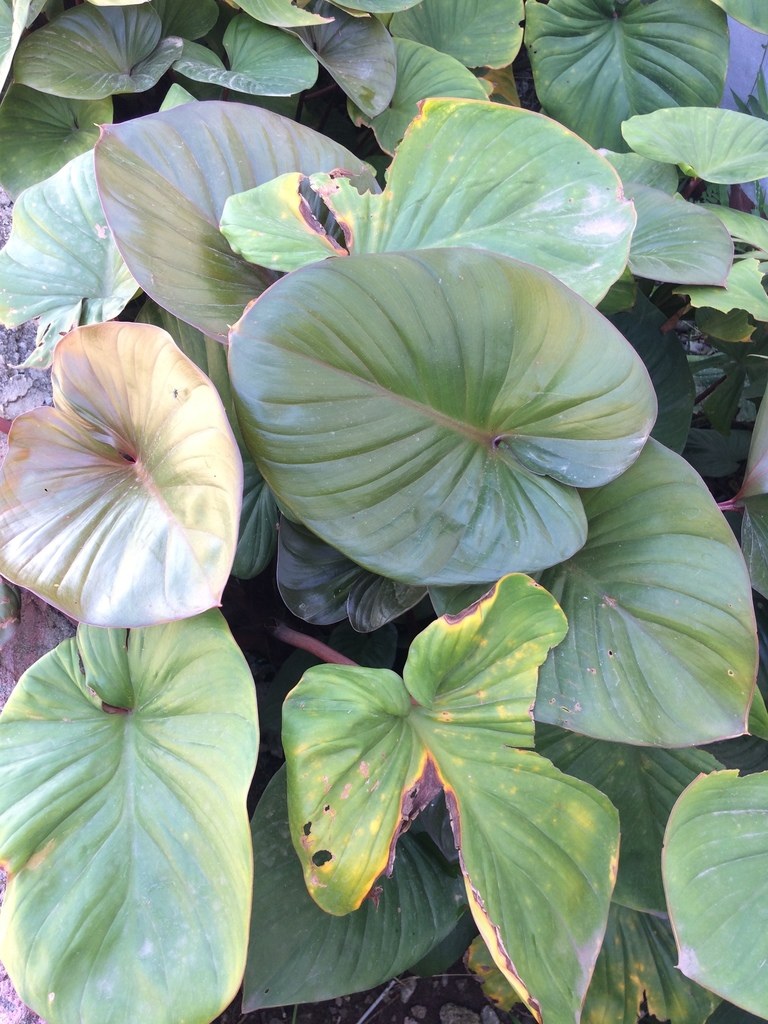
Most hemiepiphytic aroids will not mature without something to climb. This is the single intervention that moves a collection forward more than any fertilizer schedule. A Monstera deliciosa on a slab of tree fern, or a thick moss pole kept genuinely wet — not damp, wet — will start producing fenestrated, then perforated, then split-and-perforated leaves within a season or two. The same plant in a hanging basket will produce heart leaves until it dies of old age.
The mechanism is partly mechanical (the aerial roots find purchase and pull water and nutrients directly into the node) and partly hormonal (contact with a moist vertical surface seems to trigger the shift to adult morphology in many species, though the physiology is still being worked out). What the grower needs to know is operational: give the plant a substrate it can grip, keep that substrate wet, and let the aerial roots actually enter it rather than dangle.
Totem choice matters. Sphagnum-wrapped PVC works but dries fast. Tree fern is excellent and ethically fraught. Cork rounds stuffed with sphagnum are a reasonable compromise. Whatever you use, plan for the plant to outgrow it — a mature P. verrucosum wants a column, not a stake.
Reading the reproductive phase
Maturity, strictly speaking, is reproductive. An aroid is adult when it flowers — when it produces the spathe and spadix that define the family. In cultivation this is rare for many of the species collectors chase, partly because we keep them in arrested intermediate states, and partly because some species simply require canopy-level light and a mass of tissue we never grow them to.
When it does happen, the inflorescence is itself diagnostic. Anthurium spadices vary in color and curvature in ways that separate species the leaves cannot: A. warocqueanum's long, pendant, pale spadix is unmistakable next to the stubbier, darker spadix of A. regale. Philodendron spathes often show internal color — deep maroon in P. melanochrysum, greenish-cream in P. gloriosum — that confirms identity if the foliage left any doubt.
Flowering also changes the plant's energy budget abruptly. A philodendron that has just spent itself on a spathe will often pause leaf production for a month or more. Don't repot, don't push fertilizer, don't move it. Let it recover and it will resume from a more mature node than the one it left off at.
A short field protocol
When a new plant arrives, before you even pot it, look at the node. Count the cataphylls — present, persistent, deciduous, scarred. Note their color, texture, and whether they are keeled. Photograph the petiole in cross-section if you can; D-shaped, terete, grooved, and winged petioles separate a great many otherwise confusable species. Measure the internode at the most recent growth; compare it to the one before. Lengthening internodes under stable light usually mean the plant is climbing toward an adult phase.
Then look at the newest leaf, not the oldest. The youngest fully expanded leaf is the closest thing the plant has given you to a current statement of its capacity. Old leaves are history; they were made under conditions that may no longer apply. If the newest leaf is larger, more deeply colored, and more sculpted than the one before, you are doing something right and the plant is moving forward on its arc.
The patience this requires is the actual hobby. A Philodendron spiritus-sancti from tissue culture may take five years to show you the long, drooping, sickle-shaped adult leaf you bought it for. The cataphylls and the lengthening internodes are the receipts in the meantime — small, dry, easy to overlook, and the only honest record of where the plant actually is.