Somewhere right now, a Philodendron hederaceum is sitting in a plastic nursery pot on a windowsill above a radiator, getting watered once a week whether it needs it or not, surviving in the kind of neglect that would kill most things worth caring about. It has been there so long that the pot has left a ring on the paint. Nobody knows its name. Nobody needs to. It is simply "the philodendron," the one that came in a gift basket, the one whose cuttings fill a dozen water glasses up and down the hall. It is the everyplant — and for exactly that reason, most serious collectors have walked past it for years without a second glance.
That is a mistake worth correcting. Because Philodendron hederaceum is not some poor relation of the genus. It is the same genus — same evolutionary lineage, same peculiar leaf chemistry, same capacity for phenotypic drama — as Philodedendron gloriosum, P. melanochrysum, and the spiritus sancti that trades for the price of a used car. The heartleaf got there first. For most of us, it was the beginning. Going back to look at it clearly is, strangely, a way of understanding why we ended up here.
What the Genus Actually Is
Philodendron is the second-largest genus in the family Araceae, with somewhere north of 450 accepted species depending on which treatment you follow — and considerably more in circulation under names that taxonomists are still sorting out. They span the American tropics from Mexico to Bolivia, from sea-level riverbanks to cloud forest at 2,000 meters. Some are hemiepiphytic: they germinate in the canopy and send roots earthward. Others start at ground level and climb toward light they can't yet see, a behavior called skototropism that still impresses anyone who watches it happen under controlled conditions. The genus has been doing interesting things for a long time.
P. hederaceum occupies the lowland end of that range — humid forest understories in Mexico, Central America, and the Caribbean, at elevations where the air stays warm and the light is genuinely dim. In that context, the plant makes complete sense: broad leaf area to catch scarce photons, fast-growing stems to get above the competition, roots that grip whatever substrate they find. The traits that make it so tractable in a dorm room are the same traits that evolved for a crowded, impoverished forest floor. It did not become easy. It already was.
This matters because collectors sometimes treat ease of care as a sign of diminished worth, as if a plant that forgives neglect is somehow less serious than one that drops leaves the moment humidity drops below 60 percent. The argument collapses under the weight of the genus it belongs to. Hederaceum and gloriosum share not just a genus name but a real evolutionary history, a common toolkit of alkaloids, extrafloral nectaries, and spathe-and-spadix reproductive biology. The family resemblance is not superficial.
Every collector has a creation myth. For most of us, it involves a heartleaf cutting in a glass of tap water on a kitchen counter.
The Velvet Question
Here is something worth pausing on: Philodendron hederaceum has a velvet form. Not a cultivar exactly — more a population variant, found in cultivation under the informal descriptor 'velvet leaf,' with noticeably pubescent leaf surfaces that catch light the way melanochrysum does. Most people who own one have no idea it's considered anything other than the standard heartleaf. They bought it at a hardware store for four dollars.
The collectors who obsess over velvet — the people who pay serious money for P. melanochrysum, who hunt down a true P. gloriosum with clean white venation and the right leaf shape, who argue in comment sections about whether a given P. sodiroi is actually on its own roots — those same people often have a heartleaf in the corner of their grow room because it roots quickly and makes a good nurse plant for cuttings laid against its stems. They're using the most accessible member of the genus as infrastructure. There is something almost poetic about that, or at least something instructive.
Velvet in philodendrons comes from trichomes — tiny epidermal hairs that scatter light across the leaf surface and give it that characteristic matte depth. The trait appears independently across the genus in species that are not closely related, which suggests it confers real adaptive advantage, probably in high-humidity, low-light environments where the extra surface texture may aid in water vapor absorption or simply reduce reflectance. Hederaceum's velvet form carries the same structures. Look at one under a loupe sometime. It is not a different category of plant from the ones on the grail lists. It is the same category at a different price point.
The Creation Myth
Every collector has a creation myth. For most of us, it involves a heartleaf cutting in a glass of tap water on a kitchen counter. A node below the waterline, a white root tip appearing after a week, the slightly too-eager transplant into potting mix that should have waited another ten days. The cutting lived. Of course it lived. Hederaceum cuttings live through interventions that would be fatal to most other things — wrong pH, insufficient light, substrate that stays wet for two weeks. The plant's tolerance is the reason it works as a first teacher.
What it teaches, if you pay attention, is the core mechanic of the family: the node is the unit of the plant. Roots come from nodes. New growth comes from nodes. A cutting without a node is a piece of leaf with ambitions and no future. Once you understand that, you understand every aroid cutting you will ever take. The heartleaf demonstrates it clearly because everything happens fast and visibly. The same logic applies to the P. verrucosum slip you paid forty dollars for, except the verrucosum makes you wait longer and punishes your mistakes more thoroughly.
The shift from heartleaf to serious collecting is usually a species encounter — the moment you see a gloriosum in person and understand that the leaf is not just big but structured, that the white venation is raised and the surface is matte and the whole thing looks less like a houseplant than like something that evolved to be looked at. Or a melanochrysum coming in as a new leaf, that particular bronze-green of the unfurling cataphyll, the velvet surface not yet fully expanded. Something clicks. But the grammar was already there, learned from the plant on the windowsill.
Phenotypic Range and Why It Should Embarrass Us
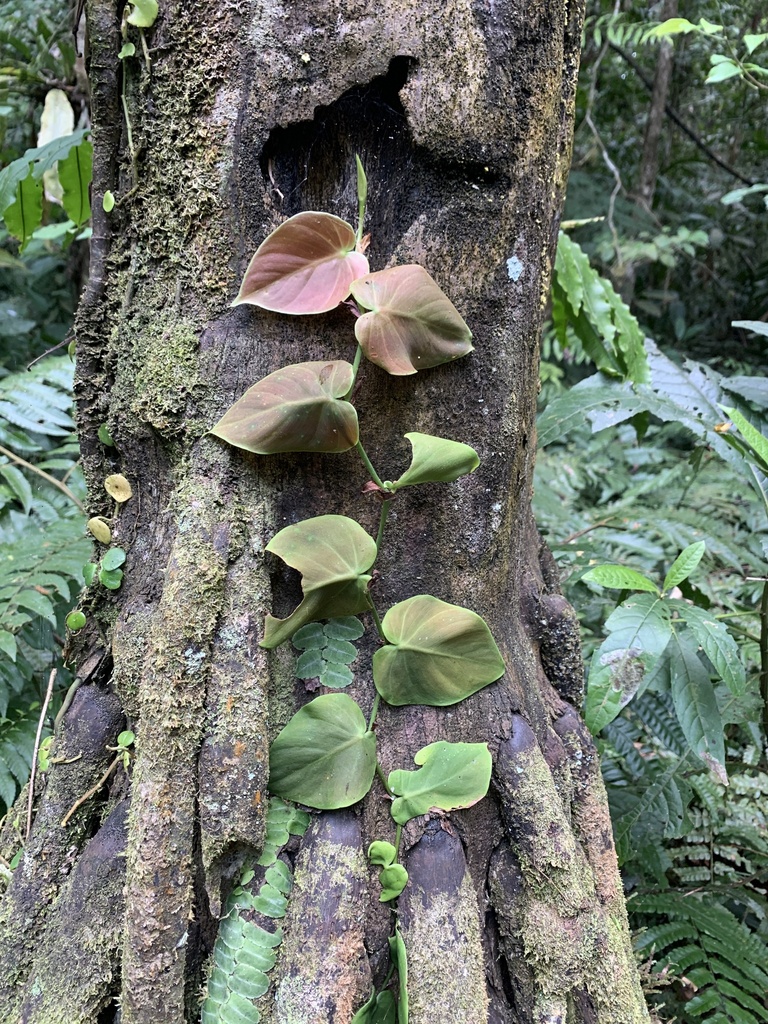
Philodendron hederaceum produces phenotypic variation that most collectors have never examined closely enough. Standard heartleaf leaves run heart-shaped, 8–15 cm at maturity in typical indoor conditions. Climb the same plant up a 60 cm moss pole, keep humidity above 65 percent, and apply a dilute balanced fertilizer through the growing season, and you'll get leaves pushing 25 cm with a texture shift visible to the naked eye. This is not a different plant. This is what the plant actually looks like when it isn't being ignored.
There are named selections in circulation — 'Brasil,' with its irregular yellow-green variegation running along the midrib; 'Micans,' now understood by many growers to be the velvet-leaf population formalized into a trade name; 'Lemon Lime,' which runs a chartreuse that sits somewhere between P. golden goddess and a highlighter pen. These are not novelties. They demonstrate the species' range, the same plasticity that makes the broader genus so endlessly varied. A collector who has only seen 'Brasil' as a grocery-store impulse purchase and never grown it properly has seen maybe half of what the plant can show them.
There is a broader point here about how we look at common plants. Familiarity is not the same as knowledge. A species that has been in cultivation long enough to become cheap and ubiquitous has also been observed long enough that its behavior is well-documented, its tolerances understood, its morphological range mapped. That is useful information. The rarest plants in the hobby come with far less of it.
Rarity, Price, and What We're Actually Chasing
The economy of rare aroids is not entirely rational, and most serious collectors know this. A P. spiritus-sancti — the ghost philodendron, endemic to a single river valley in Espírito Santo, Brazil, critically endangered in the wild — commands prices in the thousands not purely because it is beautiful, though its narrow, pendulous leaves are genuinely striking, but because it is scarce in cultivation and carries the weight of its own near-extinction. The price is partly aesthetic and partly a kind of grief made transactional.
Hederaceum has no such story. It is not endangered. It grows in ten countries. It is available at every garden center in the continental United States from March through October. Its price reflects its availability, and there is nothing wrong with that. But availability has nothing to do with the plant's intrinsic interest, its evolutionary complexity, or its relationship to the rest of the genus. We have simply decided as a hobby that scarcity equals significance, and while that decision is economically comprehensible, it is also a little bit arbitrary.
None of this is an argument against chasing rare species — the hunt is genuinely part of what makes this hobby interesting, and rare plants from threatened habitats deserve cultivation attention for reasons beyond aesthetics. It is an argument for looking at the common plant clearly. The heartleaf will outlive most of the grails in most of our collections, not because it's better but because it is suited to the conditions most of us can actually provide. That is worth something.
Care Done Seriously
Grown properly, P. hederaceum is not the same plant as the one in the dorm room. Seriously grown means: a chunky substrate with real drainage — perlite and orchid bark at a minimum, something that won't stay wet for more than four or five days after a thorough soak. It means a support, because the plant is a climber and the leaves respond to vertical growth by sizing up. It means humidity above 60 percent if you want the velvet-leaf population to show its surface texture fully, and it means fertilizer through the growing season — a balanced NPK at half the label rate, consistently, rather than occasional heavy doses.
What it does not require is the anxiety infrastructure of a verrucosum: no heating mat, no grow tent, no hourly humidity checks. The species' genuine tolerance means you can push conditions toward better without worrying that a single missed watering will cost you a node. That makes it an excellent plant for practicing technique — learning what airy substrate actually feels like versus compacted potting mix, learning what healthy root structure looks like when you unpot, learning what the early signs of root rot smell like before they become catastrophic. The heartleaf is a low-stakes laboratory for skills you will use on high-stakes plants.
There is also the matter of propagation. Hederaceum roots from a single-node stem cutting in plain water in under two weeks under warm conditions. That speed makes it useful for understanding the mechanics of aroid propagation without the cost of failure. Take fifty cuttings. Experiment with rooting hormone versus none, water versus sphagnum, light versus dark placement. By the time you apply those lessons to something you paid real money for, they will be second nature.
Coming Back to the Beginning
The experienced collector who goes back to the heartleaf with fresh eyes tends to notice things they missed the first time. The way a new leaf unfurls from a cataphyll — that papery sheath that splits and peels back to reveal the fully formed leaf, rolled inside like a letter — is the same process in every philodendron, played out here in a few days rather than the anxious weeks a gloriosum makes you wait. The extrafloral nectaries on the petioles, secreting a clear, slightly sticky liquid that attracts ants in the wild and baffles indoor growers, are the same structures present on species that cost a hundred times more. The smell of a fresh spathe on a mature indoor specimen — a faint, slightly musky sweetness — is a version of what the whole genus smells like when it reproduces.
None of that makes hederaceum a substitute for the plants that deserve the reverence they get. A gloriosum is not replaceable by a heartleaf any more than a common house sparrow stands in for a bird-of-paradise. But the sparrow can teach you what flight looks like, what feathers do, what a bird is — before you ever see the rare one. The heartleaf did that for most of us, whether we knew we were learning or not.
If you have one collecting dust somewhere, give it a moss pole and a better pot and six months of actual attention. See what it becomes. It will not become a melanochrysum. It will become something more interesting than you expected — which is, in the end, what the whole genus keeps doing, one leaf at a time.