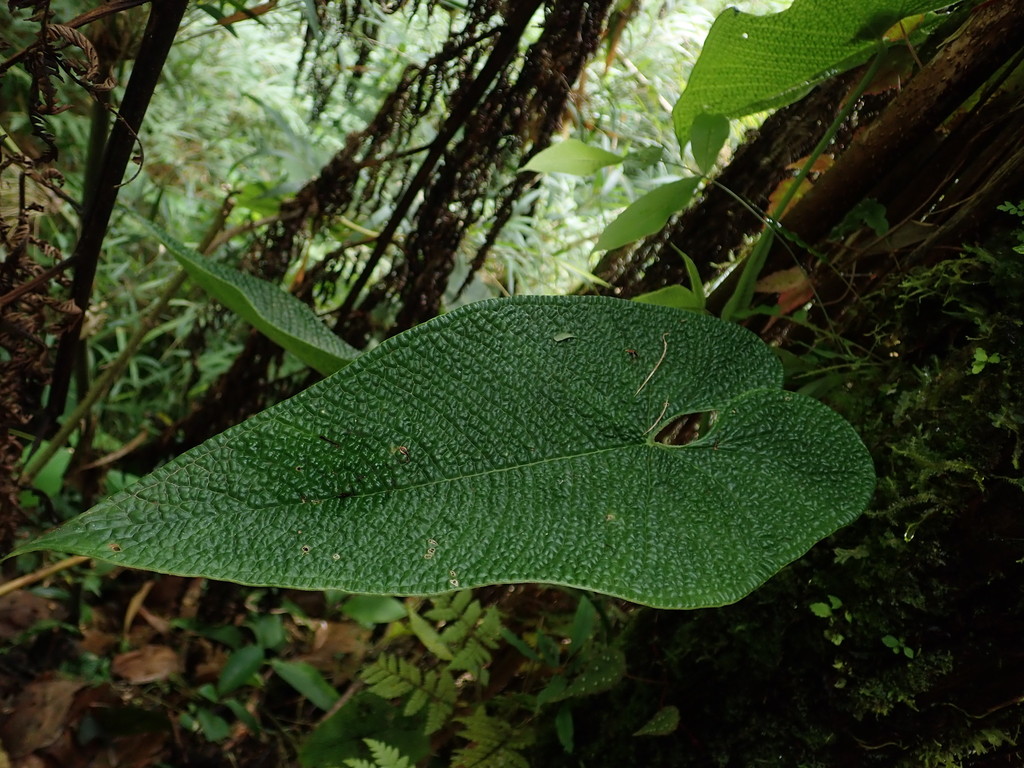
Hold a mature leaf of Anthurium papillilaminum up to a raking sidelight and the surface stops being a leaf. It becomes topography. The puckering between each lateral vein pulls the blade into a series of raised panels, each one slightly convex, so that the light catches and drops away across the whole plane in a slow oscillation of shadow. You are looking at a few hundred square centimeters of plant material, and it reads like aerial photography of a plowed field.
This quality — called bullation, from the Latin bulla, a bubble or stud — is not unique to anthuriums. Savoy cabbage has it. So do some hoyas and certain Philodendron gloriosum forms. But no genus has weaponized it quite the way Anthurium has, and nowhere on earth has evolution pressed it further than in the cloud forests of Ecuador and the adjacent Colombian Andes, where a cluster of velvet-leaved, deeply quilted species grows in conditions that most collectors spend years trying to simulate.
What Bullation Actually Is
Bullation is a structural consequence of uneven growth rates between a leaf's upper and lower epidermis. The tissue between veins expands faster than the veins themselves, and the blade has nowhere to go but up. The result is that the interveinal zones dome outward, constrained on all sides by the vascular framework, creating those characteristic cushioned panels. The denser and more regular the venation, the finer and more pronounced the quilting — which is why species with close-set secondary veins tend to look more dramatically textured than those with widely spaced ones.
In anthuriums, the effect is amplified by a second variable: the thickness and density of the lamina itself. A thin, papery leaf can buckle slightly and still stay relatively flat. A thick, heavily succulent blade — the kind that feels almost rubbery between the fingers — holds its domed panels rigidly, so each one maintains its convex curve all the way to the vein margins. Anthurium papillilaminum, collected from the Esmeraldas and Pichincha provinces of Ecuador, is the standard reference for this combination. The leaf is so thick you can press a fingernail into it and feel genuine resistance, and the bullation is so pronounced that the surface casts its own micro-shadows in diffuse midday light.
The velvet texture that accompanies bullation in many of these species is a separate but related phenomenon — the result of trichomes, tiny epidermal hairs that scatter incident light and produce the soft, matte finish collectors describe as velvety. In A. papillilaminum, both traits occur together, which is partly why the species photographs so well: the velvet kills specular reflection while the bullation sculpts the diffuse light into genuine three-dimensional contrast.
The puckering between each lateral vein pulls the blade into raised panels — light catches and drops away like aerial photography of a plowed field.
The Ecuadorian Cloud Forest as a Design Brief
Esmeraldas province in northwestern Ecuador runs from sea level up through premontane forest into proper cloud forest, and somewhere in that vertical gradient, roughly between 500 and 1,500 meters, lies the range where most of the dramatically bullate Anthurium species do their growing. The conditions there are specific: temperatures that rarely swing more than eight or ten degrees Celsius across a full day, humidity that seldom drops below 80 percent, and a diffuse light regime created by persistent cloud cover and dense canopy. Plants growing there never experience the kind of evaporative stress that would force them to build stomatal defenses the way a lowland species might.
What they experience instead is consistent moisture, consistent warmth, and a light quality that is bright but almost never direct. The thick, bullate lamina may be an adaptation to exactly this regime — a way to maximize light-capture surface area in a low-flux environment without the energetic cost of producing a larger, flatter blade. The domed panels effectively increase the surface area exposed to whatever angle the light arrives from, and the velvet trichomes may scatter that diffuse light more efficiently across the mesophyll. Whether or not that precise adaptive story holds up to rigorous scrutiny, the plants behave as though it does: move them into direct sun and the velvet burns to bronze. Give them deep shade and the panels flatten and lose definition. They are calibrated for the middle of a cloud forest, and they tell you so.
This specificity is what makes the Ecuadorian bullate anthuriums so interesting to grow and so reliably difficult to fake. You can give a Monstera deliciosa a warm room and a weekly water and it will live for decades. You cannot do that with A. papillilaminum or A. crystallinum × papillilaminum hybrids and expect them to maintain their texture. The bullation is a live readout of whether the conditions are correct.
Anthurium papillilaminum and Its Closest Rivals
Among collectors who focus on bullate anthuriums, the conversation usually starts with A. papillilaminum and then moves quickly to A. forgetii, A. magnificum, and the various interspecific hybrids that have proliferated as tissue culture and private collection work have produced more plants than the hobby has previously seen. Each species sits at a slightly different point on the texture spectrum.
Anthurium forgetii lacks the sinus — the gap between the two basal lobes — that most anthuriums have, giving it a perfectly ovate outline, and its venation is fine enough that the bullation reads more like hammered metal than plowed earth. A. magnificum, which comes from slightly higher elevations in Colombia rather than Ecuador, has broader, more widely spaced secondary veins, so the bullate panels are larger and less numerous, with a coarser, more architectural feel. A. papillilaminum sits between them: finer than magnificum, heavier and more deeply puckered than most forgetii forms.
The hybrids complicate everything, which is partly the point. A papillilaminum × magnificum cross can produce leaves that combine the close venation of the former with the sheer blade size of the latter — panels that are simultaneously fine and large, which is a combination neither parent achieves alone. Some of the most aggressively bullate plants in circulation right now are F2 or backcross selections from exactly this parentage, though provenance documentation is inconsistent enough that collectors should be skeptical of specific lineage claims from vendors who cannot provide records.
Why These Leaves Photograph Like Nothing Else
The reason bullate anthuriums have become a disproportionate presence in collector photography on social media — despite being harder to grow than most popular species — comes down to simple optics. A flat, glossy leaf is a specular reflector. It returns light from one angle efficiently and from every other angle poorly, which means photographers spend a lot of time fighting reflections or waiting for narrow windows when the geometry works. A bullate velvet leaf is the opposite. The trichomes scatter light diffusely across the surface while the three-dimensional structure of the panels creates its own internal contrast at every angle.
In practical terms, this means you can photograph A. papillilaminum with a single window and get a result that looks lit from three directions simultaneously. The raised panels catch the light. The sunken valleys between them hold shadow. The velvet gives the highlight zones a soft, non-specular quality that reads as depth rather than shine. Every leaf becomes its own lighting problem that the plant has already solved.
There is also the question of scale ambiguity. A mature papillilaminum leaf can reach 40 to 50 centimeters on a well-grown specimen, but the texture is so complex that photographs of it rarely read as macro shots of foliage. The image looks like a landscape — or a fabric, or a geological cross-section — until something in the frame provides scale. Collectors have exploited this deliberately, shooting leaves without context to create images that are genuinely ambiguous about what they're depicting. It is a minor art form, and the bullate leaf is its primary medium.
Growing Conditions That Preserve the Texture
The bullation on these plants is not fixed at the moment a leaf unfurls. It develops over the first few weeks of the leaf's maturity, and it can be suppressed or enhanced by conditions during that period. Growers who push for maximum texture consistently report the same variables: high humidity during leaf development (above 80 percent is the target, with 85–90 percent being better), diffuse bright light, and a substrate that retains moisture without staying waterlogged — typically a chunky mix of fine orchid bark, perlite, and a small proportion of coco coir or sphagnum.
Temperature consistency matters more than the absolute number. These plants tolerate a range of roughly 18–28°C without complaint, but rapid swings — the kind that happen when a heating system cycles on and off aggressively in winter — seem to produce leaves that develop their bullation unevenly, with some panels flattening out and others remaining raised in a way that looks like damage rather than texture. A grow tent or dedicated cabinet with a stable environment is not an affectation for these species; it is the difference between a leaf that looks like the plant photographs in herbarium records and one that looks like a stressed houseplant.
Airflow is the variable most often underweighted. High humidity without movement produces fungal pressure and wet-foot problems, and wet-foot stress suppresses bullation dramatically. A small circulation fan keeping air moving continuously does more for texture quality than most collectors expect the first time they try it.
The Ethics of Collecting These Plants
Most of the A. papillilaminum in collector hands today is tissue culture material from Ecuadorian nurseries or private propagators working from nursery stock, and the species is not currently listed under CITES Appendix I or II — though Anthurium as a genus has enough wild-collection pressure in some regions that the conversation about regulation is ongoing. Buying tissue-cultured or nursery-propagated plants rather than seeking out wild-collected material is the default responsible position, and most reputable vendors in the current market are transparent about propagation source if asked directly.
The harder question is about hybrid production and the documentation of parentage. The bullate anthurium market has produced a number of named hybrid lines and trademarked cultivar names over the past five years, some well-documented and some not, and the collector community has not developed consistent standards for what level of evidence is required before a cross should be named and sold. Buying an unlabeled or vaguely labeled 'crystallinum hybrid' from a show table and growing it out is fine. Paying a premium for a specific hybrid lineage without provenance documentation is a different transaction, and the burden of skepticism is on the buyer.
What the Surface Keeps Telling You
There is a reason experienced growers check the new leaves on their bullate anthuriums before anything else when they walk into the grow space in the morning. The texture is responsive. A leaf developing with tight, even bullation in a regular grid pattern is a leaf that has had what it needs. A leaf with uneven puckering, flattened zones, or panels that stayed partially suppressed is a leaf that experienced some stress — a humidity drop, a temperature swing, a few days of inadequate light — during the critical period after it unfurled. The plant is providing a continuous record of its own conditions, written in the surface of each successive leaf.
This is part of what makes growing A. papillilaminum and its relatives genuinely absorbing rather than simply ornamental. You are not just keeping a plant alive. You are trying to reproduce, in a spare room in whatever climate you happen to live in, the precise atmospheric conditions of a cloud forest at 900 meters in Esmeraldas. The leaf tells you how close you got.
Every new unfurling is a small score, and the texture is the marking rubric. Get the conditions right, and the surface of a mature leaf will stop being a leaf again and become that landscape — the puckered panels catching light, the velvet killing the reflection, the whole thing sitting in your grow cabinet looking like it belongs somewhere with a canopy above it and mist rolling in at four in the afternoon. That is the whole point.