The Anthurium forgetii in the back corner of my grow tent put out its last leaf in March. It is now October. The petiole of the next leaf has been visible for six weeks — a pale green nub thickening at a rate that would embarrass a glacier. In the same tent, a Philodendron gloriosum has unfurled four leaves in the same window, each one the size of a dinner plate. Both plants are healthy. Both are getting roughly the same care. One is simply built differently.
Feeding the fast ones is easy: more light, more water, more nitrogen, stand back. Feeding the slow ones is the actual craft. A plant that produces two leaves a year cannot metabolize what a Monstera deliciosa inhales in a week, and the fertilizer regimen that keeps a Thaumatophyllum glossy will, applied to a dressleri, slowly cook its roots in the dark. This is a strategy for the second kind of plant — the ones that punish enthusiasm.
What "slow" actually means
Slow growth in aroids is not laziness or stress, though both can mimic it. Species like Anthurium forgetii, A. dressleri, A. luxurians, the velvet-leaved Philodendron melanochrysum in juvenile form, and most of the high-elevation Ecuadorian anthuriums evolved in environments where the limiting factor was never nutrition. It was light filtered through forty meters of canopy, temperatures that rarely cracked 75°F, and a constant, gentle hydration from cloud and leaf litter. Their metabolism is calibrated to that idle.
Fast aroids — deliciosa, gloriosum, most Thaumatophyllum, the common hybrids — come from edge habitats, gaps, disturbed forest. They are opportunists. Hand them light and food and they will spend it. The slow species cannot spend it, and the excess has to go somewhere. Usually it goes into the substrate as salt accumulation, or into the root system as low-grade chemical burn, or into pathogenic fungi that were waiting for exactly this kind of buffet.
The first principle, then: feed the plant you actually have, not the idea of growth you want. A forgetii that produces two leaves a year on a clean regimen is not underfed. It is on schedule.
A slow plant is not a hungry plant on strike. It is a different machine, with a smaller fuel tank and a longer combustion cycle.
The dilution math nobody wants to do
Most synthetic fertilizers are formulated for production growers pushing turnover. The label rate on a bottle of 20-20-20 or a balanced urea-free product like Dyna-Gro Foliage Pro assumes the plant is actively transpiring, actively photosynthesizing, and actively consuming. The standard recommendation of one teaspoon per gallon, weekly, is calibrated for greenhouse conditions and fast crops.
For a slow collector species, I run somewhere between 1/8 and 1/4 of that rate. Roughly 50 to 100 ppm nitrogen, measured with a cheap TDS meter once you've calibrated against your tap water's baseline. That's it. Apply it with every watering rather than pulsing strong doses, which is the part most people get wrong. A slow plant cannot use a pulse. It can use a trickle.
The math gets more humbling when you factor in that a plant putting out one leaf every three months is photosynthesizing at a fraction of the rate of its faster cousins. The nitrogen demand is genuinely low. The micronutrient demand — calcium, magnesium, the trace metals — is proportionally higher than the macronutrient demand, because structural tissue still needs to form correctly even when it forms slowly. This is why velvet anthuriums on pure synthetic NPK often develop pale, papery leaves: plenty of fuel, not enough scaffolding.
Why the substrate matters more than the bottle
A chunky aroid mix — bark, perlite, pumice, a little sphagnum, maybe charcoal — holds almost no nutrition on its own. This is the right substrate for these plants because their roots evolved to scramble across mossy branches and leaf litter, not to sit in peat. But it means every milligram of nutrition you want available has to be applied, because the medium will not buffer for you.
I lean on three slow inputs to do the buffering instead. A light topdress of worm castings, refreshed every four to six months. A pinch of Osmocote Plus (the one with micronutrients) worked into the top inch, at maybe a quarter of the label rate — twenty or thirty prills for a six-inch pot, not a tablespoon. And a monthly soak with a dilute kelp or fish hydrolysate, something like a 1:500 dilution of Neptune's Harvest, which provides amino acids and trace elements the synthetics skip.
The point of this stack is redundancy at low concentration. If any single input fails — the castings go anaerobic, the Osmocote dumps after a hot week, the kelp burns — the others are still feeding at a survivable level. A luxurians does not forgive a single bad week the way a pothos does.
Reading the leaf, not the calendar
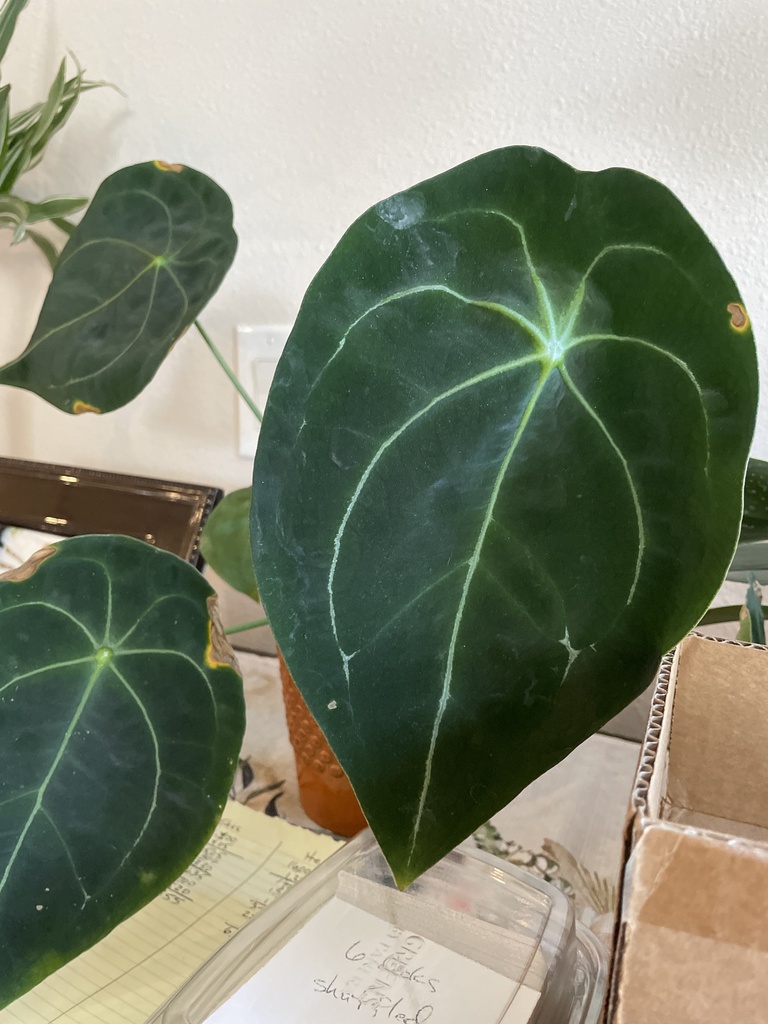
The most useful diagnostic tool for a slow grower is the leaf that just hardened off. Compare it to the one before. Is it larger? Smaller? Is the venation as deep, the velvet as dense, the petiole as thick? The plant tells you, in increments of months, whether your regimen is working.
Pale new growth with green veins on a velvet anthurium usually means iron or manganese deficiency, often caused by pH drift in the substrate — common when you're watering with hard tap water and the bark is breaking down. A new leaf that emerges smaller than the previous one, with everything else equal, suggests root damage, often from accumulated salts. Run a flush: plain water, three times the pot volume, slowly, and let it drain completely. Then go back to your dilute feed.
Brown crispy margins on a dressleri or papillilaminum are almost never "low humidity" in a properly enclosed setup. They are fertilizer burn or salt edge, and the fix is less food and more flushing, not more misting. The leaf you damage today is the leaf you'll be staring at for the next eight months.
Seasonality, even indoors
Under grow lights at a fixed photoperiod, it's tempting to assume the plant has no seasons. It does. Even in a sealed cabinet at constant 72°F and 80% humidity, slow aroids respond to changes in barometric pressure, to the marginal shifts in day length that leak through windows, and to whatever internal clock the species evolved with. Most of the velvet anthuriums I grow slow down noticeably from November through February regardless of what the lights are doing.
I cut fertilizer roughly in half during those months and stretch the interval between waterings by a day or two. Not because the plant is dormant — true dormancy is rare in tropical aroids — but because consumption drops and unused nutrients become liability. In March, when the spears start moving again, the regimen ramps back up over four to six weeks.
The collectors who lose plants in winter almost never lose them to cold. They lose them to the same summer feeding schedule applied to a plant that has quietly stopped eating.
The case for boredom
The hardest part of feeding slow plants is psychological. You will read about someone in Florida whose forgetii is throwing a leaf every five weeks under shade cloth and rainwater, and you will want to do something. Add an amendment. Switch fertilizers. Move it to better light. Repot into fresh mix because surely the old mix is the problem.
Don't. The single biggest predictor of long-term success with slow collector species is a boring, consistent regimen held for years. The growers I know with mature dressleri and decade-old warocqueanum specimens are not doing anything exotic. They are doing the same dilute feed, the same flush, the same substrate refresh, every month, for as long as they've owned the plant. The plant rewards the patience by, very slowly, becoming the plant you wanted.
Two leaves a year, held for ten years, is twenty leaves — and the twentieth leaf on a well-fed forgetii is something close to a religious object. Feed for that leaf. Not for the next one.