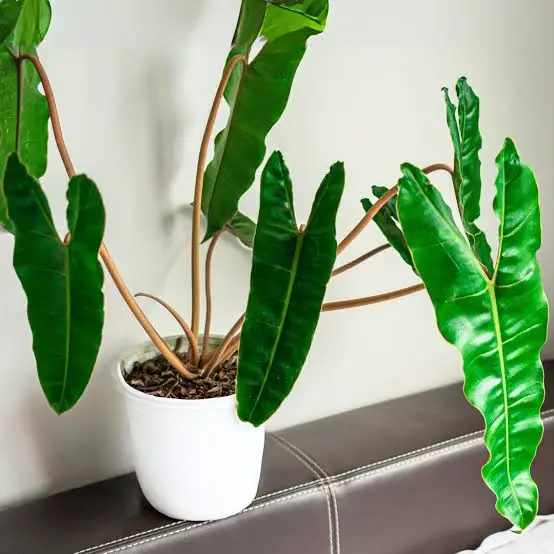
The first time you see a mature Philodendron billietiae in good light, the petioles stop you. Not the leaves — though a fully extended blade, ribbed and strap-shaped, can run past a meter on a well-fed plant — but the stems. They are orange in the way that ripe persimmons are orange: saturated, warm, slightly unreal against any shade of green. The color isn't a trick of the grow light. It's there in the wild, threading through the understory of the Guiana Shield, and it's there in your grow tent, and it does not fade when the plant is happy.
Philodendron billietiae was formally described by Croat, Grayum, and Hammel in 1997, collected from specimens found in French Guiana, Guyana, and Venezuela — the ancient, Precambrian plateau region that botanists and geologists both treat as exceptional ground. The Shield is old in a way that most landscapes aren't, and the plant communities it supports have been evolving in comparative isolation for long enough that what grows there often looks like nothing nearby. Billietiae is named for Frieda Billiet, a Belgian botanist. It is a hemiepiphyte — it climbs, roots along the way, and in good conditions never really stops.
What the Shield Made
The Guiana Shield is not a rainforest in the Amazonian sense. Parts of it are wet, humid, and canopied, but it also includes tepui highlands, white-sand savannas, and gallery forests along rivers that drain a geology unlike anything to the south. What survives there tends to be adapted to both intensity and variability — intense rainfall, intense drought, intense light at canopy breaks. Philodendron billietiae grows in the forested, lower-elevation sections, usually on the trunks of larger trees, climbing toward light with the patient ambition of a plant that has centuries to work with.
The strap leaf is a feature shared with a handful of other Philodendron sections — P. maximum, P. stenolobum, and several undescribed species have similar blade geometry — but billietiae's combination of the elongated, entire leaf with that petiole color puts it in a category of one. Collectors who grow the broader Araceae family sometimes describe it as the species they'd keep if forced to choose a single strap-leaf: functional enough to be satisfying, distinctive enough to never become invisible on the shelf.
In habitat, the plant produces leaves sequentially, each one sizing up as the stem climbs and the root system expands. Grown without a totem or support, it sprawls and sulks; given something to root into — tree fern fiber, moss pole, cork bark — it responds with increasing leaf size over successive flushes. This is not metaphor. A cutting that produces 30 cm blades on the bench will push 60 cm blades after six months on a moss post, and a specimen that has been on a tall cork column for two years may exceed that again. The plant is tracking its own vertical progress.
The petioles are orange in the way ripe persimmons are orange: saturated, warm, slightly unreal against any shade of green.
The Flush Rhythm and What Drives It
Billietiae is not a constant grower. In stable conditions — 70–80% humidity, temperatures between 18°C and 28°C, consistent watering — it tends to push flushes in clusters: two or three leaves in quick succession, then a pause of several weeks, then another run. Collectors who grow it under high-intensity supplemental light (typically a 30–50 µmol/m²/s PAR range at the leaf surface, not direct beam) report more frequent flushing than those growing in ambient bright indirect conditions, but the clustered rhythm persists regardless. It seems to be internal, not purely reactive.
The new leaf emerges from the cataphyll tightly rolled, lime-green and almost translucent, and hardens over roughly ten to fourteen days depending on humidity and temperature. The petiole color develops as the leaf expands — juvenile petioles are greenish-orange, brightening to the full persimmon tone as the tissue matures. A new flush on a large specimen is worth watching: the emerging blade, backlit by a grow light, has a quality that's hard to find in any other Philodendron except perhaps a large P. gloriosum unfurling flat on the soil.
Understanding the pause between flushes matters for troubleshooting. Growers who interpret the resting phase as a sign of root rot or nutrient deficiency often overcorrect — more fertilizer, more water — and create the actual problem they feared. Billietiae's substrate should be chunky enough to drain fast: a base of perlite and orchid bark in roughly equal parts, with some coco coir for moisture retention, works well. The roots are thick and light-colored; dark, mushy roots indicate anaerobic conditions, not a fertilizer deficit. When in doubt, let the pot dry down 60–70% between waterings and trust the rhythm.
Cultivation Mechanics
Given that billietiae wants to climb, the choice of support structure matters more than most growers expect. A thin bamboo cane or a narrow sphagnum pole will not satisfy a mature plant; the aerial roots it produces are substantial, and they want to penetrate and grip. Cork bark rounds — the kind sold for reptile enclosures, 15–20 cm in diameter — work exceptionally well. The roots colonize the fissures readily, and cork doesn't break down quickly. Moss poles work too, provided they're kept consistently moist so aerial roots actually make contact.
Fertilization should be consistent rather than aggressive. A balanced fertilizer (something near a 3-1-2 NPK ratio) applied at half the label rate with every other watering during the growing period keeps the plant moving without pushing soft, vulnerable new tissue. Some growers run a higher-nitrogen formula during spring and summer, switching to a bloom-emphasis formulation in autumn to harden tissue before any cool-season slowdown. Both approaches work; the failure mode is sporadic, infrequent fertilization followed by a heavy application, which can spike salts in a fast-draining substrate and tip-burn the leaves.
Humidity below 55% for extended periods produces narrow, slightly cupped leaves with crisp edges. The plant won't die, but the blade geometry suffers. Above 65%, with good airflow, it grows as it's meant to — full-width blades with clean margins and that orange stem color at its most saturated. An oscillating fan running on a low setting is not optional in a sealed grow space; stagnant high humidity is how you get fungal issues on a plant that otherwise has few common pest problems except the usual thrips and mealybugs that find their way into any collection.
The Variegated Form Arrives
Sometime in the mid-2010s, a variegated Philodendron billietiae appeared in Southeast Asian trade — Thailand initially, then Indonesia, then with inevitable speed into the broader international collector market. The variegation is sectoral and unstable, producing leaves with cream to pale yellow blotching that ranges from half-moon patterns to heavy marbling to nearly full-leaf whitout on a bad run. The orange petiole is retained. When the variegation expression is good — a balanced half-moon against a deep green blade — the plant is genuinely arresting.
The price it reached at peak market, roughly 2021 to early 2022, was not reasonable by any prior standard for an aroid that wasn't tissue-cultured into mass production. Single nodes with documented variegation history sold in the range of several hundred to well over a thousand US dollars at auction, with particularly striking full-plant specimens reaching multiples of that. It was not the most expensive aroid of that period — Monstera obliqua fenestrated forms and certain Anthurium crystallinum hybrids were trading higher — but billietiae variegata reached prices that surprised even experienced collectors who had watched the market inflate through 2020.
What drove the spike was partly the combination: the existing desirability of the species, the rarity of confirmed stable cuttings, and the moment — a period when home gardening demand had spiked globally and social media virality could move a plant's value faster than supply could respond. The correction came, as it always does. Variegated billietiae is still not cheap, but nodes that traded at four figures now move at a fraction of that. The lesson the market keeps teaching, and collectors keep relearning, is that unstable variegation in an aroid that isn't yet tissue-culture-accessible will always be subject to sudden repricing when enough cuttings circulate.
Variegation: Stability, Reversions, and What to Look For
The instability of billietiae variegata is real and worth taking seriously before a purchase. The variegation appears to be chimeral — meaning it arises from a genetic sector in the meristematic tissue rather than from a cell-wide mutation — which makes it prone to producing fully green growth (reversion) under stress or even at random. A plant that has been producing beautiful half-moons can push a completely green leaf with no warning, and subsequent leaves may or may not return to pattern.
Growers who have managed the variegated form successfully report that stability improves with consistent, non-stressful conditions: no dramatic temperature swings, no extended dry periods, no aggressive root disturbance. Stressors seem to push the meristem toward producing the more genetically stable green tissue. This isn't guaranteed — chimeral plants do what they do — but it's consistent enough to be useful guidance.
When evaluating a cutting, look for one where the variegation appears in the petiole tissue as well as the blade; petiole-level variegation often (not always) correlates with more consistent expression in subsequent leaves. A heavily white leaf without any green photosynthetic tissue is a liability: it looks dramatic in a photo but will be slow, fragile, and possibly unable to sustain itself if the following leaf is also heavily white. A collector prioritizing long-term growth over short-term aesthetics should favor balanced marbling over the full whiteout that photographs well but struggles.
Where It Fits in a Collection
Philodendron billietiae occupies a specific niche: it's large, it climbs, it needs vertical space, and it rewards patience over the course of years rather than months. It is not a plant for someone optimizing for a dense, low-shelf collection of dozens of small specimens. A single mature plant on a tall cork column, given a 30–40 cm footprint, can become a feature of a grow space rather than an item in it.
For collectors focused on the Guiana Shield as a collecting theme — a coherent biogeographic approach that also includes Philodendron gigas, several Anthurium species from the same region, and certain hoyas found in adjacent gallery forest zones — billietiae is a logical anchor. It's the most immediately recognizable species from the region, and growing it alongside others from that floristic zone produces a space that has a kind of internal logic that random acquisition never achieves.
The green form remains the right choice for most growers. It's more affordable, more stable, grows faster without the metabolic drag of reduced chlorophyll, and demonstrates the species' character — that petiole, that flush rhythm, that eventual scale — without the added anxiety of monitoring variegation expression. If the variegated form is what you want, buy it understanding the instability and price it accordingly. Either way, the plant earns its space.
The Slow Return
Philodendron billietiae has been through the full arc that the collector market puts desirable species through: obscurity, discovery, virality, price spike, correction, settling. It's on the far side of that now, more accessible than it was at peak, less discussed than it was during the frenzy. That's the right condition for actually growing it well — when a plant stops being a financial instrument and goes back to being a plant, people start paying attention to what it actually does.
What it does is this: it climbs slowly, it flushes in clusters, it hardens its petioles to a color that no photograph quite captures accurately, and given several years on a good support in a warm and humid room, it becomes something that visitors stop in front of and don't immediately know how to describe. That's the version worth growing toward. The auction price is old news. The plant is still there, doing what it was doing on the Guiana Shield long before anyone thought to put a number on it.