Say the word Anthurium to most people and they picture the flamingo flower: a glossy, lipstick-red heart with a yellow tail, sold in supermarket floral departments and forgotten on office windowsills. That plant is real, and it is an Anthurium. It is also the least interesting thing the genus does. The red heart is not even a flower in the way you think, and it accounts for a rounding error among the roughly one thousand named species climbing, creeping, and hanging through the wet forests of the American tropics.
What collectors chase is the leaf. Anthurium is the connoisseur's genus among houseplants, generally slower to grow, fussier about air and water, and more dependent on humidity than the Philodendrons it is so often confused with. The reward for that extra work is foliage with the texture of crushed velvet, of corrugated metal, of hammered pewter veined in silver. Once you have seen a good one in person, the supermarket heart stops looking like the same plant at all.
What Makes an Anthurium an Anthurium
Anthurium is the largest genus in the Araceae, the arum family, better known to collectors simply as the aroids. Its members number around a thousand described species, with many more still unnamed in herbarium drawers and cloud-forest ridgelines. They range from tiny tank-dwelling epiphytes, plants that perch on tree branches rather than root in soil, to giants whose single leaves can outgrow a doorway. What unites them is not the showy red bloom of the florist trade but a set of quieter structural signatures.
Two of those signatures are nearly definitive, and both are the fastest way to tell an Anthurium from a Philodendron across a crowded greenhouse bench. The first is the geniculum, a swollen, bendable joint at the top of the leaf stalk, right where the stalk meets the leaf blade. Think of it as a little knee: it lets the plant angle each leaf toward the light and flexes visibly when you tilt the pot. Philodendrons lack this knee. The second tell is what the plant does with its new growth. Anthurium wraps each emerging leaf in a prophyll, a protective sheath that tends to dry to a papery, persistent husk clinging at the leaf base. Philodendrons instead produce cataphylls, disposable bracts that yellow and shed away cleanly. Learn those two features and you will rarely be fooled, no matter what the label says. Our Philodendron vs. Anthurium field guide covers each tell in detail.
The red heart is not even a flower in the way you think, and it accounts for a rounding error among a thousand species.
The Velvet Cardboards
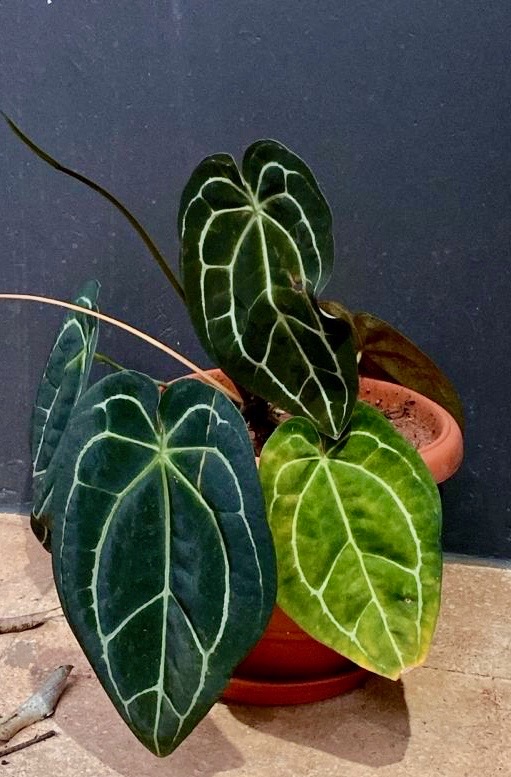
The heart of the collector's obsession is a group botanists place in the section Cardiolonchium, the velvet-leaved anthuriums. Their leaves are heart-shaped, matte, and covered in microscopic surface texture that scatters light so the blade reads as deep green velvet, laced with bright white or silver veins. The texture is not a coating you can wipe off; it is the anatomy of the leaf itself, which is exactly why damage to it is forever.
Two species are the sensible on-ramps. Anthurium clarinervium is stiff, forgiving by velvet standards, and holds its bold white venation on a rounded, cardboard-thick leaf; it is the plant most people should start with. Anthurium crystallinum is softer, faster, and a touch more demanding about humidity. From these entry velvets the path climbs steeply toward the grails. Anthurium warocqueanum, the so-called Queen, hangs arm-length pendant leaves that can pass a metre in a happy plant. dressleri, from a narrow slice of Panama, is darker, blockier, and notoriously particular. These are not plants you buy to fill a corner; they are plants you keep the way other people keep orchids.
The Pleated Giants
A separate lineage trades velvet for architecture. Anthurium veitchii, universally called the King, produces long strap-heart leaves ribbed with deep parallel corrugations, as though each leaf were pressed from a sheet of corrugated metal. Mature leaves routinely exceed a metre, and the pleating is not decoration; it stiffens a very long, thin blade the way flutes stiffen cardboard, letting the leaf hang without folding in half.
Anthurium regale works at similar scale but keeps a broader, more classically heart-shaped leaf with pale veins standing proud of a semi-matte surface. The giants ask for vertical room and steady support, a moss pole or slab, because their instinct is to climb and let each new leaf grow larger than the last. Give one the space it wants and it will happily rearrange your idea of what a houseplant leaf can be.
The Oddities
Then there are the species that break the rules the others follow. Anthurium forgetii does away with the notch. Most Anthurium leaves have a sinus, the cleft where the two rounded lobes of the heart meet the stalk. forgetii has none: the leaf base closes into a complete oval and the stalk attaches inside the blade rather than at its edge, a condition botanists call peltate, like a shield held by a handle behind its center. The effect is a clean, floating oval rimmed in fine pale veins.
Anthurium wendlingeri goes the other direction entirely, hanging narrow pendant straps a metre or more long, with a corkscrewing bloom that looks like nothing else in the genus. And at the dark end of the spectrum sit the near-black hybrids, the most famous being Ace of Spades, bred for a broad, matte leaf so deeply pigmented it drinks the light out of a room. The oddities are where the genus stops behaving like a category and starts behaving like a thousand separate experiments.
The Bloom Is Not a Flower
The supermarket red heart deserves a proper explanation, because understanding it explains much of the market's chaos. What looks like a single waxy flower is an inflorescence, a whole cluster of flowers built on the standard aroid plan. The finger-like spike at the center is the spadix, and it is studded with hundreds of tiny true flowers, each complete and functional. The colored heart behind it is the spathe, a modified leaf, or bract, whose only job is to frame and advertise the spadix. In the florist Anthurium the spathe is bred to be big, red, and glossy. In the foliage species it is often a modest green or purple sliver you would never notice.
Here is where it matters for buyers. Anthurium species cross with one another with unusual ease, and their tiny flowers are easy to hand-pollinate. That promiscuity is a gift to breeders and a curse to shoppers: intentional hybrids and accidental crosses flood the market, and a seedling sold as one pure species may carry the genes of three. Combine that with honest misidentification and the occasional wishful label, and you have a genus where provenance is worth as much as the plant. Buy from growers who can tell you where a plant came from, and treat any bargain grail with the skepticism it has earned.
Keeping One Alive
The care baseline is consistent across the genus, and it comes down to a single idea: these are epiphytes and near-epiphytes that hate wet feet. Pot them in a very airy, chunky mix, orchid bark and perlite, sometimes with a handful of sphagnum moss to hold a little moisture, in a blend that drains within seconds and never stays soggy. Roots that sit in dense, waterlogged soil rot fast, and a rotted Anthurium rarely comes back.
Humidity is the second pillar, and the velvets in particular want it high, often 70 percent or more. But humidity without moving air is a recipe for fungal and bacterial rot, so pair the moisture with a small fan or an open, breezy spot; still, swampy air is the enemy. Give them bright light that never lands as direct midday sun on the leaf, the kind of light a few feet back from a bright window.
The last pillar is vigilance, and it is not optional. Thrips, sap-sucking insects barely visible as slivers of movement, are the defining pest of the genus. On a velvet leaf their feeding leaves silvered scarring that never heals, and because Anthurium holds its leaves for a very long time, that damage stares back at you for years. Worse, thrips scarring can telegraph into the emerging leaves that follow. Inspect new growth obsessively, quarantine every incoming plant, and act at the first silver streak rather than the tenth.
Where to Begin, and What It Costs
A beginner should start with Anthurium clarinervium. It gives you the full velvet experience, the white veins, the thick heart, the geniculum flexing toward the window, while forgiving the humidity lapses and watering mistakes that would kill a warocqueanum outright. Grow one well for a year and you will have learned the genus's whole grammar: the airy mix, the balance of moisture and airflow, the daily thrips patrol.
On price, honesty serves everyone. Anthurium values swing with fashion and propagation supply, and a species that commanded a mortgage payment one season can become an affordable seedling the next as tissue culture catches up. No one can promise you an investment, and any seller who does is selling something other than a plant. Buy the leaf in front of you because you want to watch it grow, learn to read the geniculum and the prophyll so no label can lie to you, and let the genus earn the patience it demands one enormous, silver-veined leaf at a time.