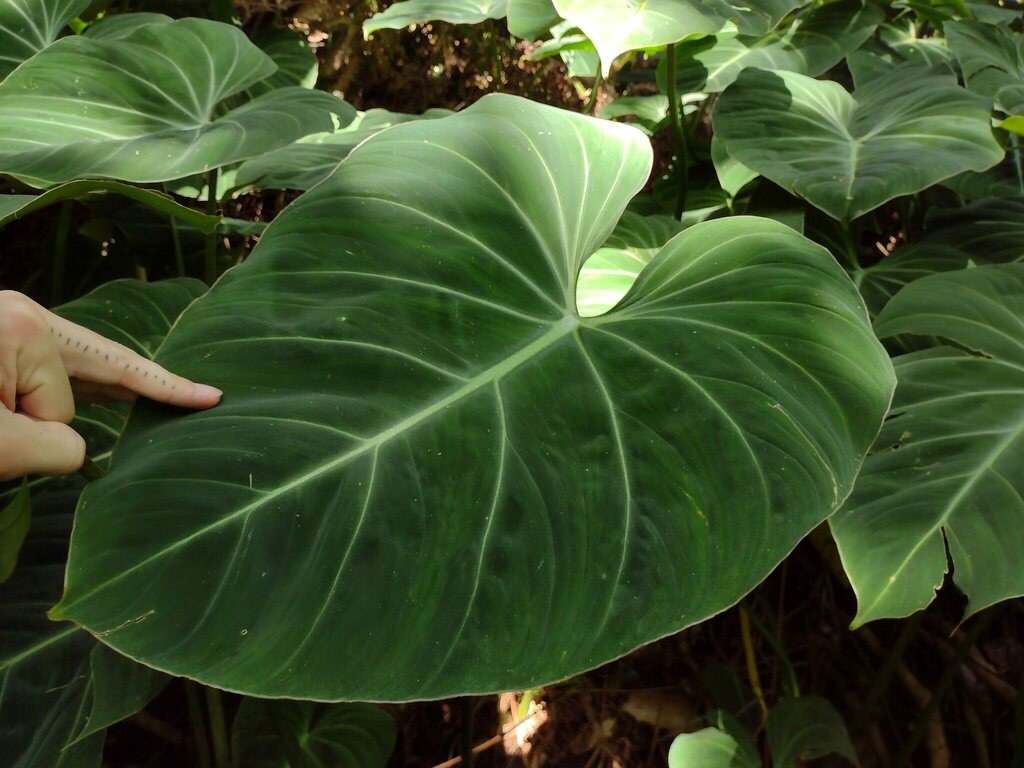
Stand at a good collector's bench and you will see the problem. A dark, heart-shaped, velvety leaf laced with chalk-white veins sits in one pot. Two pots over, a dark, heart-shaped, velvety leaf laced with chalk-white veins sits in another. They could be sisters. One is a Philodendron and one is an Anthurium, and they are not even close relatives — no more alike, botanically, than a shark and a dolphin, two animals that arrived at the same streamlined shape by swimming down the same evolutionary river from opposite banks.
That resemblance is a genuine problem and not just a party trick, because the two genera are worth different money, want different care, and get mislabeled constantly — sometimes by honest accident, sometimes not. The good news is that you never have to guess. Ignore the part of the plant that fools everyone, the leaf, and look instead at three features that give an honest answer every time: a joint, a sheath, and, if you are lucky enough to catch one, a flower that is not a flower.
Why They Fool You in the First Place
Philodendron and Anthurium are both aroids — members of Araceae, the arum family that also includes peace lilies, monsteras, and the corpse flower. So they share a family resemblance the way distant human cousins do. But within that family they sit in separate genera that split apart a very long time ago, and their likeness is mostly a case of convergence: two unrelated plants evolving the same solutions because they solved the same problem. Both grow in the dim, wet understory of American rainforests. Both climb or creep along trees. Both, in their most collectible species, have arrived at the same look — a broad heart-shaped leaf, a light-drinking velvet surface, and pale veins that stand out like stitching. The rainforest asked a question and two genera, independently, wrote nearly the same answer.
This is exactly why the leaf is the worst thing to judge by. A velvet Anthurium like clarinervium and a velvet Philodendron like gloriosum can be near-identical from across a room, and photographs — the way most plants are bought now — flatten out the very details that would tell them apart. Sellers know this, and a plant labeled as the more expensive genus sells for more, so the incentive to blur the line runs one direction. Learn the three tells below and no label, honest or otherwise, can put one past you.
Ignore the leaf. It is the one part of the plant designed, in effect, to fool you.
Tell One: The Knee (the Geniculum)
This is the single most reliable tell, and it lives at the top of the leaf stalk. Run your finger up the stalk — botanists call it the petiole — from where it leaves the stem to where it meets the blade. On an Anthurium, just before the leaf, you will feel a short swollen segment, often a slightly different color or texture from the rest of the stalk, sometimes visibly wrinkled or ringed. That is the geniculum, and the plainest way to describe it is a knee. It is a flexible joint that lets the plant swivel each leaf to face the light through the day, and if you gently tip the pot and watch the leaf, you can often see it flex right there.
On a Philodendron, that knee is absent. The petiole runs smoothly into the base of the leaf with no swollen joint, no separate hinged segment — the stalk simply arrives at the blade and stops. Some philodendrons taper or groove near the top, but there is no distinct puffy knuckle you can roll between your fingers. So the test is physical and fast: feel for the knee just below the leaf. A knee means Anthurium. No knee means Philodendron. This one feature settles the majority of arguments before you have even looked at anything else.
The only trick to it is knowing what you are feeling for, which is why it helps to learn on a plant you can identify for certain. Find a confirmed Anthurium and a confirmed Philodendron, feel both geniculum-hunting, and the difference stops being abstract. After a dozen plants your fingers know it without your eyes.
Tell Two: The Sheath and the Litter It Leaves
The second tell is about how each genus protects a new leaf as it emerges, and it leaves evidence you can read even when the plant isn't actively growing. Philodendrons wrap each new leaf in a cataphyll — a papery protective sheath, a bit like a leaf-shaped envelope, that stands up beside the growing tip while the real leaf unfurls out of it. Once the leaf hardens, the cataphyll's job is done: it dries to a thin brown or straw-colored tissue and either drops off or hangs on as a crispy, translucent wisp. A philodendron in active growth is almost always littered with these — spent brown sheaths clinging around the newest leaves or collected in the pot. That litter is a signature.
Anthuriums don't put on that show. Their new leaves push up from a prophyll, a sheath at the very base of the leaf stalk that tends to stay put as a small persistent structure rather than drying into conspicuous papery banners that shed all over the plant. So the reading is: if the growing point is surrounded by dried, papery, envelope-like cast-offs, you are almost certainly looking at a Philodendron. If new leaves emerge cleanly with no crowd of brown paper sheaths, lean Anthurium.
This tell is a touch softer than the knee — conditions and species vary, and a very tidy grower may have picked the litter off — but combined with the geniculum it is close to airtight. Knee plus no papery litter says Anthurium loudly. No knee plus a mess of brown sheaths says Philodendron just as loudly.
Tell Three: When It Blooms, the Argument Ends
If your plant ever flowers, you can stop guessing entirely, because the reproductive parts are where the two genera stop pretending to be alike. Both build the standard aroid inflorescence — not a single flower but a cluster: a finger-like central spike called the spadix, studded with many tiny true flowers, standing in front of a modified leaf called the spathe. That much they share. What the spadix and spathe are made of is where they part ways.
On an Anthurium, the spadix carries bisexual flowers — each tiny flower is complete, with both male and female parts, and each wears little modified petals called tepals. The spathe usually sits open and flat behind the spadix like a backing card rather than wrapping it, and after bloom the spadix often persists and swells into a colorful spike of berries. On a Philodendron, the flowers are unisexual and naked: the spadix is divided into zones — female flowers down at the bottom, male flowers up top, a sterile band between — and the flowers have no tepals at all. The spathe forms a hood or boat that wraps the spadix like a folded canoe, usually white, cream, or wine-colored, and it opens for only a day or two.
There is even a party trick that clinches it. Many Philodendrons are thermogenic — for a night or two the bloom literally heats itself, sometimes to blood temperature, to vaporize its scent and lure the beetles that pollinate it. If you ever rest a finger on a philodendron bloom at night and feel warmth, no further test exists. Anthuriums don't do this. The catch, of course, is that neither genus blooms often in a living room — which is exactly why the knee and the sheath, available on any plant on any day, are the tells you will actually use.
The Softer Clues (Useful, Not Decisive)
A few other features help, as long as you treat them as supporting evidence rather than a verdict. Leaf texture is the famous trap: many prized Anthuriums are deeply quilted, with the primary veins sunk into the surface so the leaf looks pillowed between them, and that sunken, three-dimensional velvet is more common on the Anthurium side. But plenty of philodendrons are velvety too, and texture alone has sent many confident buyers home with the wrong genus. Use it to form a hunch, then confirm with the knee.
Growth habit can nudge you as well. The crawling, ground-running species with a thick horizontal stem creeping across the soil — the ones that want a long shallow pot — are disproportionately Philodendrons, like the emblematic gloriosum. Anthuriums more often sit as a rosette or climb, though there are crawlers and climbers in both camps, so this is a lean, not a law. Sap and roots offer little: both genera carry irritating sap you shouldn't get in your eyes, and both throw aerial roots, so neither helps you separate them.
The Hard Cases: Velvet Against Velvet
The genuinely difficult matchups are the ones the market trades on: a velvet, white-veined, heart-leaved Anthurium such as clarinervium or crystallinum set beside a velvet, white-veined, heart-leaved Philodendron such as gloriosum or verrucosum. Photographed side by side, even experienced growers hesitate. This is precisely where you abandon the leaf and go straight to the knee. Feel the top of the petiole on each: the Anthurium will have its geniculum, the Philodendron won't. Then glance at the growing tip for papery cataphyll litter. Two tells, ten seconds, argument over.
Juveniles are the hardest of all, because young plants of both genera are smaller, softer, and less differentiated than their adult selves — the geniculum on a baby Anthurium is subtler, and a young philodendron may not be shedding obvious sheaths yet. When a plant is too young to read confidently and the stakes are high, the honest move is to buy from a grower who can tell you the plant's parentage and history, not just show you a flattering photo. Provenance is the tiebreaker when anatomy is still ambiguous, and a seller who knows exactly where a plant came from is worth more than one who merely knows what it looks like.
If you want to go deeper on either genus once you can tell them apart, our primers lay out how each one actually lives: getting to know Philodendron and getting to know Anthurium.
The Ten-Second Field Method
Put together, the whole thing collapses into a routine you can run on any plant, in any shop, in the time it takes to pick up the pot. First, feel the top of the leaf stalk for a swollen, bendable knee — the geniculum. Knee present, it's an Anthurium; knee absent, it's a Philodendron. Second, look at the newest growth for dried, papery, envelope-like sheaths shedding around it: a mess of brown paper points to Philodendron, clean emergence points to Anthurium. Those two checks agree far more often than not, and when they agree you are done.
Third — only if the plant happens to be blooming — read the inflorescence: a flat backing spathe with a berry-setting spadix of complete little flowers is Anthurium; a wrapped hood over a zoned, tepal-less spike, maybe even warm to the touch at night, is Philodendron. You will rarely need this last test, but it is the one that never fails, the botanical bedrock under the two quick tells you'll actually reach for. Learn the knee first. It alone will save you from most of the mistakes the velvet leaf is waiting to lead you into.