Somewhere in a Colombian cloud forest, a seed no larger than a peppercorn germinates in leaf litter, sends up a modest heart-shaped leaf, and begins looking for a tree. It finds one, presses flat against the bark, and starts climbing. Ten feet up, the same plant is unrecognizable: leaves the length of your forearm, velvet-dark, dripping at the tip. That single organism, juvenile at the bottom and monstrous at the top, is the whole argument for the genus Philodendron in one vertical line.
Collectors fall for the velvets and the variegates, but the genus rewards a slower attention. Learn what makes a philodendron a philodendron, and how it wants to live, and you have most of what you need to grow the harder aroids that come after it.
What Makes a Philodendron a Philodendron
Philodendron is a large Neotropical genus in Araceae, the arum family that botanists and collectors call the aroids and the same family as peace lilies, monsteras, and anthuriums. Estimates run past 500 species, most of them native to the tropical Americas, from Mexico down through the Amazon basin. The name translates, aptly, as "tree-loving," and that habit is the key to the whole group.
Nearly all of them are hemiepiphytes: they begin life on the ground or germinate in a tree, then climb, spending part of their lives with roots in soil and part clinging to bark, drawing moisture from the air. Collectors sort them into two broad habits. Climbers vine up trunks, leaves enlarging as they ascend. Crawlers run a thick horizontal stem called a rhizome across the forest floor, sending up one leaf at a time as they creep.
The most useful field skill is telling a philodendron from an Anthurium, which can look maddeningly similar. Philodendrons produce a cataphyll on each new leaf: a papery protective sheath that wraps the emerging growth, then dries to a brown tissue and drops off or hangs on as a wisp. They also lack the geniculum, a swollen "knee" or flexible joint at the top of the leafstalk that anthuriums have. Papery sheath, no knee: philodendron. Our Philodendron vs. Anthurium field guide walks through every tell.
A juvenile philodendron and its climbing adult self can look like two different plants entirely, and often do.
The Friendliest Door Into Serious Aroids
Anthuriums are gorgeous and, frankly, temperamental. Philodendrons are the forgiving cousin. As a group they grow faster, root more willingly from cuttings, and tolerate the ordinary sins of a home grower, a missed watering or a dry spell, better than most of the aroids people covet.
That makes the genus the sensible on-ramp. A first plant can be a heartleaf philodendron, the trailing green vine sold in every garden center, or the cultivar 'Brasil' with its painterly yellow center, or Philodendron 'Micans', whose small leaves carry a bronze velvet finish that hints at the expensive velvets to come. Keep one of those alive and happy for six months and you have learned the rhythm the whole genus wants. Then you graduate.
The Velvet Climbers Collectors Chase
The velvets are where the obsession usually starts. melanochrysum, the black-gold, wears a dark near-black leaf shot through with a fine gold shimmer, and its long drip-tip leaves, tapered to a point that sheds rainwater in the wild, lengthen dramatically once the plant is climbing something. In a pot on a shelf it stays modest; on a moss pole it stretches into a different animal.
verrucosum earns its name from the verrucae, the warty bristly hairs that fur its red-green leafstalks; the leaf above is iridescent green with a paler backbone of veins and a wine-red underside. It wants humidity and rewards it. gigas is the matte one, a deep olive that photographs almost featureless and becomes genuinely enormous at maturity, leaves measured in feet rather than inches.
None of these three is a beginner plant, exactly, but none is out of reach either. They ask for the same things: something to climb, air moving around the leaves, and humidity that doesn't crash. Give them a pole and they will show you why people keep buying velvets they swore they had enough of.
The Crawlers and Their Long Shallow Pots
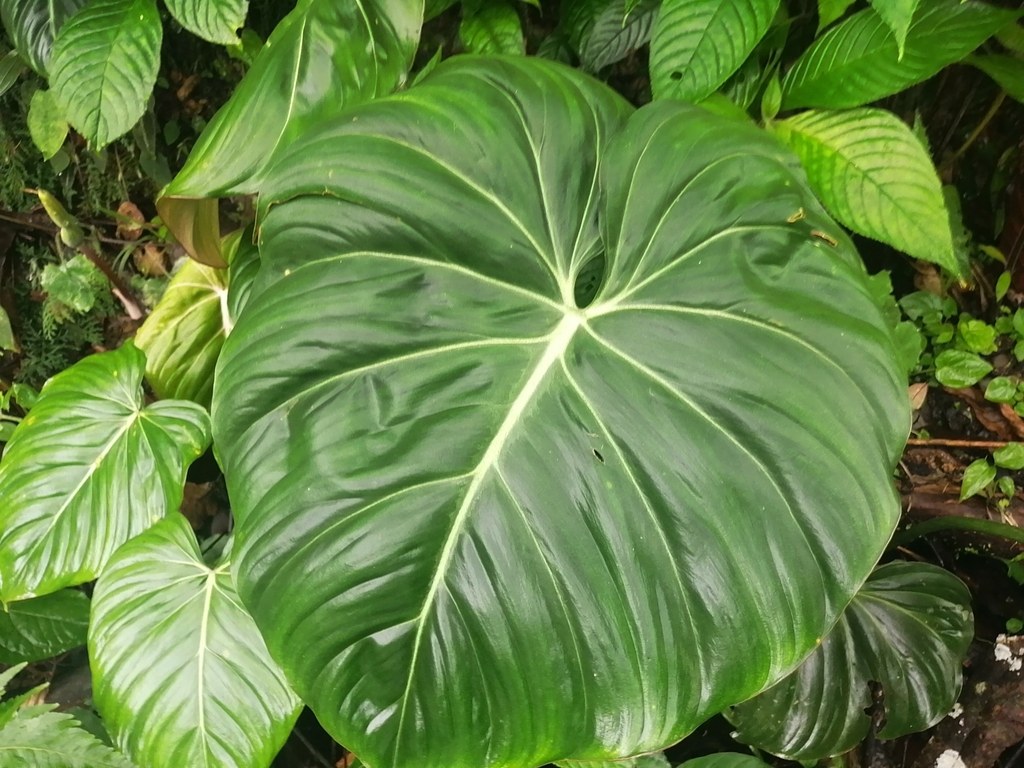
The crawlers are a different discipline. Philodendron gloriosum is the emblem: a broad heart-shaped velvet leaf, deep green, veined in bright chalk-white, held up one at a time from a rhizome that creeps horizontally just at the soil surface. The single most common mistake with it is a deep pot. A gloriosum wants a long shallow one, because the rhizome travels sideways, not down, and a deep container just holds soggy media around a stem that never uses it.
The mamei and plowmanii crowd behave the same way. Philodendron mamei quilts its leaves and dusts them with silver; plowmanii ripples its glossy leaf along a thick creeping stem. Plant any of them to run, not to sink, and set the growing tip so the rhizome has room ahead of it. They are slower than the climbers, and there is a particular satisfaction in watching one march the length of its planter over a season.
The Variegation Cult and Its Cautions
Then there is the pink. The Pink Princess is a cultivated philodendron whose dark leaves throw unstable patches of bubblegum pink, and "unstable" is the operative word. The variegation is a chimera, a mix of tissue types in one plant, and it wanders: a stem can revert to plain green or, at the other extreme, throw a nearly solid pink sheet. Collectors argue endlessly about "high-pink" plants and how to encourage them.
The honest guidance is simpler than the forums make it. Pink tissue carries no chlorophyll, the green pigment that lets a leaf feed itself, so an entirely pink leaf cannot photosynthesize and will eventually starve the growth above it. Prize the plants that balance pink against green. Do not overpay for near-albino sheets that look spectacular in a listing photo and cannot sustain themselves. The same logic governs the White Knight and White Princess, whose white sectors are beautiful and, past a point, a liability.
The Grail and the Baseline
Every genus has its unicorn, and for Philodendron it is spiritus-sancti. Known from only a handful of plants in the wild, in the Brazilian state of Espírito Santo it is named for, it is effectively extinct in its native habitat, surviving mostly in cultivation among a small circle of growers. Its long, pendent, narrow leaves are almost austere next to the velvets; the reverence is about rarity and story more than flash.
You will likely never own one, and that is fine, because the care baseline that keeps the whole genus happy is unglamorous and cheap. Pot into a chunky airy mix, bark and perlite more than peat, so water drains fast and roots get air. Give bright indirect light, the brightness of a room a foot back from a window, not direct noon sun. Aim for moderate-to-high humidity with some airflow, and let the mix approach dryness between waterings rather than staying wet.
The last piece is the one that trips up new growers most. Climbing philodendrons make small juvenile leaves until they have something to climb; put a moss pole in the pot and let the plant grip it, and the leaves that follow can double or triple in size. The dramatic foliage you bought the plant for is the adult form, and it only arrives once the plant is climbing. Patience is the fertilizer nobody sells.