Most people meet a Hoya before they know its name. It's the thick-leaved vine on a grandmother's windowsill, the one that seems immortal and occasionally, without warning, hangs out a cluster of tiny flowers so precise they look machined. The leaves feel like they've been dipped in wax, which is exactly why the common name is wax plant. For years it sat in the background of houseplant culture. Then collectors noticed how many different Hoyas there were, and the background became a hobby of its own.
Leaf People files Hoyas next to the aroids — the Monsteras and Philodendrons and Anthuriums — because the same people tend to grow both. But it's worth being clear from the start: a Hoya is not an aroid. It belongs to a completely different branch of the plant family tree, and that difference explains almost everything about how it behaves.
Not an Aroid: Where Hoya Actually Comes From
Hoyas belong to Apocynaceae, the dogbane family, and more specifically to the milkweed subfamily (Asclepiadoideae). In plain terms, their closest famous relative is the roadside milkweed that monarch butterflies lay eggs on — not the Monstera on the shelf beside them. If you ever snap a Hoya stem and see white sap bead up, that milky latex is the family signature.
This matters beyond trivia. Aroids and Hoyas want to be grown differently. Many prized aroids are thirsty jungle-floor plants that sulk if they dry out. Hoyas descend from tough, sun-drenched climbers, and they are built to endure drought. Treat a Hoya like a fussy velvet aroid — constant moisture, low light — and you will rot it. Treat it a bit like a succulent and it will outlive most things in the room.
Cut the spent flower stalk off and you have not tidied the plant. You have deleted next year's flowers.
What Makes a Hoya a Hoya
Hoyas are tropical vines from Asia, the Pacific Islands, and Australia — climbing and trailing plants that, in the wild, are mostly epiphytic, meaning they grow perched on other plants (the bark of a tree, usually) rather than rooted in the ground. Their roots cling and grip rather than dig. That lifestyle is the reason they tolerate, even prefer, so little soil.
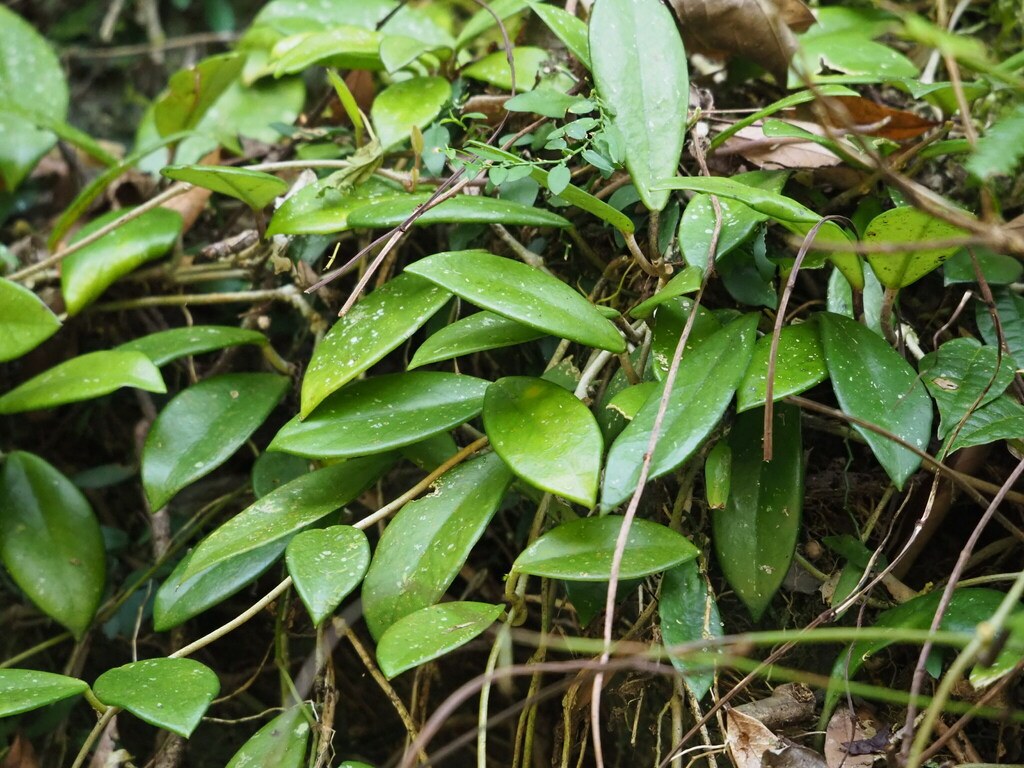
Their calling card is the leaf: thick, firm, often glossy, and frequently succulent — able to store water the way a jade plant's leaves do. Beyond that shared toughness, the genus refuses to be typecast. There are roughly 500 or more species, and their foliage ranges wildly. There is the near-round, plump Hoya kerrii, sold as a single leaf around Valentine's Day as the "sweetheart plant." There is the needle-thin, curtain-forming linearis, which looks more like a fringe of green string. There is callistophylla, veined in dark inlay like a stained-glass window, and the big paddle leaves of obovata. Line them up and you would not guess they were relatives.
The Flowers Are the Whole Point
You do not grow a Hoya only for the leaves. You grow it for the bloom, and the bloom is genuinely strange in the best way. Flowers arrive in an umbel — a cluster of blooms all springing from a single point, like the ribs of an umbrella turned inside out. Each individual flower in that ball is a tiny five-pointed star, often no bigger than a fingernail, with a second little star sitting at its center called the corona. The geometry is so clean that first-time bloomers routinely assume the flowers are fake.
Many Hoyas are fragrant, and the scent tends to arrive at night — chocolate, vanilla, honey, or cinnamon, depending on the species. Then there is the party trick: the flowers often "sweat," beading up droplets of sweet, sticky nectar that can drip onto the floor or the leaves below. It is not a disease and not a pest. It is the plant advertising to nocturnal pollinators. Put a saucer under a heavy bloomer if the drip bothers you.
The One Rule Everyone Learns the Hard Way
Here is the single most important thing to know about this genus, and the mistake almost every new grower makes exactly once. Those umbels of flowers do not sprout randomly from the vine. They grow from a specific woody stub called a peduncle, also known as a spur — a short, bare, gray-brown stalk that pokes out from the stem. And a Hoya re-blooms from the same spur, in the same spot, year after year after year.
So when the flowers fade and that leftover stub looks dead and ugly, the instinct is to snip it off and tidy up. Do not. Cutting the peduncle does not clean up the plant — it deletes next year's flowers from that location entirely. A mature Hoya can carry dozens of these spurs, each one a reusable flowering station, and a plant that seems to bloom "more every year" is really just accumulating spurs it was allowed to keep.
The rule is simple enough to memorize: let the spent flowers drop on their own, and never cut the bare stalk they hung from. If you are pruning a Hoya for size or shape, learn to recognize the peduncle and route your cuts around it. This one habit separates people whose Hoyas bloom from people who wonder why theirs never do.
How Collectors Sort the Genus
With 500 species and countless cultivated varieties, collectors tend to file Hoyas into a few informal camps. The gateway group is the easy, waxy carnosa types — durable, common, and cheap — along with their brightly colored mutations. A Krimson Queen has creamy margins around a green center, and its sibling Krimson Princess reverses that, with cream at the center. Both are variegated "sports," spontaneous color mutations of the plain species that growers noticed and propagated.
Then there is the "splash" crowd, whose leaves are flecked with silvery specks as though someone shook a wet paintbrush over them — pubicalyx is the classic, fast and forgiving and dark-flowered. There are the fine-leaved trailers like linearis, grown as living curtains in a hanging basket. There are the thick statement leaves of obovata and kerrii, each one big enough to be a plant unto itself.
And there is the Hindu Rope, formally Hoya carnosa 'Compacta,' a mutation whose leaves curl and fold in on themselves so tightly the whole vine looks like a braided rope. It's the same species as the plain windowsill carnosa — just wearing a very different coat.
Care, in Plain Terms
Grow a Hoya roughly the way you would grow a succulent. Give it the brightest light you can short of scorching midday sun — and understand that light is the currency that buys flowers. A Hoya in dim light will survive for years and simply never bloom; the brighter it grows, the more likely it is to spur up. An east or west window, or close to a bright south one, is the sweet spot indoors.
Because they're epiphytes, Hoyas hate dense, soggy soil. Use a very chunky, airy mix — many growers cut regular potting soil heavily with orchid bark, perlite, and even chunks of charcoal, and some skip soil altogether and run them in semi-hydro (an inert clay-pebble medium fed with a water reservoir). Whatever the mix, let the roots dry out substantially between waterings. Warmth helps, and drafty cold windowsills in winter do not. Above all, be patient: a young Hoya usually has to mature and fill its pot before it will flower at all, and rushing it does nothing.
The upside of all this is that Hoyas are among the most forgiving plants a collector can own. They are long-lived, pest-resistant, and far more tolerant of neglect than the temperamental velvet aroids. If you are someone who overwaters everything, a Hoya may be the plant that finally works for you — provided you can learn to hold back.
Where to Start
For a first Hoya, buy on toughness, not rarity. Hoya carnosa and its cultivars, pubicalyx, and the chunky kerrii are all cheap, widely sold, and genuinely hard to kill. Get comfortable with the watering rhythm on one of these before spending real money on a thin-leaved or fancy-veined species that will punish mistakes.
One honest note so you go in with clear eyes: getting a Hoya to bloom is not automatic. It takes three things stacked together — enough light, enough maturity, and the discipline not to cut the spurs. Give it those and most of the common species will reward you eventually. Fail on any one of them and you'll have a perfectly healthy vine that simply never performs. The plant is easy. The flowers are earned.