Pick up almost any begonia and look at a single leaf head-on. One side of the blade is bigger than the other where it meets the stalk, as if the plant were drawn by someone who lost interest halfway across. That crooked, uneven shape is the whole family's signature, and once you can see it you can name a begonia across a greenhouse, a windowsill, or a photo taken by a stranger in a rainforest.
Here is the thing worth saying up front: begonias are not aroids. They belong to their own family, Begoniaceae, and the genus Begonia is one of the largest groups of flowering plants on the planet, somewhere near 2,000 species. Leaf People files them next to the philodendrons and anthuriums for one honest reason, which is that the same people tend to collect both. But a begonia and a monstera are about as related as a house cat and a heron.
The Universal Tell: One Crooked Leaf
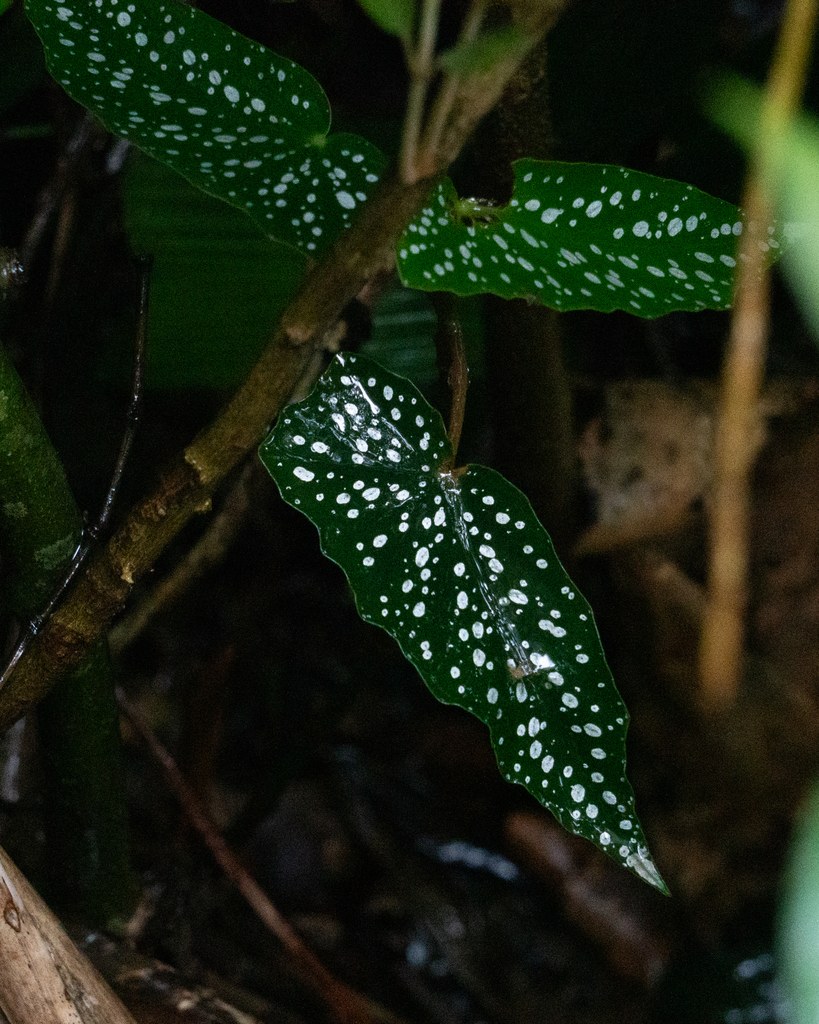
Begonias are wildly variable. Some are the size of your thumbnail; some throw canes taller than a person. Some have leaves like polished pewter, some like green sandpaper, some nearly black. Faced with that range, beginners want a rule, and there is one that almost never fails: the asymmetric leaf. Look at where the leaf stalk (the petiole — the little stem that connects blade to plant) joins the blade. On a begonia, the two halves of the blade are unequal, one lobe reaching down past the other. Collectors call it the "angel wing" shape, and it is the fastest way to recognize the genus in the wild.
That lopsidedness is not a flaw; it is how begonia leaves are built. The classic silver-spotted Begonia maculata shows it plainly, but so does a tiny jungle species you have never heard of. When you are unsure whether a mystery plant is a begonia at all, stop looking at color and texture, which lie constantly, and check the leaf's symmetry. If it is honestly lopsided, you are almost certainly holding one.
That crooked, uneven leaf is the whole family's signature; once you can see it, you can name a begonia anywhere.
Three Growth Forms, and How to Tell Them Apart
Collectors sort the genus by how the plant grows rather than by how it looks, because the growth form tells you how to care for it. There are three. The first is the cane or angel-wing type: tall, upright plants with jointed, bamboo-like stems that swell at each node (the point where a leaf attaches). The polka-dot maculata is the poster child, with olive leaves flecked in silver spots and a startling blood-red underside. These are the tallest, sturdiest begonias, and the most forgiving indoors.
The second is the rhizomatous type — rhizomatous meaning it grows from a rhizome, a thick horizontal stem that creeps along the soil surface and pushes up leaves as it travels. These are grown almost entirely for their foliage, and they include the celebrated Rex cultivars: Rex 'Escargot', whose leaf spirals inward like a snail shell, and Rex 'Fireworks', all metallic purple-silver with dark veining. A cultivar, for the record, is a cultivated variety — a plant selected and named by growers rather than found as-is in nature.
The third is the tuberous type, grown from a tuber (a fat underground storage organ, like a small potato) that often goes dormant and dies back for a season before returning. These are more a garden and flowering group than a collector's foliage prize, valued for big showy blooms rather than leaves. Most of the plants a rare-houseplant person chases live in the first two camps.
Grown for the Leaves, Not the Flowers
For the foliage begonias — the rex and rhizomatous crowd — the flowers are almost beside the point. People collect these plants for surfaces: metallic silvers, deep maroons, and in a handful of jungle species a genuine iridescent blue. That blue is not pigment but structural color, meaning the leaf's microscopic architecture bends light to look blue, the same trick a peacock feather uses. It is an adaptation to catch the scraps of light that reach a dim forest floor.
Texture is the other obsession. Many prized begonias are bullate — a word for leaves with a blistered, quilted, puckered surface, as though the tissue were pulled taut between the veins. Begonia ferox, the "devil" begonia, takes this to an extreme, raising black spiky cones across a heavily bullate leaf. Begonia venosa goes the opposite way, coating thick leaves in a soft felty fuzz that reads gray-green and holds moisture in its dry native scrub. Between the spirals, the metallics, and the fuzz, a shelf of foliage begonias can look like a cabinet of minerals.
About Those Flowers
Begonias do flower, and the mechanics are worth a sentence because they are unusual. The plants are monoecious — meaning a single plant carries separate male and female flowers rather than combining both sexes in one bloom. You can tell them apart easily once you know: the female flower has a small winged capsule sitting behind the petals, a little three-cornered pod that will ripen into seed. The male flower has no such pod.
On the foliage types, the blooms are modest, often small pinks and whites on wiry stalks, and many growers pinch them off so the plant spends its energy on leaves instead. On the tuberous garden begonias the flowers are the entire reason to grow the plant. Either way, no one buys a Rex 'Escargot' for its flowers, and no one should.
The Honest Part: Care and How They Die
Here is where enthusiasm meets reality. The jewel and rex begonias want high humidity, the kind you find under a rainforest canopy, and they resent dry indoor air. But humidity is also what kills them, because the single most common way a begonia dies is crown rot — the crown being the base of the plant where stems meet soil. Let water pool there, especially in still air, and the tissue turns to mush almost overnight. Its close cousin is powdery mildew, a white fungal dusting that blooms fast in humid air with no movement through it.
The fix is not complicated, just specific. Give bright indirect light — bright enough to read by comfortably, but not direct sun scorching the leaves. Use an airy, fast-draining mix so roots never sit in water. Water the soil, not the plant; keep the crown and leaves dry. For rex and jewel types, raise the humidity, but pair it with airflow — a small fan, an open shelf, anything so the air is not stagnant. That single pairing, humidity plus movement, prevents most begonia deaths.
The payoff for the trouble is propagation, which begonias make almost too easy. Many rhizomatous and rex types will grow an entire new plant from a single leaf. Pin a healthy leaf flat against moist substrate, nick a few of its main veins, and in a matter of weeks tiny plantlets push up from the cuts. One good leaf becomes a windowsill.
Where to Start
If you are new, do not start with a rex. Start with a cane type like maculata — the polka-dot begonia is far more forgiving of ordinary room humidity and irregular watering, and it grows fast enough to reward you within a season. Get comfortable reading its stems and leaves, learn the rhythm of watering the soil and leaving the crown dry, and you will build the instincts the fussier begonias demand.
From there the door opens onto strange places: the striped, herringbone-veined Begonia listada, the fuzzy paulensis with its round quilted leaves — see paulensis — and eventually the iridescent, bullate, near-black species that make people whisper in greenhouses. It is a genus you can spend a life inside and never reach the end of. Two thousand species, and every one of them crooked in exactly the right way.