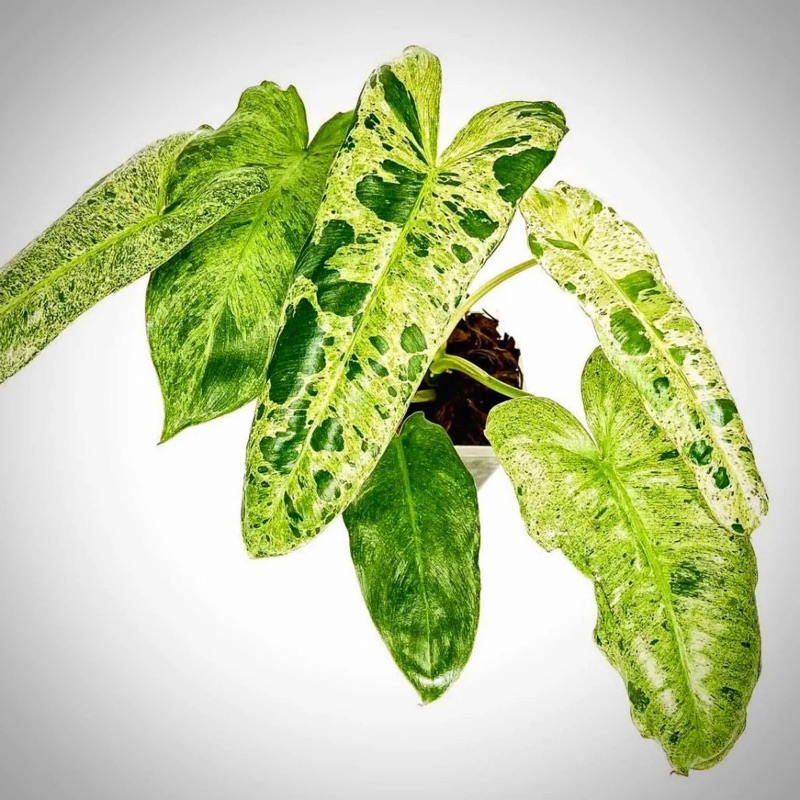
The cutting arrived wrapped in damp sphagnum and labelled, with obvious uncertainty, Philodendron sp. 'Malay Gold'. The seller had acquired it from a hobbyist in Kuala Lumpur, who had it from a market vendor, who had it from — well, that was where the chain broke. Two nodes, one leaf half-unfurled, and a petiole cross-section that was almost D-shaped but not quite. Three collectors on a forum agreed it was something new. Three others were certain it was a mislabelled gloriosum. One person posted photographs of a herbarium sheet from Kew and said nothing further.
This is how it goes with the marbled mysteries — the philodendrons that slip between the cracks of the genus's sprawling, under-resourced taxonomy. Philodendron is one of the largest genera of flowering plants, with somewhere north of 500 accepted species and a revision process that has been, charitably, ongoing. For collectors who chase velvet leaves and silver venation, the uncertainty is not a problem to be solved. It is, in a strange way, part of the point.
What We Mean When We Say 'Unplaced'
An unplaced philodendron is not necessarily a new species. More often it is a known species with a tangled synonym history, or a cultivated form that diverged from documented wild populations, or simply a plant collected before anyone filed the paperwork. The genus has been revised piecemeal over the past century — by Schott in the 1850s, by Croat and collaborators in the decades since — and the work is genuinely unfinished. There are valid species described from single herbarium sheets collected in Colombian cloud forest in the 1940s and never seen again in the wild. There are trade plants with ten years of collector history and zero botanical literature.
The practical result is a category that collectors have come to call, loosely, the 'sp.' plants — Philodendron sp. 'Cobra', Philodendron sp. 'Peru Green', Philodendron sp. 'Ring of Fire', which has been suggested as a hybrid, a sport, and at least two different species depending on who you ask. The 'sp.' designation is honest. It means: we think this is a Philodendron, we have given it a working name, and we are making no further promises.
What makes this interesting rather than merely frustrating is that the uncertainty runs in both directions. Some 'sp.' plants are eventually matched to accepted species — sometimes to the collective embarrassment of the collectors who had insisted otherwise. Others turn out, after genetic sequencing, to be genuinely novel. In 2021, a plant circulating in European aroid collections as Philodendron 'Joepii' was confirmed as a distinct species, P. joepii, characterized by its deeply lobed, almost trisected leaf base — a shape so improbable that early photographs were dismissed as fakes.
The plant doesn't care that nobody can name it. It keeps pushing new leaves, each one an argument the botanists haven't settled yet.
The Taxonomy of Desire
There is a particular kind of collector who is drawn specifically to the unresolved. Not every hobbyist chasing Philodendron gloriosum wants uncertainty — they want a true, wide-leaf, white-veined specimen with the right velvet texture, and they want to know exactly what they have. But the sp. plants attract a different impulse: the pleasure of being present at something undetermined, of growing a plant whose story is still being written.
This is not mere romanticism. Experienced growers who work with unplaced philodendrons often develop genuine observational skill. When a plant has no reference literature, you watch it closely. You document petiole sheath length, the angle of the sinus, whether the midrib is raised or sunken on the abaxial surface. You compare notes with growers in Singapore, in Brazil, in the Netherlands. You build a distributed, informal body of knowledge that sometimes, eventually, feeds into formal botanical work.
The collector community around Philodendron sp. 'Florida Ghost' is a useful example. The plant — a hybrid or cultivated form producing pale, almost white juvenile leaves that darken with maturity — has been in trade for decades with no clear wild origin. Hobbyists have documented its reversion patterns, its response to different light intensities, the conditions under which it holds the pale phenotype longest. None of that is published. All of it is useful. Some of it will matter when someone eventually does the genetic work.
Provenance as a Kind of Faith
With named species, provenance is verifiable in principle. A Philodendron melanochrysum grown from seed collected in Antioquia, Colombia has a traceable line you can at least attempt to follow. With unplaced plants, provenance collapses into testimony. You believe the person who sold it to you. You trust the photograph they took of the parent plant. You note that the person they acquired it from has been in the hobby for fifteen years and has never misrepresented a plant.
This makes the market for sp. plants an economy of reputation in a way that named species are not, quite. A collector with a long history of accurate identifications, who is careful about what they call a new find and what they label 'possibly sp.', has social capital that translates directly into the prices their plants command. It also means that a single credible accusation of mislabelling — intentional or not — can be damaging in ways that feel disproportionate to outsiders.
The plants themselves are indifferent to all of this, which is worth remembering. A Philodendron with silver-feathered venation and a heart-shaped blade pushing past thirty centimetres does not require a species epithet to be worth growing. The argument about what it is exists alongside, and entirely separately from, the experience of growing it.
Growing in the Dark, Literally and Otherwise
Care for an unplaced philodendron is necessarily improvised from analogy. You look at leaf texture — velvet surface, prominent venation, a blade that feels thick and substantial — and you infer the plant probably comes from a humid, shaded understory. You look at petiole length relative to blade size and guess at the light conditions it evolved for. You check whether the roots are running and fine or thick and searching, and you adjust your substrate accordingly.
For most of the marbled mysteries in current trade, this analogical care works reasonably well because they are, almost certainly, philodendrons from wet tropical forest — and the genus is not wildly variable in its requirements. Airy substrate, consistently warm temperatures between 18 and 28°C, humidity above 60 percent, bright indirect light with some morning sun tolerated. Good airflow matters more than many growers credit; stagnant humidity is not the same as the moving moisture of a forest understorey.
Where things get interesting is the outliers — the plants that behave strangely under standard aroid conditions. A sp. plant that sulks in high humidity but thrives with better airflow and slightly lower moisture might be from a seasonally drier habitat, or from higher elevation, or might simply be responding to a pathogen that has taken hold because nobody knew exactly what conditions it needed. The lack of a name means a lack of reference points, and that demands closer observation and more willingness to experiment than most named-species care guides require.
The Ethics of the Unnamed
Collecting plants of uncertain origin is not ethically neutral, and it is worth being clear about that. Some plants enter the trade having been wild-collected without permits, and the opacity of the 'sp.' category can, intentionally or not, obscure that history. A plant with no documented wild population and no tissue-culture origin has to have come from somewhere, and 'a hobbyist in Borneo' is sometimes a euphemism.
The collector community has been slowly, unevenly developing norms around this. Asking for documentation is more common than it was a decade ago. Preferring plants with known tissue-culture propagation histories — even when that limits the available stock — is a position more hobbyists are willing to take publicly. None of this is solved, and the secondary market, where cuttings change hands many times, makes traceability difficult in practice even for people who care about it.
What the marbled mystery makes visible, though, is something true of the whole hobby: the plants we grow are entangled with the places they came from, whether we can name those places or not. Ignoring that entanglement is a choice, not a neutral default.
When the Name Finally Arrives
Occasionally, a plant gets resolved. The genetic work is done, the herbarium specimens are matched, and a proper binomial gets published. This is supposed to be a settling moment, and in some ways it is. Growers who have been careful in their documentation feel vindicated. The plant gets a stable reference point.
But there is also, among some collectors, a small deflation. The thing that made the plant interesting — its resistance to classification, the community of observation it generated, the slightly conspiratorial pleasure of being in on a secret the botanists hadn't caught yet — evaporates. It becomes a gloriosum or a joepii or a new species with a formal epithet honouring the collector who first brought it to attention. It becomes, in some sense, ordinary.
This sounds like a perverse response to knowledge, but it points at something real about why people collect the unresolved. The name was never quite the point. The point was the attention the plant demanded, and the community that attention created, and the slightly vertiginous pleasure of growing something that the established order of things hadn't figured out how to contain. You can keep all of that even after the name arrives. Most serious growers do. But you have to choose to.
What It Means to Love the Uncertain
There is a line that gets quoted occasionally in the aroid forums, origin unknown, possibly apocryphal: 'The plant doesn't care that nobody can name it.' It's the kind of thing that sounds trite until you have spent three weeks adjusting the humidity and light on a two-node cutting of something labelled Philodendron sp. 'Spiritus Sancti look-alike (unverified)' and watched it finally push a new leaf — pale at first, then darkening to that particular blue-green that photographs never quite capture.
The uncertainty, it turns out, focuses attention in a way that certainty doesn't. When you know what you have, you can rely on the literature. When you don't, you have to look. You have to watch the way the cataphyll splits, note whether the new leaf unfurls faster in the morning light, track how the root system responds to a shift from coco coir to a chunkier mix of bark and perlite. You become, in a small way, a botanist yourself — not because you have the training, but because the plant has given you no other option.
The marbled mystery is, in the end, a teacher. It teaches patience, observation, and a tolerance for not-knowing that the rest of the hobby — with its reference guides and tissue-culture certificates and verified provenance — doesn't always demand. Whether the name eventually arrives or doesn't, the practice of paying that kind of attention to a living thing is its own justification. The plant keeps pushing new leaves. The argument continues. Both of those facts are, somehow, entirely satisfying.