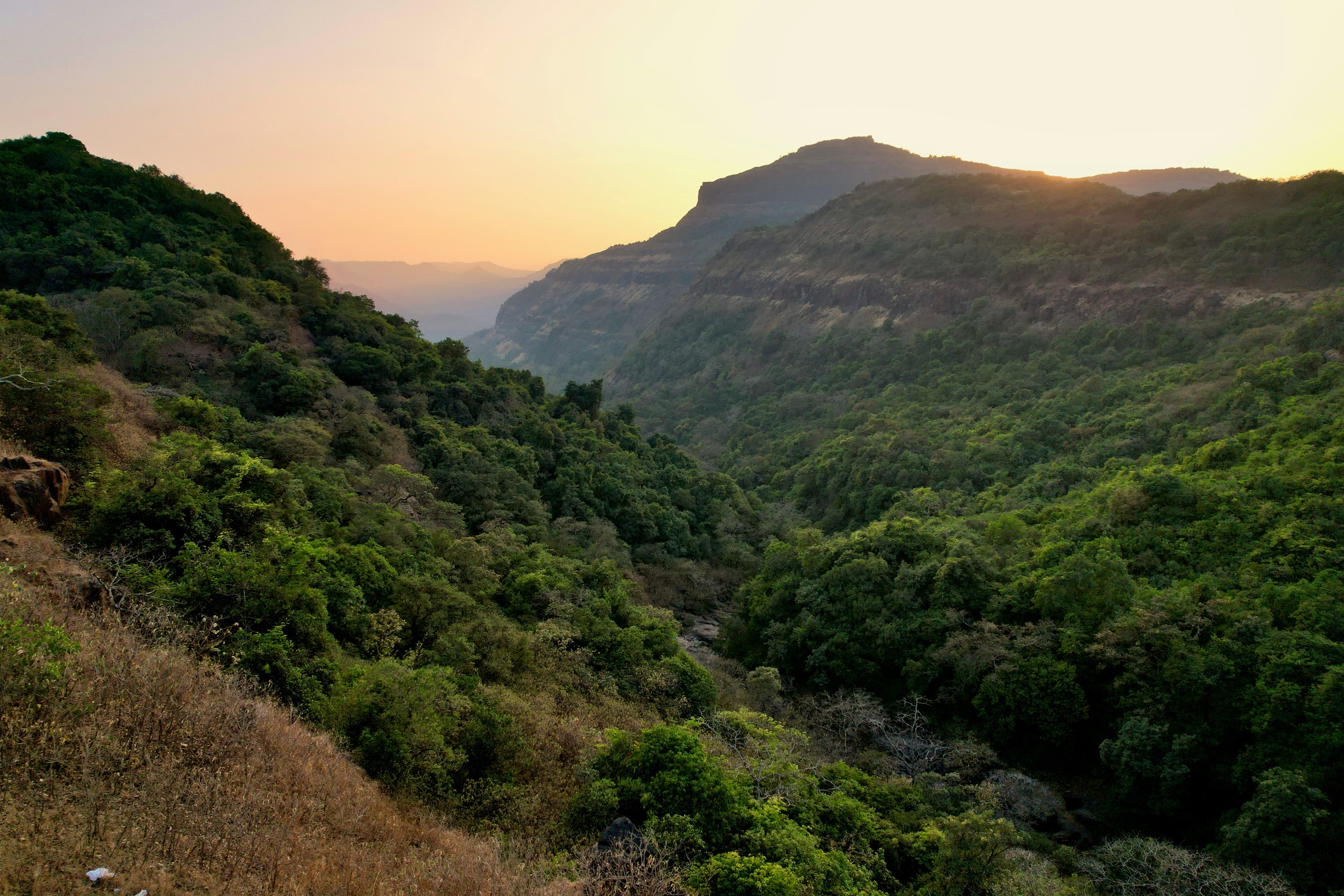
By early June the Arabian Sea is already nervous. A brown haze sits over the Kerala coast, the air thickens to something almost chewable, and then — sometimes overnight — the southwest monsoon breaks. Three to four metres of rain fall on the upper Ghats between June and September. On exposed ridges near Agumbe in Karnataka, gauges have recorded over seven metres in a single season. The forest doesn't merely tolerate this assault; the entire ecology is timed to it, calibrated down to the week. Mosses green up in hours. Dormant aroids push new spathes before the second week of rain. Streams that were gravel beds in April run waist-deep by July.
The Western Ghats are not the Himalayas — younger, more famous, more photogenic to the outside world. The Ghats are older: a remnant escarpment of the Indian plate, elevated when Gondwana fractured, and they have been a biological island of sorts ever since. The chain runs roughly 1,600 kilometres from Gujarat's Tapti River to the southern tip of Tamil Nadu, rarely exceeding 2,500 metres, hugging a coast that faces the full fetch of the Arabian Sea. That position is everything. The Ghats are the first landmass the monsoon strikes, and the plants that live there have had sixty million years to specialise for exactly what happens when it does.
A Mountain Range Built for Rain
The Western Ghats are classified as a biodiversity hotspot — one of thirty-six recognised globally — and the designation earns its keep. Roughly 5,000 flowering plant species have been recorded here; around 1,700 are endemic, meaning they occur naturally nowhere else. That endemism figure is not a curiosity. It is the biological consequence of geography and time. When the Indian plate drifted north after Gondwana broke apart, it carried a cargo of ancestral flora. Millions of years of isolation on a moving landmass, followed by collision with Asia and the establishment of the monsoon system roughly fifteen million years ago, produced a pressure-cooker for speciation.
The windward western slopes receive the rain; the leeward eastern side sits in a pronounced rain shadow. That single fact divides the Ghats into two ecological worlds separated by a ridge you can walk across in an afternoon. On the west: wet evergreen and semi-evergreen forest, shola grassland mosaics, freshwater swamp systems. On the east: dry deciduous forest grading into scrub. The plants of the wet western face evolved under a regime of seasonal extremes — not the relatively stable humidity of equatorial Borneo or Amazonia, but a binary rhythm: bone-dry, then drowned. Every adaptation you find in this flora is a response to that binary.
Elevation compounds the picture. The shola forests — montane patches of dense, gnarled evergreen trees surrounded by rolling grassland — sit above roughly 1,500 metres and experience a different stress again: mist, low temperatures, and poor, acidic soils. Many of the species confined to sholas are restricted to single mountain blocks, having had no corridor for dispersal since the last climatic upheaval. The result is intense micro-endemism: a single valley can hold species found in no adjacent valley.
The forest doesn't merely tolerate the monsoon's assault — every leaf angle, every root system, every tuber is timed to the week it arrives.
The Myristica Swamps: A Relic World
Among the Western Ghats' rarest plant communities, the Myristica freshwater swamp forests deserve a focused look. These are small, seasonally flooded stands dominated by members of the nutmeg family (Myristicaceae) — principally Myristica fatua and Gymnacranthera canarica — growing with their root systems perpetually or periodically submerged in slow-moving freshwater. They occur in low-lying areas of Kerala and Goa, almost always in the foothills below 200 metres, and their total extent is now measured in dozens of hectares rather than square kilometres.
What makes a Myristica swamp botanically remarkable is the community it supports rather than the trees alone. The perpetually wet, low-light understory beneath those buttressed trunks harbours liverworts, filmy ferns, and, critically, a suite of aroids adapted to growing with their roots in anaerobic muck. Typhonium species and several undescribed Amorphophallus relatives have been documented here, along with rheophytic (river-adapted) ferns that lie flat against submerged rocks when the swamp floods hard. These systems function as refugia — islands of permanent wet within a landscape that dries severely each March and April.
The ecological pressure on Myristica swamps is acute. Conversion for paddy cultivation and rubber plantations has eliminated most known sites. What remains is patchy and legally under-protected. Some of the best-documented stands are on private land in Kerala's Kasaragod and Kannur districts, persisting more by accident of ownership than by design. Several botanical surveys conducted in the 2010s catalogued new species within these swamps even as the swamps themselves were shrinking — the uncomfortable standard story of tropical biology.
Hoyas of the Ghats: Climbing the Monsoon Wall
The Western Ghats hold a scattering of Hoya species that represent the westernmost extension of a genus centred on Southeast Asia. Hoya wightii, described from the Nilgiri Hills, grows as an epiphyte on mossy tree trunks in wet evergreen forest, its succulent leaves functioning as a water reservoir through the dry months when the bark it clings to loses moisture fast. Hoya ovalifolia occurs on rocky outcrops and degraded forest edges, tolerating more exposure and lower humidity than most of its relatives — a pragmatic adaptation for a genus trying to persist at the edge of its range.
What's instructive about Ghat hoyas is what their morphology tells you about the monsoon regime. Thick, coriaceous leaves appear repeatedly across unrelated epiphytic lineages in this forest. The logic is the same each time: a plant rooted in bark or moss has no access to soil water during the five-month dry season, so leaf succulence is a buffer. The wax cuticle, heavy and sometimes reflective, reduces evapotranspiration. The same plant must then handle the opposite problem — sustained, heavy rain — and the waxy surface sheds water efficiently, reducing the risk of fungal colonisation on a leaf that can live for several years.
These hoyas do not match the collector image of Hoya as a trailing houseplant in a terracotta pot. In situ they are often pressed against vertical bark in deep shade, flowering only at certain months, their umbels timed to specific pollinator windows that correspond to monsoon breaks. Growing them well in cultivation requires understanding that the dry season isn't an accident to be corrected with constant watering — it's a signal the plant is waiting for.
The Impatiens Archipelago
No genus illustrates Western Ghats speciation as vividly as Impatiens — the balsams. The Ghats host somewhere between 75 and 90 endemic Impatiens species, depending on which taxonomic revision you're working from, and new ones are still being described from single ridge systems. The genus has radiated explosively here, and the driver is clear: Impatiens are annual or short-lived perennials that require high moisture during germination and establishment, making them perfect colonisers of the monsoon window. They live fast. Many complete their entire life cycle — germinate, flower, set seed, die — within the four months of heavy rain.
The floral diversity is extraordinary and largely invisible to anyone outside the region. Impatiens campanulata, with pink tubular flowers dangling from shaded streamsides in the Agasthyamalai hills, is physiologically distinct from Impatiens parasitica, which grows on mossy rocks in the Wayanad plateau. The differences in spur length, petal form, and flower colour across Ghat species track pollinator differences — certain bee species, specific hover flies — that are themselves distributed in patches across the escarpment. When you have many pollinators divided by ridges and valleys, and a plant that is annual and therefore under strong selection each season, you get rapid divergence. The Ghats are a machine for making new Impatiens.
For the collector watching from a distance, the Impatiens of the Ghats are mostly ungrowable — annuals with specific pollinator requirements, no horticultural trade, and legal protections that make collection impossible. Their value to us is conceptual: they are the clearest demonstration available of how the monsoon's strict seasonality acts as an evolutionary clock.
Aroids of the Wet Evergreen Forest
The aroids of the Western Ghats are less famous than those of Borneo or the Peruvian Amazon, but the wet evergreen forest on the lower western slopes holds a genuinely distinct aroid flora. Amorphophallus species emerge from underground corms during the first monsoon rains, flower before producing leaves — in some species, the spathe and spadix appear on bare soil before any foliage — then retreat underground by October. The tuber is the long-term investment; everything above ground is seasonal infrastructure, to be abandoned when the dry season begins.
Remusatia vivipara is perhaps the most architecturally striking. It produces large, peltate leaves on tall petioles in shaded forest understory, and its propagules — small, spine-covered bulbils — attach to passing animals or birds and are dispersed while the parent plant is still leafy. The adaptation makes sense in a monsoon forest: if you're going to disappear underground for five months, you want to spread your genetic material before you do. Several Colocasia and Alocasia species grow in wet, seasonally flooded sites in the foothills, their broad laminae angled to shed rain efficiently — a seemingly trivial trait that becomes significant when three metres of rain fall in four months and fungal pressure is extreme.
The rheophytic niche — plants specialised for life on rocks in fast-moving streams — is occupied by several undescribed or poorly known aroids in the Ghats, particularly in Karnataka and Kerala. These grow prostrate, with narrow, strap-like leaves that offer minimal resistance to flow when floods surge in July. They are among the least studied components of the flora, accessible only when water levels drop, and known from handfuls of collections.
Pressure on a Hotspot
UNESCO added the Western Ghats to its World Heritage List in 2012, recognising 39 separate properties across Kerala, Tamil Nadu, Karnataka, and Goa. The designation brought attention, but the pressures it was meant to spotlight have not eased substantially. Legal plantation expansion — tea, coffee, rubber, eucalyptus — continues on forest margins. Hydroelectric projects have flooded valley systems in Kerala. Quarrying for laterite, the iron-rich stone that underlies much of the Ghats, has removed entire hillsides. And the roads built to service these industries fragment habitat in ways that legal protection at the species level cannot fully address.
Climate models project shifts in the monsoon's onset and intensity across the Ghats. A later monsoon start, or years of reduced peak rainfall, can collapse annual species populations entirely — Impatiens that germinate late may not set seed before the dry season cuts them off. For the Myristica swamps, reduced groundwater recharge could mean that the baseline wet conditions that define the community are no longer met. There's no substitute habitat. These are hyper-specialist communities that took millions of years to assemble; they do not reassemble on a human timescale.
The botanical survey work continues — several institutions in Thiruvananthapuram, Coimbatore, and Pune maintain active Ghat programs, and citizen science contributions via platforms like iNaturalist have meaningfully increased documentation of range and phenology. What those surveys keep finding is that the flora is richer than expected and more pressured than previously documented. Both facts are true simultaneously, which is the particular discomfort of working in this forest.
Why This Place Draws You
For anyone who grows equatorial plants in a climate they were never designed for, the Western Ghats offer a different kind of lesson from Borneo or the Amazon. The forest here did not evolve in stable, year-round high humidity. It evolved to survive a brutal dry season and then explode when water arrives. That is a rhythm a grower in a northern city can understand, even approximate: the dormancy is real, the burst of growth in response to moisture is real, the tuber or succulent leaf as reservoir is a problem you can actually solve on a windowsill.
The Amorphophallus corm sitting inert in your cabinet through winter and the hoya's thickened leaves hanging through a dry summer are not failures of care — they are the correct expression of a flora shaped on a monsoon escarpment. The plant is doing exactly what sixty million years of seasonal extremes taught it to do. The forest it came from is still up there on the Ghats, catching the Arabian Sea's first breath each June, greening in hours, filling its streams, producing its annual explosion of Impatiens and Remusatia and unnamed aroids on flooded rocks. The season builds the forest. And the forest has been building itself, each June, for longer than most mountain ranges have existed.