Fly into Tarapoto in the San Martin region of northern Peru and the forest hits you before the humidity does. The Andes aren't finished here — they're dissolving, ridge by ridge, into something lower and wetter, the cordillera shedding elevation the way a wet dog sheds water. Mist sits in the quebradas until midmorning. The rivers run dark, the colour of old tea, and the banks are draped in leaves that no nursery back home can adequately prepare you for.
This is the western fringe of the Amazon basin, and it is not what people picture. The popular image — a flat, steaming green infinity — belongs to the central and lower basin, where things are enormous, monotonous, and largely inaccessible for plant exploration. The places that produced Philodendron lynamii, Anthurium vittariifolium, Philodendron atabapoense, and Philodendron tortum are different landscapes entirely: foothills, blackwater tributaries, cloud-washed ridges, and floodplain galleries where the soil is almost devoid of nutrients. Understanding that geography is understanding why the plants look the way they do.
A Thousand Rivers, Not One
The Amazon River proper is a convenient fiction — a label for a system of roughly 1,100 tributaries that drains about 40 percent of South America. The Rio Napo rises in Ecuador and crosses into Peru before meeting the main stem near Iquitos. The Rio Marañón descends from the Peruvian Andes through a canyon system so steep that botanical expeditions were reaching its tributaries only in the late twentieth century. The Rio Atabapo, which lends its name to Philodendron atabapoense, drains the border region between Colombia and Venezuela, feeding the upper Rio Negro — itself a major tributary that joins the Amazon at Manaus, more than 1,500 kilometres from the Andes.
Each of these systems has its own chemistry, its own flood pulse, its own flora. Collectors who talk about 'Amazon plants' are usually describing plants from a collection of overlapping microworlds that share a basin but not much else. A species adapted to a seasonally flooded igapó forest on the Rio Negro has little in common ecologically with one that scrambles up a mossy tree fern on a Peruvian foothill at 900 metres. The Amazon is not a place. It is a category.
The distinction matters practically. If you know that a plant comes from a blackwater system, you know something real about what the roots experienced: low pH, low conductivity, mineral scarcity. That tells you how to water, what substrate to build, how forgiving the plant will be if you push fertiliser.
The forest didn't produce electric-pink new leaves or metre-long ribbons for beauty — it produced them because competition was lethal and the ground was nearly worthless.
What Blackwater Rivers Actually Are
The tea colour is tannins and humic acids leached from decomposing leaf litter — the same chemistry that makes a cold brew dark. Blackwater rivers like the Rio Negro and the upper Atabapo are among the most nutrient-poor bodies of water on earth. Their pH can run between 3.5 and 5, their electrical conductivity is sometimes lower than distilled water, and the fish that live in them are specialists for a reason: almost nothing edible drifts through. The rivers are also remarkably clear in terms of suspended sediment, which is why the water looks black rather than brown — there's nothing cloudy in it.
Plants growing on blackwater riverbanks receive no alluvial mineral deposit when the river floods. The annual pulse that enriches whitewater floodplains — the silt-laden, nutrient-rich inundation of várzea forest — simply doesn't happen here. What happens instead is that the forest recycles almost everything internally, through a tight mycorrhizal web in the top few centimetres of soil. Nutrients cycle fast and low, meaning the available pool at any moment is tiny. This is one of the engines driving epiphytism: getting off the ground and onto a host tree allows a plant to intercept canopy throughfall, trap debris in its own leaf axils, and bypass the competitive scrum at the soil level entirely.
Philodendron atabapoense occupies this kind of territory — the gallery forests and humid margins around the Atabapo drainage where the substrate is sandy and acidic and waterlogged soil is an intermittent fact of life. Its deep maroon leaf undersides are thought to function as a reflective layer, capturing wavelengths of light that filter through the upper canopy; in a forest where light is currency, undersides matter as much as surfaces.
The Elevation Gradient: A New World Every Few Hundred Metres
The Andes don't drop smoothly into the Amazon basin. They collapse in a series of terraces, ridges, and fault-bounded valleys, and every few hundred metres of descent represents a shift in temperature, cloud cover, soil type, and humidity regime. Ecologists call the transition zone the 'montane-to-lowland gradient', and it is, by most measures, the most species-rich terrestrial environment on the planet. A single hectare of Peruvian premontane forest at around 600 metres can hold more vascular plant species than all of Great Britain.
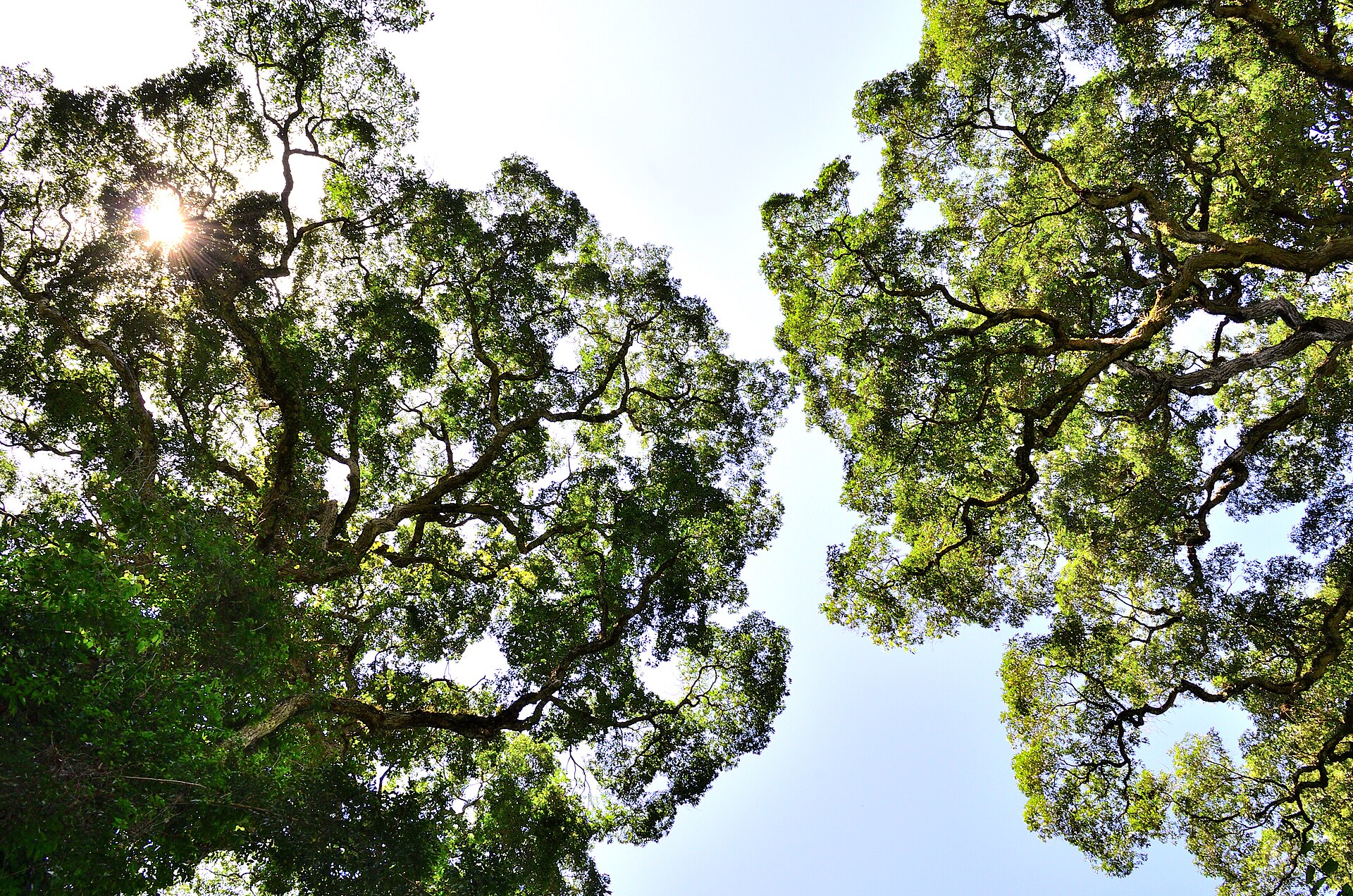
The San Martin region of northern Peru sits at the heart of this gradient, where the eastern Andes break into what locals call the selva alta — high jungle — before descending into the selva baja. It is here, in this transition, that Philodendron lynamii was collected: a climber producing new leaves of a saturated pink-red that oxidises slowly to green as chlorophyll production catches up. That flush colouration is common in aroids from light-competitive environments. The hypothesis is that anthocyanins in young, vulnerable leaves act as a sunscreen while the cellular machinery is still assembling, protecting developing tissue from photodamage before the chloroplasts are ready. The colour is not decorative. It is armour.
Temperature swings along this gradient are significant. At 1,200 metres, nights can drop to 14 or 15°C even near the equator. At 400 metres, nighttime lows rarely fall below 20°C. Many of the aroids collectors grow at home occupy a narrow band of this gradient, which is why getting temperatures right matters more than people often acknowledge.
Philodendron lynamii and the San Martin Foothills
Philodendron lynamii is named for Ron Lynam, a plant explorer and collector active in Peru during the late twentieth century, and its type locality is in the San Martin region — the foothills and lower montane forest of northeastern Peru. In habitat it is a hemiepiphyte, germinating in the soil and then climbing, committing increasingly to the host tree as it matures. Adult leaves are large, glossy, and dark green; juvenile and transitional leaves often carry that distinctive flush of reddish-pink that makes established plants so visually arresting.
Growing it well requires accepting that it came from a place with consistent humidity, warm nights, and a substrate that never truly waterlogged for long — the slopes drain. In cultivation it rewards chunky, bark-heavy mix with good drainage, humidity above 65 percent, and temperatures that don't dip below 18°C. It climbs enthusiastically given a moss pole or coir totem. The pink new leaf is not a guarantee at every stage of growth; younger plants in lower light will produce it less reliably, which is worth knowing before assuming the plant is struggling.
Philodendron tortum and the Art of the Skeletal Leaf
Nothing in the genus looks quite like Philodendron tortum. The leaves are pinnately divided to the point of appearing skeletal — narrow, twisting segments radiating from a central rachis, the whole structure looking less like a leaf than like a diagram of one. It comes from the Amazonas state of Brazil, the western Brazilian lowlands bordering Peru, where the forest canopy is dense and lateral light is scarce.
The deeply dissected leaf form is an adaptation to wind and light both. In a canopy where sudden squalls are common, a solid leaf is a liability — it catches wind and tears, or levers the stem off its support. A fenestrated or deeply lobed leaf lets air pass through. The dissection in tortum is extreme enough to suggest that light-flecking may also play a role: the narrow segments allow dappled light to reach leaves lower on the plant rather than creating a solid shadow. The architecture is elegant in an engineering sense before it is elegant in any aesthetic one.
In a collection, tortum is less demanding than its looks imply. It tolerates somewhat lower humidity than many velvet-leaf Philodendrons and appreciates good airflow. It climbs, and the leaf form becomes more dramatic — the segments longer and more twisted — as the plant matures on a vertical support. Keeping it as a creeping, unstaked plant produces smaller, less divided leaves. The full expression of the species requires height.
Anthurium vittariifolium: Leaves as Long as Your Arm
Anthurium vittariifolium belongs to a group sometimes called the strap-leaf or ribbon anthuriums — a handful of species from the western Amazon basin whose leaves abandon any pretence of a broad lamina and narrow instead into straps, sometimes exceeding a metre in length in mature specimens. In habitat, these plants grow as pendulous epiphytes, their leaves hanging downward from high branches over forest streams and rivers, which is why they look so strange in a terrestrial pot: the form was built for hanging.
The berries are pink to red, strung on an infructescence that resembles a beaded cord, and they're one of the more reliable identifiers in the field. The species occurs through Colombia, Ecuador, and Peru, often associated with humid forests near watercourses, which again points to the western edge of the basin rather than the flat interior. It prefers to dry slightly between waterings — hanging epiphytes in nature experience wetting events followed by full drainage and airflow, not persistent moisture. Mount it, hang it, give it a coarse substrate and humidity above 60 percent, and it will produce those ribbons reliably.
The plant challenges assumptions about what an anthurium is. Most hobbyists picture the genus as velvety, heart-shaped, terrestrial. vittariifolium is none of those things, and growing it well means abandoning those assumptions entirely and thinking about where the roots actually live in a forest — gripping bark, fed by rain and dew, exposed to air on all sides.
Why This Geography Matters to a Collector
Knowing the provenance of a plant is not botanical pedantry. It is practical information. A plant from a blackwater, low-pH environment will behave differently under high fertiliser EC than one from a mineral-rich whitewater flood forest. A plant from the premontane gradient of San Martin tolerates a cooler night than one from the Amazonian lowlands at 200 metres. Getting the conditions roughly right — or at least not catastrophically wrong — requires knowing which version of the Amazon the plant is from.
There is also the larger reward of understanding what you're looking at. Philodendron lynamii's pink new leaf, atabapoense's maroon underside, tortum's skeletal segments, vittariifolium's hanging ribbons — none of these traits are accidents or ornaments. They are precise solutions to specific pressures: light competition, nutrient scarcity, wind load, the need to intercept canopy drip without sitting in standing water. A collection of these plants is, in some sense, a field guide to the western Amazon compressed into a grow room.
The forest that produced them is still largely intact at its fringes, though not permanently. The San Martin region has lost significant lowland forest to coca and oil palm; road-building into the Amazonian interior continues. The plants in circulation in the hobby were, in most cases, originally collected during a narrow window of botanical exploration — the 1980s through the 2000s — and what reaches collectors now is largely propagated material. Knowing where those originals came from, and what the forest there actually looks like, is not separate from the act of growing them. It is part of what it means to grow them well.