The smell hits before the sight does. A sweetish, gagging wave — rotting meat, old fish, something metabolically wrong — rolling out from a riverbank thicket of Macaranga scrub in the Barisan foothills of Sumatra. Then you see it: a single, mottled, burgundy-and-cream spathe rising three metres out of the ground, its edges crimped like a ruff, its spadix a finger of pale cream pointing straight up into the canopy gap. Amorphophallus titanum in full bloom lasts thirty-six to forty-eight hours. If you are standing in front of one in the wild, you are extremely lucky and should understand that this event, this spike, this theatrical rotting smell that pollinating carrion beetles can detect from kilometres away, was seven years in preparation underground.
The forest behind it is not dramatic in the usual way. There is no single view, no grand savannah panorama. Sundaland's lowland dipterocarp rainforest closes around you in layers — a dim, dripping understorey forty metres below a canopy that barely lets through five percent of available light. The competition here is not between predator and prey but between photons and root space, between a strangler fig's roots and the trunk they're devouring, between a Rafflesia embryo threading itself through a host vine and the vine's immune response trying to stop it. The forest has been running this competition for perhaps sixty million years without a hard frost to reset the board. What it produced is the most biologically extreme flowering-plant community on the planet.
Sundaland: A Platform of Stability
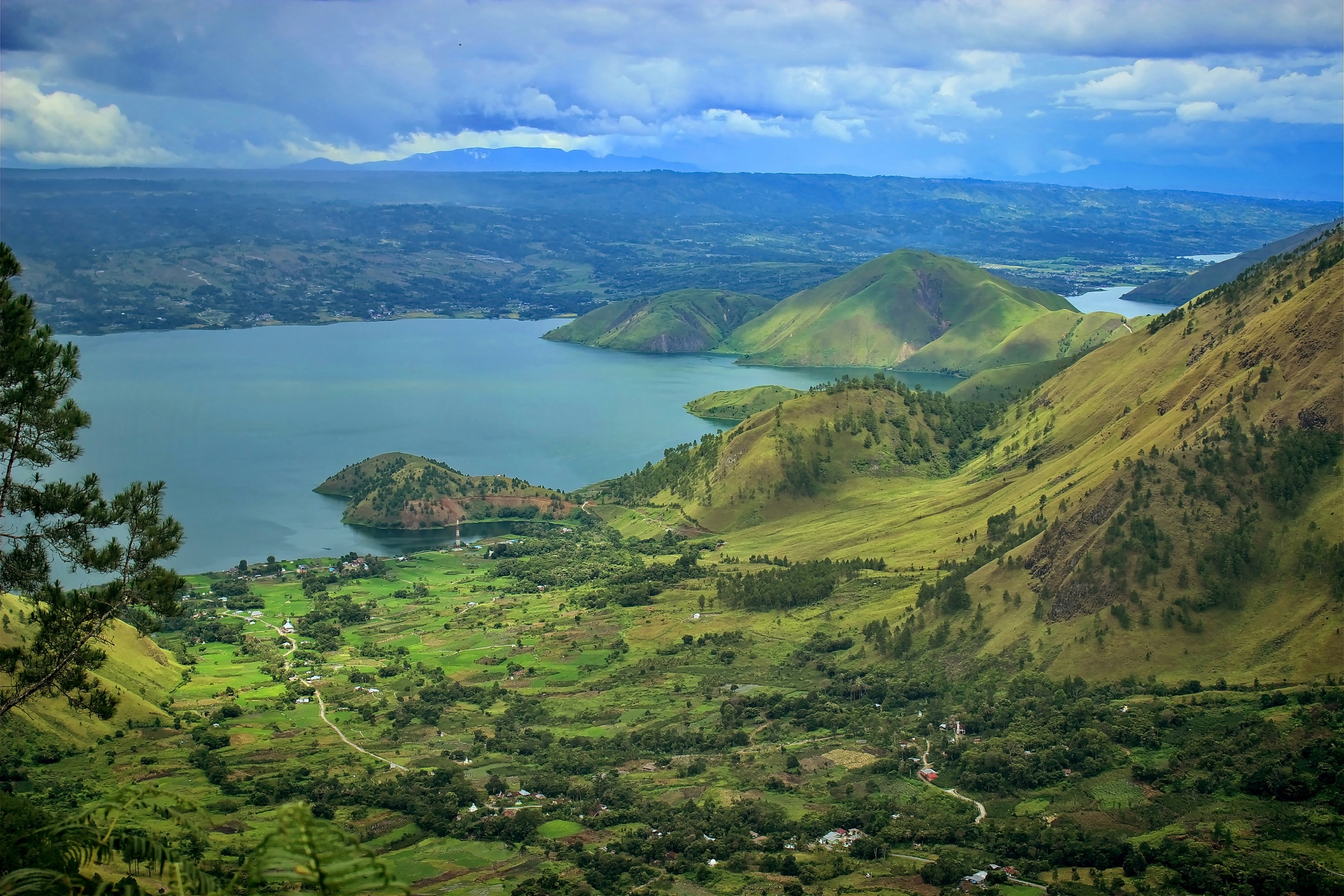
Sundaland is the biogeographical region centred on the Malay Peninsula, Borneo, Sumatra, and Java — a block of continental shelf that spent most of the Cenozoic as connected land whenever sea levels dropped. Sumatra alone covers roughly 473,000 square kilometres, stretching along the equator with the Barisan mountain range as a spine, flanked to the east by one of the world's largest expanses of tropical peat swamp. This geography matters because it describes a place that has been warm, wet, and productive for tens of millions of years, never glaciated, never truly droughted, never forced through the species-purging bottleneck that repeatedly scoured temperate zones.
Stability of that duration doesn't produce a relaxed ecosystem. It produces an arms race. Every niche is occupied, every gap exploited, every resource contested by organisms that have had geological time to specialise. In this context, extreme morphology isn't aberrant — it's the predictable outcome. Gigantism, parasitism, mimicry, and chemical warfare are what plants do when competition is that old and that dense.
The lowland dipterocarp forest that covers much of Sumatra's interior — named for the Dipterocarpaceae family that dominates its canopy, whose seeds spin down on paired wings like botanical helicopters — is the culmination of this process. Canopy trees reach sixty metres. Beneath them, the forest floor receives so little direct light that a seedling may spend decades waiting for a treefall gap before it can grow with any urgency. It is in these conditions, and in the seasonally flooded peat swamps to the east, that the most spectacular botanical adaptations on the planet evolved.
Sumatra's lowland forest has been running the same competition for sixty million years. What it produced is the most extreme flowering-plant community on Earth.
The Corpse Flower's Long Game
Amorphophallus titanum belongs to the aroid family, Araceae — the same family as the Alocasia and Philodendron we obsess over indoors — but it has taken the family's characteristic spathe-and-spadix inflorescence to a scale nothing else has matched. The largest recorded bloom reached 3.1 metres in height. It is, unambiguously, the largest unbranched inflorescence of any plant on Earth.
The biology is worth understanding. The plant exists for most of its life as a single enormous corm, which can weigh over 70 kilograms, putting out one compound leaf per year to photosynthesize and rebuild energy reserves. When reserves are sufficient — this takes between seven and ten years in the wild — it flowers. The thermogenic spadix heats up to near human body temperature and volatilises a cocktail of dimethyl trisulfide and dimethyl disulfide, compounds that smell precisely like rotting animal flesh. This targets carrion beetles and flesh flies, which tumble down into the female flowers at the base of the spathe, pick up pollen, and carry it to the next bloom. The entire event is over in two days.
The obvious question is: why bother? Why not just flower more often, smaller, like almost every other plant? The answer is that in a hyper-competitive lowland forest, reliable pollinators are a limited resource. Producing a massive, thermogenic, chemically sophisticated bloom once a decade and advertising it for kilometres is more energetically efficient than producing small, frequent flowers that compete with thousands of other species for the same generalist pollinators. Extreme investment, concentrated in time, is the winning strategy — provided the forest is stable enough to let you wait seven years.
Rafflesia: A Flower That Abandoned Being a Plant
Thirty kilometres from a titan arum site in the Bengkulu highlands, pushing through secondary forest along a logging track, you may find a different kind of superlative: a five-petalled flower nearly one metre across, splotched deep burgundy and cream, sitting directly on the ground with no stem, no leaves, no roots of its own. Rafflesia arnoldii is the largest single flower of any plant, and it is also one of the most extreme evolutionary solutions to the problem of living in competitive forest: it has abandoned photosynthesis entirely.
Rafflesia is a holoparasite. Its entire vegetative body is a network of filaments woven through the stem tissue of its host, a vine in the genus Tetrastigma (family Vitaceae, the grape family). The parasite has shed every organ associated with independent plant life — no chlorophyll, no stomata, no functional leaves — and retains only the ability to flower and produce seed. What you see above ground is purely a reproductive structure. The bloom, again, smells of decay, recruiting carrion flies. Its seeds are distributed, it is thought, by small mammals that walk through the fallen, decomposing flower and carry seeds on their feet.
It's tempting to call this a parasitic shortcut, a cheat's strategy. But holoparasitism is extraordinarily difficult to evolve. Rafflesia must suppress the host's immune response, integrate its own vascular tissue with the host's phloem, and time its emergence to conditions suitable for pollination — all without any independent metabolism. This is not a simple strategy. It is a highly derived one that only makes evolutionary sense in a forest where the cost of maintaining photosynthetic tissue is outweighed by competition for light so severe that abandoning leaves entirely is preferable.
Aroids and Hoyas: The Understorey's Specialists
Below the dipterocarp canopy, the Sumatran understorey runs its own competition. Alocasia species — the genus that gave us the cultivated 'elephant ears' so popular in collections — are native across Southeast Asia, and Sumatra hosts several wild species exploiting the dim, humid floor. Alocasia lowii, Alocasia reginula, and their relatives have evolved large, peltate leaves with distinctive venation patterns: a structural adaptation for gathering diffuse light, and, in the case of heavily ribbed surfaces, for shedding the constant rain without fungal colonisation. These are not decorative choices. They are engineering solutions to specific physical problems.
Hoyas in Sumatra are equally strategic. Hoya latifolia, one of the larger-leaved species, grows as an epiphytic climber on dipterocarp bark, its roots gripping the rough, resin-scented surface while its leaves intercept the scattered light that makes it through the canopy. Some Sumatran hoyas have evolved extraordinarily thick, succulent leaves — an adaptation not to drought but to the irregular supply of nutrients in an epiphytic life, where there is no soil buffer. Several species in the region produce a latex that may deter herbivory. The genus across Sundaland numbers in the hundreds of species, many still undescribed, occupying a different bark elevation, light level, or host species.
The pitcher plants of the genus Nepenthes complete the picture of the understorey's resource strategies. Sumatra hosts species including Nepenthes rafflesiana, Nepenthes ampullaria, and Nepenthes bicalcarata, the last notable for housing a mutualistic ant species, Camponotus schmitzi, inside its hollow tendrils. N. ampullaria does something genuinely unusual: it has reduced its pitcher's digestive enzyme production and instead collects leaf litter falling from above, composting it for nutrients. In a forest where phosphorus and nitrogen are locked in competition, a plant that catches falling leaves rather than insects has found an elegant lateral solution.
Orangutans, Tigers, and the Forest's Animal Logic
Pongo abelii, the Sumatran orangutan, is not incidental to this forest's botanical story. As a frugivore and seed disperser, the orangutan is part of the dispersal network for dozens of large-fruited tree species. The fig trees that feed orangutans during lean months — several Ficus species that fruit asynchronously — are in turn the forest's keystone food source when dipterocarps are not masting. The orangutan's movement through the canopy, breaking branches and creating micro-gaps, alters light availability for understorey species including the Alocasia and Hoya communities below.
Panthera tigris sumatrae, the Sumatran tiger, down to perhaps 400 individuals, keeps ungulate populations in check; ungulates, left unchecked by predation, browse understorey regeneration. The tiger's presence shapes the botanical community indirectly — a cascade that runs from apex predator to seedling survival. These are not romantic details. They are structural functions that the forest requires to maintain the conditions that produced Amorphophallus, Rafflesia, and the rest.
Palm Oil and the Speed of Erasure
Sumatra has lost more than half of its original forest cover since 1985. The lowland dipterocarp forest — the specific ecosystem that produced the botanical superlatives described here — is the most heavily targeted zone because it occupies flat, accessible terrain with deep, workable soils. Peat swamp forest, which took thousands of years to accumulate its organic substrate to depths of ten metres or more, is drained and burned in a season. The carbon release from a single drained peat swamp can exceed a year's emissions from a European country.
The driver is palm oil, Elaeis guineensis, a West African species planted in industrial monoculture across what was lowland rainforest. Sumatra's Riau province, once among the richest lowland forest landscapes in Southeast Asia, is now largely palm plantation. The peatlands of Jambi and South Sumatra are next. RSPO (Roundtable on Sustainable Palm Oil) certification exists and has genuine standards, but covers a fraction of production and does nothing for forest already converted.
What is lost is not abstractly 'biodiversity'. What is lost is sixty million years of specific evolutionary outcomes. Rafflesia arnoldii cannot be cultivated — it requires its specific Tetrastigma host and is not established in any botanical garden in sustainable population. Amorphophallus titanum can be grown ex situ, and is, in botanic gardens worldwide, but its wild population depends on intact lowland forest with the geological stability that allows a plant to wait seven years between flowerings without being disturbed. Once that forest is gone, the conditions that produced these strategies are gone with it. You cannot replant a peat swamp. You cannot reconstruct sixty million years of competitive pressure. You can only watch the chainsaw and understand what it is actually cutting.
Why This Forest Demands Attention
The case for Sumatra's lowland forest is not sentimental. It is botanical. This is the place on Earth that demonstrably, measurably produced the most extreme flowering strategies in the plant kingdom. The largest flower. The tallest bloom. A parasite that abandoned the entire vegetative body plan. An aroid that invests a decade of underground growth in a two-day event. A pitcher plant that catches leaves. A hoya that stores nutrients in leaves to survive epiphytic life without soil. Every one of these traits is a legible answer to the specific pressures of this specific forest.
Collectors who grow Alocasia under LED arrays in converted wardrobes, or who track Hoya species across Sumatran herbarium sheets, or who wait months for a titan arum to spike in a botanic garden — they are engaging with the products of this place. The forest is the origin condition. What happens to it in the next twenty years will determine how many of these evolutionary outcomes survive in any context, wild or cultivated. The race is not metaphorical. The forest that invented these plants is being cleared faster than it can be described.
Bukit Barisan Selatan National Park and Gunung Leuser National Park protect significant remnant areas. Both are UNESCO World Heritage listed. Both face encroachment. If you are a collector who cares about the provenance of what you grow — and you should be — Sumatra is the story you need to know.