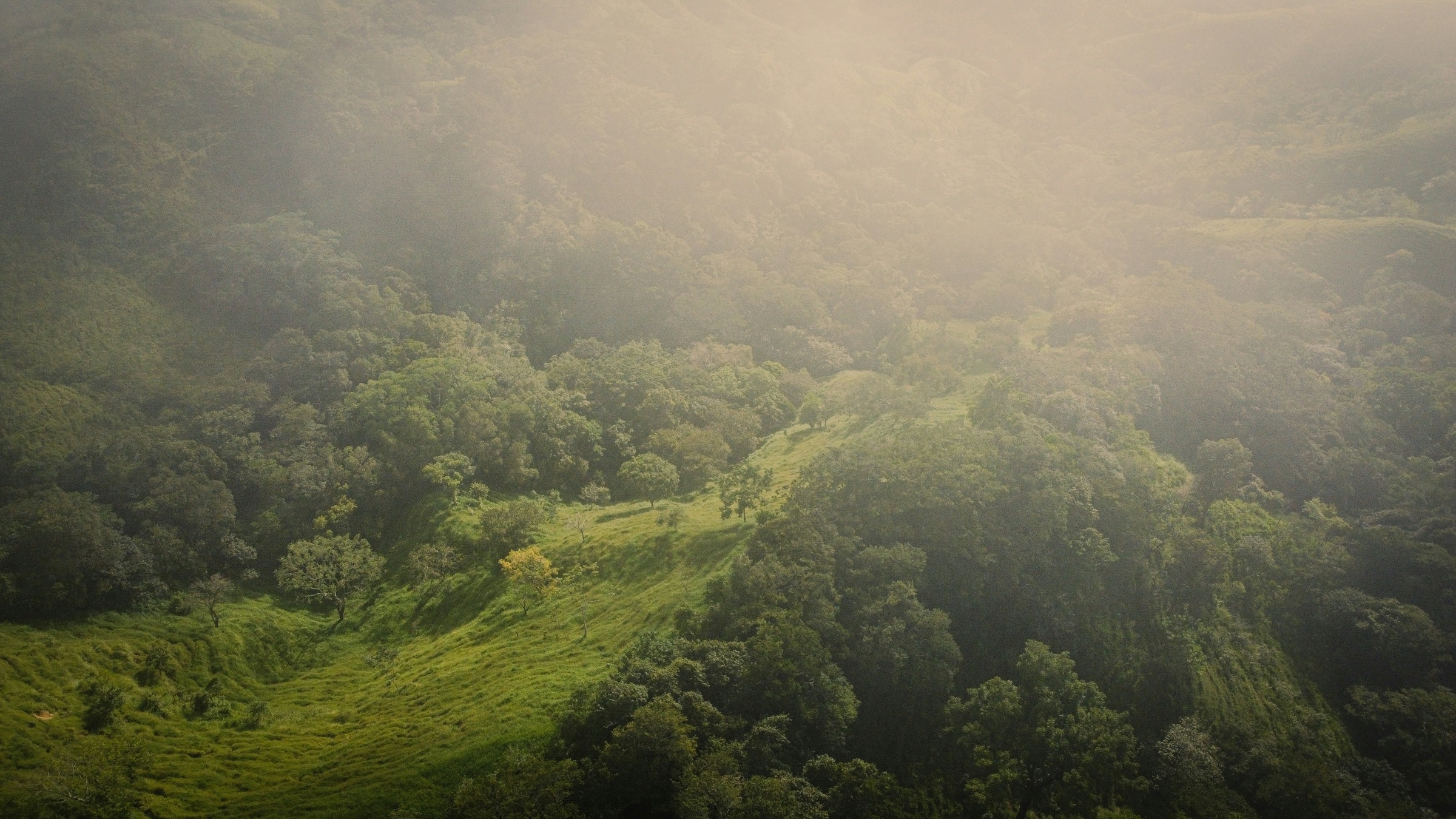
The trade winds hit the Tilarán mountains around 1,500 meters and stall. The mist they carry — hauled up from the Caribbean lowlands — has nowhere to go, so it stays. It hangs in the canopy at Monteverde for most of the year, not as rain exactly but as something thicker: a slow, cold saturation that beads on leaves within seconds of the sun going behind a ridge, which happens often. You walk the Sendero Bosque Nuboso in the Santa Elena Reserve and your jacket is wet before you've crossed the first hanging bridge. Everything around you is wet too — the bark, the moss skins on every branch, the air itself, which reads on a decent hygrometer somewhere between 85 and 100 percent, depending on whether the clouds are moving or parked.
What you are standing inside is an orographic cloud forest, a biome created by geography rather than latitude. Costa Rica's continental divide runs through here like a spine, and the moisture-laden Caribbean air is forced upward, cools, and condenses at the elevation where trees happen to be growing. The result is a canopy so perpetually damp that the trees themselves have become scaffolding for entire secondary communities — mosses and liverworts plastering the bark, bromeliads wedged into every fork, orchids sending roots into the air, and aroids pinning themselves along trunks with roots that grip rather than drink. In a drier forest, most of these passengers would desiccate and fall. Here, they accumulate across decades until a single Quercus branch carries more biomass in epiphytes than most temperate trees produce in their crowns.
How a Mountain Makes a Microclimate
Monteverde sits at roughly 1,440 meters above sea level on the Pacific slope of the Tilarán range, but it straddles the divide closely enough that the Caribbean influence dominates its weather for much of the year. The trade winds drive moisture westward; the mountains intercept it. This is not a seasonal story — the mist arrives reliably enough that the forest has a distinct name for the phenomenon: garúa, the horizontal drizzle that soaks you without ever quite becoming rain. Annual precipitation in the reserve runs around 2,500 to 3,000 millimeters when you count both rain and cloud moisture interception by the vegetation itself. Epiphytes, it turns out, are extremely efficient at intercepting cloud water and dripping it to the forest floor — they function as a secondary canopy catchment.
Elevation and exposure together create a mosaic of microclimates within a few kilometers. The windward slopes stay wetter; the leeward Pacific side dries out enough for deciduous trees in the dry season. The cloud forest corridor in between — where the reserves are concentrated — experiences relatively stable temperature (12–18°C year-round at canopy level) and near-constant humidity. That stability is the engine of epiphyte diversity. No hard dry season means no period of lethal desiccation for plants with no contact with the soil. A bromeliad that impounds water in its central tank can persist through slight fluctuations; a velvet-leaved aroid that loses water rapidly through large leaf surfaces can survive because the air itself replaces what transpiration takes.
The mist doesn't pass through Monteverde — it lives there, and every organism in the canopy has reorganized itself around that fact.
The Anthurium That Hangs Like a Strap
Anthurium wendlingeri is one of the stranger aroids in the Neotropics, and its strangeness is a direct response to growing in a place where water arrives laterally, from fog, rather than vertically, from rain. The leaves are strap-shaped — pendulous, narrow, sometimes exceeding a meter in length — and they hang. This is not the architecture of a plant competing for horizontal light in a bright clearing. This is a plant that has reduced its exposed surface per unit of length to avoid being ripped from its perch by wind while still capturing the diffuse light of a permanently overcast canopy. The leaf undersides are a deep, burnished green, but it is the texture — that dense, plush, light-scattering velvet — that signals something important about the epidermis: the papillae responsible for velvet help manage light and may reduce water loss in the brief periods when the mist lifts.
What stops collectors short, beyond the straps, is the inflorescence: a corkscrew spadix, spiraling loosely, botanically anomalous among anthuriums and unmistakable. Its function is debated, but one hypothesis is that the spiral increases the surface area available for the small beetles that pollinate it within the spatial constraints of a hanging habit. A. wendlingeri grows on mossy branches in premontane and cloud forest zones in Costa Rica and Panama, typically 800 to 1,800 meters — elevation ranges that map almost perfectly onto the Monteverde corridor. In cultivation it needs exactly what you would predict from its habitat: coarse, fast-draining bark mix, humidity above 70 percent, bright indirect light, and roots that never sit in standing moisture despite the plant never fully drying. That paradox — constant atmospheric moisture, excellent drainage — is the cloud forest in a nutshell.
Fenestrations at Elevation
Anthurium friedrichsthalii solves a different problem. Its leaves are naturally fenestrated — perforated by elongated holes running parallel to the midrib — and at first glance this seems counterintuitive in a forest defined by its moisture. Why make holes in a leaf that needs to photosynthesize in already-low light? The leading answer involves wind. Cloud forests are not still. The orographic winds that deliver the mist also move constantly through the canopy, and large intact leaves at elevation can be shredded or snapped from their petioles by gusts. Fenestrations allow wind to pass through rather than lever against the lamina — the same reason Monstera leaves split in exposed conditions. A. friedrichsthalii grows as an epiphyte on moist forest trees, its roots anchored into mossy bark, its leaves angled to catch the diffuse light that filters through the cloud.
The plant is not widely kept outside specialist collections, partly because it lacks the velvet drama of its relatives, partly because its elongated fenestrated leaves are harder to stage in a photograph. That is a collector's loss. In a forest context, these leaves are elegant in precisely the way functional adaptations tend to be — no excess, nothing decorative, everything solving a problem. Pair it with the root behavior: A. friedrichsthalii sends substantial aerial roots that travel well beyond the immediate substrate, exploring bark and moss for mineral inputs that are genuinely scarce in an environment where nutrients leach rapidly in constant moisture. You see the same root behavior in cultivation and often misread it as distress. It is not distress; it is the plant doing what cloud forest anthuriums do.
Trees as Architecture for Other Lives
The host trees in Monteverde's cloud forest — principally oaks of the genus Quercus, joined by Clusia, Ocotea, and Weinmannia species — are extraordinary not for their own growth but for what they support. A mature Quercus copeyensis in the reserve may carry sixty or more species of epiphyte on a single major branch: tank bromeliads (Tillandsia and Werauhia species) impounding water and small invertebrate communities in their leaf axils; miniature orchids pressed into the moss skin; peperomias in the crevices of bark; and aroids — juveniles of Monstera, Philodendron, and Anthurium — running their roots under the moss mat and unfurling leaves into the available light. The branch is not a branch. It is a gradient of niches organized by moisture availability, light, bark texture, and proximity to the bromeliad water tanks that create local wet spots even when the mist briefly recedes.
The moss layer itself is structural. Cloud forest mosses can hold many times their dry weight in water, and they release it slowly — giving epiphyte roots a consistent moisture source that buffers against the relatively short windows when the cloud lifts and humidity dips. Collectors who grow cloud forest species in cultivation and wonder why a bark-and-perlite mix isn't quite working often find the answer here: the substrate their plants evolved in is living, water-retentive moss over bark, not inert media. Long-fiber sphagnum in cultivation approximates this reasonably well. It dries at a rate the plant recognizes.
The Quetzal and the Tourist Economy
The resplendent quetzal (Pharomachrus mocinno) is the reason many visitors book Monteverde before they have heard of an epiphyte or an aroid. The male, with its meter-long tail feathers and iridescent green plumage, is genuinely disorienting to encounter — a bird that looks incorrectly rendered, like a rendering error in a forest simulation. Quetzals nest in cloud forest at 1,200 to 3,000 meters, depend on wild avocados (Lauraceae) for much of their diet, and cannot persist in degraded habitat. Their presence in Monteverde is directly connected to the integrity of the forest.
That integrity is not accidental. The Monteverde Cloud Forest Reserve was established in 1972, and the surrounding area developed its ecotourism infrastructure gradually enough that it retained habitat rather than converting it. Today the reserve and adjacent Santa Elena Reserve together protect around 10,500 hectares. The canopy walkways and hanging bridges — there are eight bridges on the main trail circuit, the longest spanning 170 meters — were designed to move visitors through the forest without ground disturbance, and they deliver something unusual in ecotourism: genuine contact with the canopy zone, at the elevation where the epiphytes are. You are not looking up from a trail. You are standing in the layer where Anthurium wendlingeri hangs its strap leaves into the mist.
The economic argument for conservation is visible and functional here. The reserve charges entry; the guides are local; the lodges have incentive to keep the forest intact because the quetzal and the cloud are the product. It is not a perfect system — there is persistent pressure from agriculture on buffer zones, and climate projections suggest the cloud base may rise as temperatures increase, potentially compressing the cloud forest zone upward. But for now, the forest is there, accessible, and extraordinary.
What the Mist Does to a Collector's Mind
Walking into Monteverde with any background in aroid cultivation produces a specific kind of recalibration. You recognize the species — or near-relatives of species you grow — and then you see the conditions they are growing in, and the gap between what you provide and what they experience becomes suddenly measurable. The humidity is not the main thing, though it is high. The main thing is the air movement: the mist moves. It arrives, deposits moisture, and the wind continues. Leaves are constantly refreshed with new humid air rather than sitting in stagnant wet conditions. Growers who run ultrasonic humidifiers in still grow tents and then wonder why their cloud forest species develop bacterial rot are observing this gap firsthand. Airflow matters as much as humidity.
The light is also instructive. Under the canopy at midday, with the cloud thick, it is dim — 200 to 500 foot-candles in many spots, less in deeply shaded positions. This is the light level at which A. wendlingeri evolved its velvet leaf surface and its pendant habit, maximizing surface area while minimizing wind resistance. In cultivation, bright indirect light near an east-facing window replicates this better than a south-facing exposure with a sheer curtain. The plants are telling you exactly what they need if you know where they come from.
Book the Flight
Monteverde is approachable in a way most significant cloud forest sites are not. San José is a three-hour drive; the road is rough by the last stretch but passable in a regular vehicle. The reserve opens at seven in the morning. Early entry, before the tour groups arrive, puts you on the trails in the thickest mist, when the light is flat and the epiphytes are dripping and the forest is at its most atmospheric. A guided walk with one of the reserve's naturalist guides — people who know the trees by their bark and can find a nesting quetzal by its call — covers more biological ground in three hours than a week of independent wandering.
For collectors, the trip reorients the entire project of indoor growing. You stop trying to approximate a generic tropical aesthetic and start trying to replicate a specific set of conditions for specific plants: a particular temperature range, a particular light quality, a particular rhythm of moisture arrival and mild drying that matches what a cloud forest delivers between mist events. Anthurium wendlingeri in a good setup stops being a slow, expensive challenge and becomes something you understand. The forest explains the plant. The plant sends you back to the forest. That loop is, ultimately, what collecting is actually for.