Stand in the Masoala Peninsula's lowland forest on Madagascar's northeastern coast and the disorientation is immediate. The trees are wrong. The animals are wrong. The orchids hanging in the canopy gap above you are wrong — not wrong in a defective sense, but wrong the way a parallel answer to a shared question is wrong. Everything here evolved under the same broad planetary pressures as forest life elsewhere: compete for light, attract a pollinator, deter a herbivore, distribute a seed. But Madagascar solved each problem differently, starting from a different genetic deck, in a sealed room, for an almost incomprehensible span of time.
The island separated from the Indian subcontinent roughly 88 million years ago, after an earlier split from Africa around 165 million years ago. What remained on that drifting fragment was a sample of Gondwanan life — incomplete, accidental — and whatever managed to cross the Mozambique Channel on rafts of vegetation in the millions of years since. From those founder populations, Madagascar assembled an entirely new biota. Approximately 90 percent of its terrestrial wildlife is found nowhere else on Earth. That figure is not a conservation talking point. It is the arithmetic of deep isolation, and it shapes every organism you see, from the ground up.
A Raft Across Deep Time
The geological story begins with the breakup of Gondwana, the southern supercontinent that once united what is now Africa, South America, Antarctica, Australia, and the Indian subcontinent. Madagascar peeled away from Africa first, around 165 million years ago, then detached from India approximately 88 million years ago. It has been effectively alone ever since, sitting in the Indian Ocean about 400 kilometers east of Mozambique — close enough to be tantalizing, far enough that the Mozambique Channel has functioned as an almost impassable barrier. Most continental land bridges, even temporary ones, eventually let fauna shuffle between landmasses. Madagascar never had one.
What this means in practice is that the island's original Gondwanan stock — plants, reptiles, early mammals — evolved in isolation without the competition, predation, and genetic input that reshaped their relatives elsewhere. New arrivals, when they did come, crossed water on flotsam, a lottery that favored small body size and biological flexibility. Those that survived found a land of empty niches and filled them in directions that continental evolution never took. The result is not a museum of ancient forms, though some persist. It is a live experiment, still running, in what life does when the normal constraints are lifted.
The eastern rainforest belt, running along the island's windward escarpment, is where that experiment reaches its densest expression. This strip of humid forest — narrowed dramatically by agriculture but still spectacular where it survives — receives orographic rainfall as Indian Ocean trade winds hit the highlands. Masoala, Ranomafana, Andasibe-Mantadia: these are the names that matter. They represent different altitudes and microhabitats, but all share the essential character of Madagascar's wet forest: layered, epiphyte-laden, and stocked with organisms that answer to no reference point on the mainland.
Darwin predicted the moth before anyone had seen it — a single orchid spur, twelve inches deep, forced his hand.
The Orchid That Made Darwin Uncomfortable
In 1862, Charles Darwin received a box of orchid specimens from Madagascar. Among them was Angraecum sesquipedale, a white, star-shaped flower from the eastern lowland forest. Its most arresting feature was its nectary — a hollow spur at the base of the flower extending roughly 30 centimeters, nearly a foot, in a tight green whip. Darwin examined it and wrote to a correspondent that a moth must exist with a proboscis long enough to reach the nectar at the spur's base. He was mocked for this prediction. No such moth was known.
Twenty-one years after Darwin's death, in 1903, entomologists described Xanthopan morganii praedicta — the subspecies name meaning, essentially, 'the predicted one.' The hawk moth carries a proboscis that, when uncoiled, extends to match the spur. This is coevolution made visible: each incremental extension of the spur favored moths with longer tongues, who could drink nectar competitors could not reach, and each incremental lengthening of the moth's tongue created selective pressure for still-deeper nectaries, locking the two species into an arms race that ended in a structure extreme enough to embarrass a skeptic. The flower could not have been built anywhere else, because the moth that drove its architecture is found nowhere else. Remove either party, and the system collapses.
Angraecum sesquipedale also illustrates a broader principle of the eastern forest: the specificity of its relationships. Continental ecosystems often have more redundancy — if one pollinator fails, another steps in. Madagascar's long isolation produced tight, often exclusive pairings between plant and animal, which makes the system extraordinarily refined and, in the same stroke, fragile. The precision is a product of the same isolation that makes the island extraordinary.
Lemurs and the Mammals That Weren't
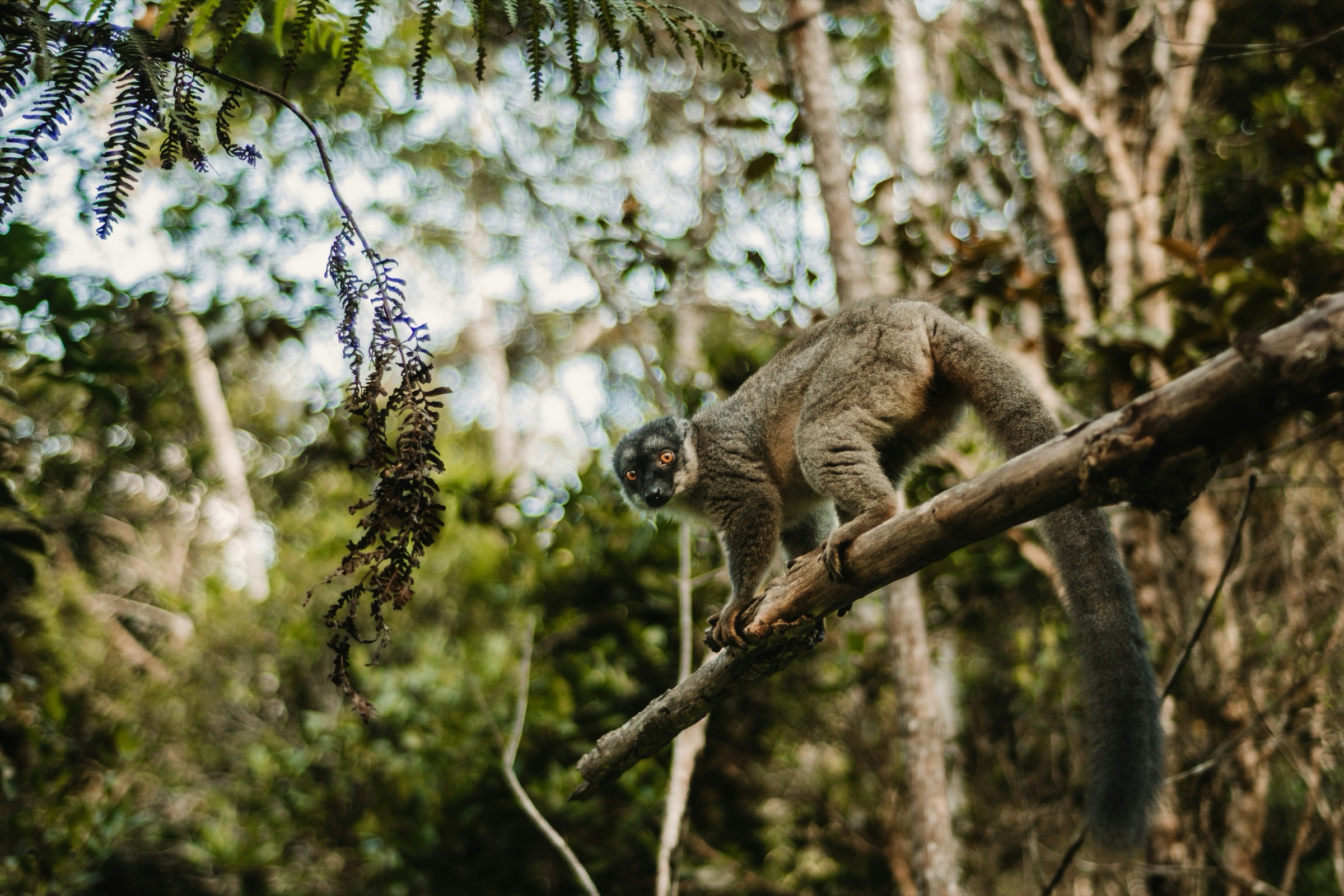
The mammals of Madagascar's rainforest require a moment of reorientation for anyone trained on African or Asian wildlife. The island has no great apes, no cats, no rhinoceroses, no deer. What it has instead are lemurs — around 100 recognized species, representing an entire suborder of primates, Strepsirrhini, that was outcompeted and largely replaced on the mainland by the higher primates but found a refuge here. The indri (Indri indri) is the largest living lemur, reaching up to 9 kilograms, and its territorial calls carry through the Andasibe-Mantadia canopy at dawn with the quality of a foghorn — haunting, unnervingly loud for a primate that could fit in your arms.
In the rainforest understory and canopy, lemurs fill roles that monkeys and squirrels and small antelopes occupy elsewhere. Some are frugivores critical to seed dispersal for large-seeded trees. Others are folivores, occupying a niche that convergently resembles that of colobus monkeys in Africa, despite sharing no recent ancestor with them. The aye-aye (Daubentonia madagascariensis) uses a percussive foraging strategy — tapping bark to locate wood-boring larvae by sound, then extracting them with a skeletal, elongated third finger — that is functionally identical to the method used by woodpeckers. There are no woodpeckers in Madagascar. The aye-aye is the woodpecker, built from primate materials.
This pattern — convergence on ecological function through entirely different anatomy — repeats itself across the island's fauna and flora. It is not that Madagascar's evolution is bizarre for its own sake. It is that the island's isolation forced its organisms to solve the same ecological problems that continental species solved, but with a different starting toolkit.
Plants That Wrote Their Own Rulebook
The traveller's palm, Ravenala madagascariensis, is one of the most recognizable silhouettes in tropical horticulture: a single plane of enormous banana-like leaves fanning from a central trunk like a living paddle. It is not a palm at all but a member of the family Strelitziaceae, related to the bird-of-paradise flower. Its common name comes from the water that collects in the bases of its leaf sheaths — useful in an emergency, though the 'traveller's compass' story, that the fan always aligns east-west, is unreliable in practice. What is reliable is its relationship with the black-and-white ruffed lemur (Varecia variegata), which pushes its face into the flower to drink nectar and emerges dusted in pollen. The flower's structure — robust, accessible to a creature the size of a small dog — makes sense only in the context of a lemur pollinator. On a continent without lemurs, the plant would need a different partner.
The baobabs of Madagascar present a different kind of astonishment. Six of the world's eight Adansonia species are endemic to the island, a distribution that suggests the genus diversified here after a single colonization event rather than being shared equitably around Gondwana. Adansonia grandidieri, the giant of the group, grows in the dry western part of the island, not the rainforest, but its existence anchors the broader point: Madagascar did not merely retain its biological inheritance from Gondwana. It elaborated on it, producing more variety within a single genus than exists across all of Africa and Australia combined.
The eastern rainforest also hosts pitcher plants of the genus Nepenthes — specifically Nepenthes madagascariensis in coastal and transitional habitats, a carnivorous plant whose pitfall traps supplement nitrogen intake from the island's poor, acidic soils. Carnivory in plants is almost always a response to nutrient-deficient substrate, and the sandy, laterite-influenced soils of Madagascar's eastern margins drive exactly that adaptation. The pitchers are modest by the standards of Bornean Nepenthes, but their presence on an island this far from the genus's Southeast Asian center of diversity is another reminder of how far colonization events, given enough time, can carry a lineage.
What Isolation Actually Feels Like
Walking the Masoala forest, the sensation of biological foreignness accumulates. The geckos clinging to leaves are Uroplatus — flat-tailed, bark-mimicking, with skin so perfectly textured to its substrate that finding one feels like a perceptual trick. The chameleons are absurd: Madagascar holds roughly half the world's chameleon species, ranging from Furcifer pardalis, the panther chameleon, blazing in turquoise and red in the north, down to Brookesia micra, a leaf chameleon small enough to perch on a matchstick. No closely related chameleons exist on the African mainland with this density or diversity. The island had a head start and an empty stage.
The forest itself runs through layers familiar to any rainforest visitor — emergent canopy, closed mid-story, a dim understory full of palms in the family Arecaceae (Madagascar has around 170 endemic palm species) — but the composition is wrong by mainland standards. There are no Ficus strangler figs dominating the canopy. The family Sarcolaenaceae, seventeen tree species with no relatives outside Madagascar, forms part of the closed canopy here. You are not in a variant of African or Asian forest. You are in a different forest, built from a different library.
The Crisis Running Underneath
Madagascar has lost an estimated 90 percent of its original forest cover. The eastern rainforest, which once formed a more or less continuous belt along the island's windward escarpment, now exists in fragments — some protected, many not. The pressure is slash-and-burn agriculture, called tavy, practiced by a population of over 28 million people, the majority of whom live in deep poverty. This is not a story of villains. It is a story of people without alternatives burning the forest they have to feed families, and a global conservation apparatus that has not solved the substitution problem at sufficient scale.
The biological consequence of fragmentation is what ecologists call an extinction debt — species that appear to persist in small fragments but whose populations are below viable reproductive thresholds, locally extinct in slow motion. The tight ecological pairings that make Madagascar extraordinary — the orchid and its moth, the traveller's palm and its lemur, the specialized fig relatives and their dedicated pollinators — are exactly the structures that fragment worst. Break the link anywhere and the chain fails.
Conservation organizations have made real gains: Masoala National Park, established in 1997, protects around 2,300 square kilometers of lowland and montane rainforest and has been monitored continuously for over two decades. The picture is mixed. Illegal logging and boundary pressures remain serious. But the forest is still there in Masoala, still producing the disorientation of standing somewhere that evolution answered differently.
The Draw
There is a version of the Madagascar story told as tragedy, and it is not false. But there is another version, truer to what the eastern forest actually delivers to anyone standing in it: the experience of confronting evolution's contingency. Life on Earth did not have to look the way it looks. The forms we treat as inevitable — a primate that looks like a monkey, a pollinator that is obviously an insect, a forest structured around the species we expect — are products of a particular competitive history, not laws of nature. Madagascar suspended that history for 88 million years and built something else.
The closest analogy is not a nature reserve. It is not even another forest. The closest analogy is the thought experiment physicists run when they ask what would happen if a fundamental constant were slightly different. The constant here is time and isolation, and Madagascar ran the experiment to completion. What you find in the eastern rainforest is not a window into a lost past or a preview of an endangered future. It is a present tense that diverged from ours a very long time ago and never looked back.