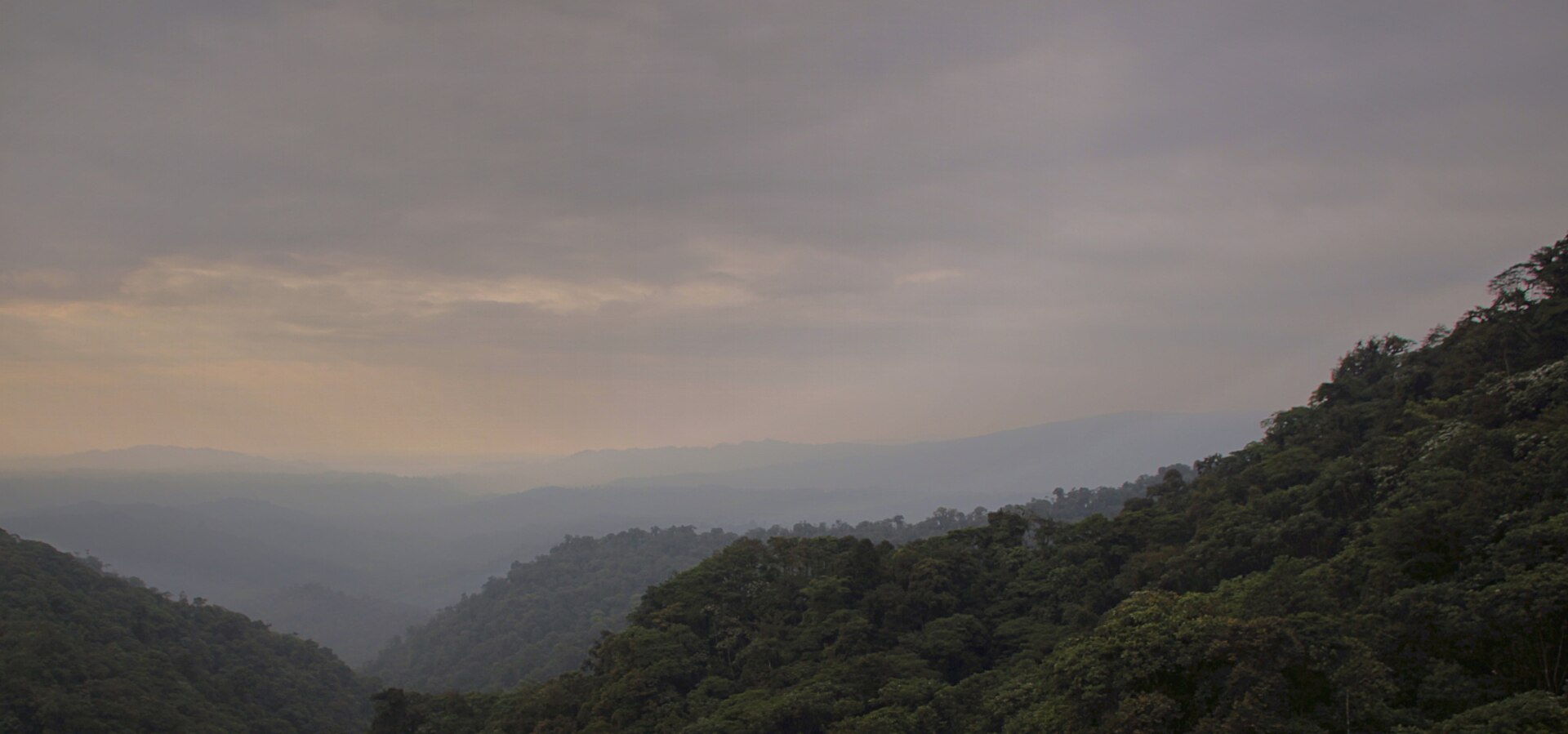
The road out of Mindo drops fast enough that your ears pop before the cloud swallows the windshield. At around 1,600 metres the cecropia canopy closes overhead and the moss deepens on every surface — bark, wire fences, the rusted chassis of a long-dead truck half-swallowed by a roadside bank. Bromeliads colonise anything stationary for more than a season. The air is cold and saturated, the kind of humidity that reads as physical weight. In this forest, that is entirely normal. It rains here more than 3,000 millimetres a year, and much of the moisture arrives not as rainfall at all but as horizontal fog driven off the Pacific, intercepted by the western flank of the Andes before it ever reaches the lowlands.
The eastern ranges tell a different story with the same grammar. The Cordillera de Cutucu and the adjacent Cordillera del Condor, tucked against the Peruvian border in southeastern Ecuador, are geologically older and botanically more isolated. Access is harder — rough roads, then mule trails, then ridge walking in cloud that settles in permanently by mid-morning. Botanists who work here talk about the ranges the way you talk about a library where half the books are still being written. New plant species are described from these collections almost every year, not because the forests are newly discovered, but because the species diversity is genuinely that deep.
The Elevator Effect
What makes Ecuador's Andean flanks so productive for plant diversity is something ecologists call the elevational gradient — the principle that a few hundred vertical metres can produce a shift in temperature, cloud cover, soil moisture, and light regime so complete that the plant communities on either side share almost nothing. On the western slope near Mindo, the transition from premontane to montane forest happens between roughly 1,200 and 1,800 metres. The temperature drops around 6°C per 1,000 metres gained; the cloud base intercepts the ridge somewhere in that band and pins a belt of persistent fog that differs from both the drier lowland and the colder ridge above. Lichens replace epiphytic mosses at a certain altitude. The aroid genera shift almost as predictably.
This stacking of microclimates is why Ecuador, which occupies less than half a percent of Earth's land surface, contains something close to ten percent of all vascular plant species. The country's species-per-square-kilometre rate for plants is among the highest on the planet. The Andes running north-south act like a wall that interrupts every weather system off two oceans, and the result is dozens of narrow ecological bands set on steep terrain — each one long enough to sustain endemic species, short enough that those species never need to disperse far to survive. Narrow endemics are not a quirk here; they are the expected outcome of the landscape's architecture.
Aroids exploit this architecture with particular efficiency. Most of the genus Anthurium — the largest genus in the family, with well over 1,000 described species — concentrates in precisely this kind of montane and premontane zone across the northern Andes. The family's preference for high humidity, indirect light filtered through canopy layers, and the chunky, fast-draining organic debris that piles up on steep slopes means that cloud forest is not a marginal habitat for them. It is the centre of gravity.
Every few hundred metres of elevation is a different country for a plant, and the aroids keep proving it.
Cutucu's Contribution
The Cordillera de Cutucu sits east of the main Andean chain, an outlier range that rises to just over 2,500 metres and is cut by steep river valleys draining into the Amazon basin. Its isolation — geographically separated from the main cordillera by lowland corridors — means that populations of plants stranded there have had time to diverge. The result is a higher proportion of local endemics than you would expect from a range of its size.
Anthurium cutucuense is one of the species that came out of collections made in these ranges. It is a dramatic plant: the leaf blade is deeply pinnatifid, meaning it is cut almost to the midrib into opposite lobes, giving the mature leaf a skeletal, architectural quality that is unlike the entire-bladed anthuriums that dominate collectors' wishlists. The lobing is not ornamentation — in dense forest understorey with irregular light, a deeply divided blade can intercept diffuse light from multiple angles without creating the shading problem a solid blade of the same area would produce. The Cutucu's broken topography and deep forest shade select hard for precisely this kind of leaf architecture.
Collecting new records from the Cutucu is still genuinely difficult work. The range has no paved road access at its higher elevations, and collections from it remain sparse relative to the species richness that researchers suspect is there. When botanists do return with specimens, they consistently find plants that do not match existing descriptions.
Philodendron patriciae and the Logic of Length
Philodendron patriciae is found on Colombia's Pacific slopes and extends into Ecuador's northwestern ranges — exactly the kind of biogeographic spread you expect from a species tied to the western Andean cloud forest belt. Its leaves are among the most recognisable in the genus: very long, corrugated pendants, the blade hanging almost vertically from the petiole, with heavy transverse rippling that runs across the full width. Mature leaves on established plants can exceed a metre in length. The corrugation is structural — it increases the blade's surface area without increasing its span, and in a dripping cloud forest where water shedding matters as much as light capture, the ridged texture channels condensed moisture to the margin and tip, away from the stomata.
The pendant orientation is equally purposeful. In the forest strata where P. patriciae grows — on steep slopes, usually as a hemiepiphyte clinging to a mossy trunk — hanging the blade vertically reduces the angle of incidence for intense light bursts that pierce the canopy during gaps. It also reduces the leaf's exposure to the hammering of heavy rain. The plant is, in effect, shaped by the weather, and what makes it spectacular in a collector's growing space is the same thing that made it useful on a foggy ridge in Esmeraldas province.
Growing P. patriciae honestly means replicating the long, wet, never-quite-cold conditions of its native elevation band. It wants warmth — a minimum around 16°C is safer than anything lower — bright indirect light, very high humidity, and a substrate that stays moist but never becomes waterlogged. In practice: chunky peat-free mix with perlite, bark, and some sphagnum, a humidifier running nearby, and patience. Mature leaf size only comes with years and a rootmass that's had room to establish.
Lynnhannoniae: An Understory Specialist
Philodendron lynnhannoniae is less widely grown than patriciae but belongs to the same elongated-pendant leaf guild. Its blades are narrower and smoother, with a clean, elegant line and a petiole proportion that makes the whole leaf read as almost impossibly refined. Described from Ecuadorian collections, it represents the kind of species that gets discovered when a botanist pays close attention to a group of plants that all superficially resemble each other and notices that the venation pattern, petiole cross-section, and spathe morphology simply do not match any existing description.
The species name honours Lynn Hannon, a botanical illustrator whose work on Ecuadorian philodendrons helped document species that would otherwise have been lumped with similar-looking relatives. That kind of detailed illustrative work — rendering the exact curve of a cataphyll, the precise number of primary veins — is still essential in a genus where the species count is a moving target and field photographs rarely capture diagnostic characters with enough precision.
As a growing subject, P. lynnhannoniae rewards the same conditions as its relatives: warm, humid, bright but not direct. Its narrower blades are somewhat more sensitive to low humidity than the heavier-leafed philodendrons — edges will brown at the tip before any other damage shows, which is an early warning to raise the moisture in the air before the problem advances.
Anthurium wendlingeri and the Corkscrew Spadix
Among the pendant-leaved anthuriums, Anthurium wendlingeri is the one that stops people in their tracks at plant shows — not for the leaves alone, though the long, dark, velvet-textured straps are striking, but for the inflorescence. The spadix is spirally contorted, twisting on itself in a tight corkscrew that has no parallel in most growers' experience of the genus. It is not a cultivated novelty; that spiral is consistent across wild-collected material and is a genuine taxonomic character of the species.
The function of the spiral spadix is still not fully resolved in the botanical literature, but the leading interpretation involves pollinator specificity. Anthurium inflorescences are visited by specialist bees and thrips that navigate by tactile and chemical cues as well as visual ones; an unusual spadix morphology may track a very specific pollinator, reducing competition from other Anthurium species sharing the same forest. The fact that A. wendlingeri is found in the wet lowland-to-premontane transition zone on both Pacific and Amazonian slopes of Ecuador suggests a species that has successfully tracked its preferred habitat across a wide range — which implies the pollinator relationship is both functional and durable.
The velvet texture of the leaves, like the velvet found in Anthurium crystallinum or A. clarinervium, is produced by papillate cells on the upper epidermis — cells that protrude slightly and create the light-scattering surface that reads to the human eye as soft. In a forest understorey where diffuse light arrives from multiple angles, the papillate surface increases the range of angles from which the leaf can absorb usable photons. It is an adaptation that happens to produce something beautiful. Growing A. wendlingeri requires attention to the same conditions — warmth, high humidity, airy mix — with the addition of a mount or basket if you want to see the pendant leaves fully extend.
Growers, Taxonomists, and the Shared Chase
There is a productive and occasionally awkward overlap between the plant collector community and working field botanists in Ecuador right now. Collectors have, in many cases, been growing plants for years that scientists have not yet formally described — propagations from material that entered the trade before a species name existed, circulating under provisional names or location tags. When a description finally comes, growers sometimes find they have been cultivating a new species all along, or discover that what they thought was one species is actually two.
The taxonomic backlog in Anthurium and Philodendron is not a failure of effort; it is a consequence of genuine diversity and the difficulty of collecting from steep, remote terrain. Describing a new species correctly requires multiple fertile specimens, comparison with herbarium material from dozens of related species, and often molecular analysis to confirm that morphological differences are not just environmental plasticity. The Cordillera de Cutucu alone is thought to harbour undescribed species in both genera. Every field season that adds new collections narrows the gap slightly.
Growers who chase these plants are not separate from that process. The cultivation of rare Ecuadorian aroids funds part of the demand that sustains the interest in finding more of them. And the detailed observation that serious collectors put in — documenting how leaf morphology changes across instars, tracking spathe colour variation, noticing that two plants sold under the same name behave differently — contributes, in small ways, to the body of knowledge that eventually lands in a formal description.
Why You Would Want to Grow These Plants
The practical argument for Anthurium cutucuense or Philodendron patriciae in a collection is the same argument you make for any plant you want to grow well: understanding where it comes from tells you what it needs. The western Andean cloud forest never gets hot. It never gets dry. The substrate the roots occupy on a mossy trunk or a decaying log is open, oxygen-rich, and perpetually damp but never sitting in water. Temperature swings are small. Light is bright but filtered through a canopy and a permanent scrim of fog. If you can produce those conditions — a warm room held above 18°C, a humidifier, a bark-and-perlite mix in a terracotta pot or on a mount, a grow light dialled for bright indirect — these plants will perform. The forest is not mysterious; it is specific, and specificity is replicable.
The deeper draw, though, is what the collector community calls the frontier. Science genuinely has not finished cataloguing what lives on those fog-soaked ridges. New Anthurium species were formally described from Ecuadorian collections within the last several years, and the pace has not slowed. A plant that someone is currently growing under a provisional location name may be formally named next field season. The grail is not definitionally unobtainable — it's just that no one has written its description yet. That is a strange and specific kind of excitement, and it is entirely real.
To grow a Philodendron patriciae or an Anthurium wendlingeri in a spare bedroom in a northern climate is to maintain a living record of a place that most people will never visit — a ridge above the cloud line in a range the road hasn't reached yet, where the botanist's field notebook still has blank pages. The fog doesn't lift until noon, and by then you've seen three things you've never seen before. The plants carry a little of that with them.