The Pan-American Highway runs from Alaska to Patagonia, minus one deliberate gap. At the Colombia-Panama border, the road simply ends — swallowed by roughly 100 kilometers of swamp, jaguar territory, and montane forest so dense and politically complicated that engineers abandoned the idea of bridging it decades ago. This is the Darién, and it is not a place you visit casually. What lives there, ecologically speaking, has been largely left alone: no agricultural clearing on any meaningful scale, minimal road access, rainfall measured in meters per year rather than centimeters.
It is also, not coincidentally, where some of the most sought-after anthurium species in cultivation originated. The matte, near-black velvet leaves that collectors spend real money chasing — the ones behind 'Ace of Spades' and its many-named siblings — are expressions of a trait refined over millennia on the dark floor of Panamanian cloud forest. To understand the plants, you have to understand the place that made them.
What the Darién Actually Is
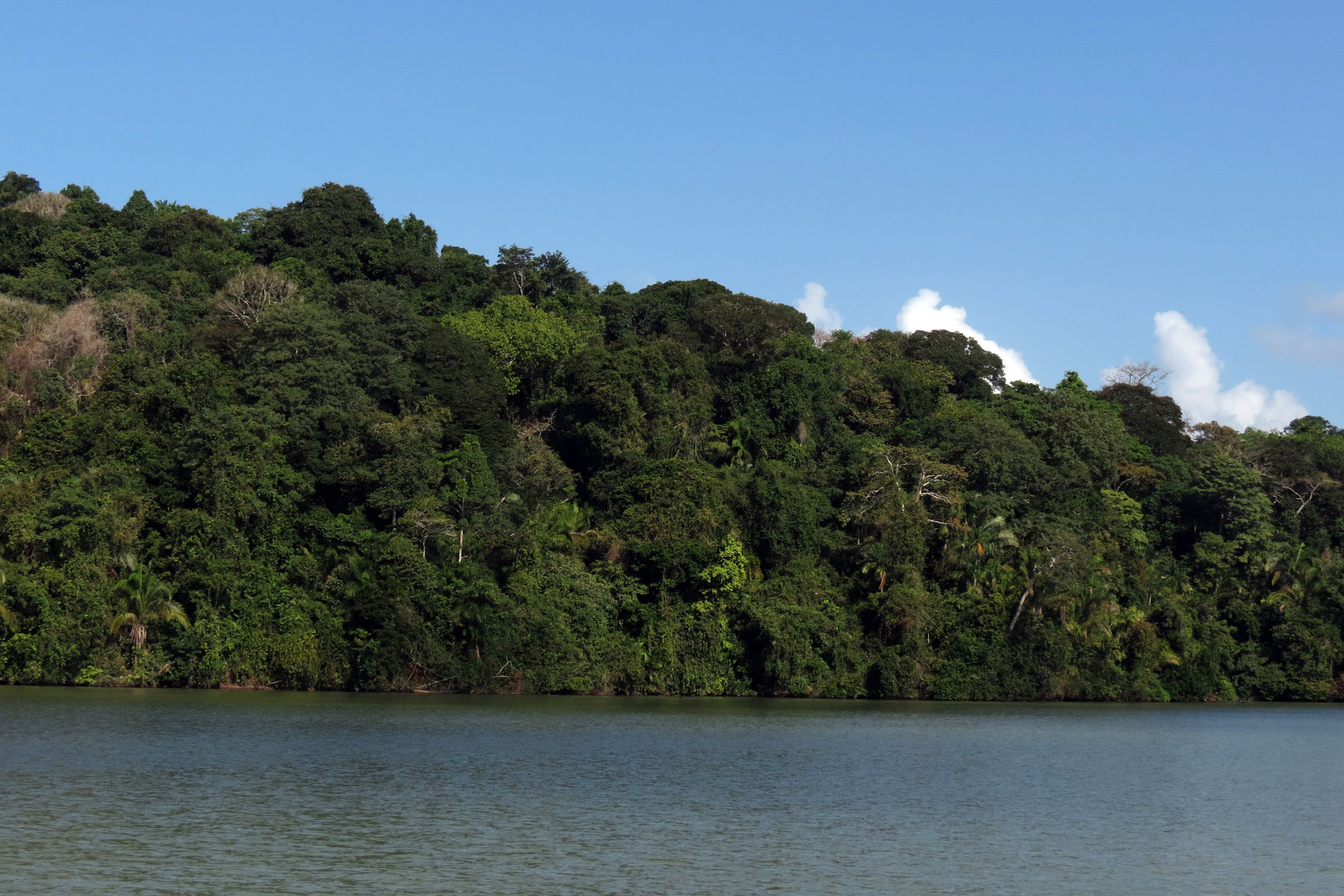
The Darién is not a single ecosystem but a compression of several. Pacific slopes carry a drier seasonal rhythm; Caribbean-facing flanks receive rain almost continuously, with annual totals reaching 3,000 to 4,000 millimeters in wetter zones. The cloud forest band — roughly 500 to 1,200 meters, depending on ridge orientation — sits in near-permanent mist, temperatures holding in the low-to-mid twenties Celsius, rarely spiking, never dipping to anything a tropical plant would call cold. Humidity stays above 85 percent for most of the year without anyone misting anything.
What this produces at ground level is a perpetual twilight. The canopy in mature Darién forest can exceed 40 meters, with a dense subcanopy beneath it, and a shrub layer beneath that. By the time light reaches the understory floor, it has been filtered through three or four successive layers of photosynthesizing material. Epiphytes colonize every available surface: mosses, ferns, bromeliads, and, clinging to trunks and fallen logs in the lower and middle stories, anthuriums.
Panama's position at the narrowest point of the Central American isthmus also means it catches weather systems from two oceans simultaneously. This geographic compression — mountains, two coastlines, and a land bridge all squeezed into a country smaller than South Carolina — creates microclimatic diversity within short distances. A ridge can separate a cloud forest from a drier valley in under ten kilometers. Species evolve in isolation on individual slopes, sometimes in ranges measured in tens of square kilometers rather than hundreds.
The velvet isn't ornamental. It's an engineering solution to a forest so shaded that leaves had to become light-collecting instruments of unusual precision.
Why Velvet Evolved Here
Velvet leaf texture in anthuriums is produced by elongated epidermal cells on the adaxial (upper) leaf surface — cells that stand upright rather than lying flat, creating microscopic structure that scatters incoming light in multiple directions rather than reflecting it from a single plane. The effect to the eye is matte, almost fabric-like. Under low-angle light, the surface appears to shift color slightly as you move around the leaf, from deep green to near-black.
This is not an accident of aesthetics. It is a solution to the specific light problem of deep understory existence. A flat, glossy leaf reflects a portion of the light that hits it. A velvet leaf — one with erect epidermal cells forming a light-trapping microstructure — absorbs a larger fraction of the photons that reach it. In a forest where usable light is already measured in small percentages of full sun, that difference matters. The velvet anthuriums of Panama are, in engineering terms, highly efficient low-light collectors.
The Darién and Panama's adjacent Chocó-adjacent forests are not the only place velvet anthuriums evolved, but they produced an unusually concentrated cluster of species with extreme velvet development and very dark coloration. The combination of stable temperatures, perpetual high humidity, and deep canopy shade created conditions where investing heavily in light-absorbing leaf structure was worthwhile. Species that made that investment survived and speciated; the ones on collectors' shelves now are their descendants.
Anthurium dressleri: The Narrowest Range
Anthurium dressleri has become a kind of benchmark species in velvet anthurium collecting — the name that signals seriousness. The plants that match the botanical description are found in a small area of Panama, in humid forest at low to middle elevations, and the wild population is genuinely restricted in range. This is not a species spread across multiple countries; it is tightly endemic to a slice of Panamanian forest, which makes both its survival in the wild and the provenance of cultivated specimens a legitimate concern.
The leaves are broadly ovate to cordate, heavily velveted, and in deep shade they read as nearly black-green — the kind of darkness that looks artificial indoors until you understand the forest it came from. Petioles are characteristically robust relative to leaf size. The plant grows as a hemiepiphyte in the wild, rooting in accumulated organic debris on trunks and in the angles of large branches rather than in mineral soil. Cultivated specimens respond to this: they want an extremely airy, chunky substrate, not the moisture-retentive mixes suited to aroids with terrestrial roots.
The name 'dressleri' in cultivation has become somewhat loose — applied to plants of uncertain parentage, unverified collection origin, or deliberate hybrid crosses that approximate the look. A true dressleri is worth distinguishing from these approximations, and reputable sellers can usually explain where their stock originated. The species' small wild range is a reason for that scrutiny, not a reason to avoid the plant.
Anthurium papillilaminum: The Foundational Parent
If dressleri is the benchmark name, Anthurium papillilaminum is the species that most shaped the velvet hybrid market, though collectors often don't realize it. Papillilaminum is the wild parent — formally or informally — behind a large number of named black-velvet crosses. Its name references the papillate texture of the leaf surface, the same elongated-cell structure that produces the velvet effect. In the wild it grows in humid Panamanian forest, hemiepiphytically, in conditions closely matching those dressleri favors.
What papillilaminum contributed to hybridization programs was primarily its reliability: it passes velvet texture and dark coloration to offspring with reasonable consistency, and it grows with somewhat more vigor than dressleri under artificial conditions. 'Ace of Spades' — possibly the most recognized name in the black-velvet anthurium trade — has papillilaminum in its documented or probable lineage, as do many of the named hybrids that followed it into the market. When collectors debate which hybrid 'looks most like a species,' they are often unknowingly describing how closely a given cross expresses papillilaminum's wild traits.
Growing papillilaminum as a species plant requires replicating Darién understory conditions more faithfully than most home environments provide by default. Temperatures should stay in the 20–26°C range consistently; cold drafts below 16°C damage leaves. Humidity above 70 percent is not optional — it is the difference between velvet that develops fully and velvet that looks dull and slightly crisp at the edges. Airflow matters as much as humidity: stagnant wet air produces fungal problems, while moving humid air replicates what happens at forest level when a mountain mist passes through.
Two Species Described in the 21st Century
Taxonomy in Panamanian anthuriums is still catching up to the actual diversity in those forests. Anthurium carlablackiae was formally described in 2022 — within the last few years — named for botanist Carla Black, who has worked extensively on Panamanian flora. Its description added another velvet species to the ledger from the same humid forest zone that produced dressleri and papillilaminum, and it serves as a reminder that botanists are still formally documenting species from these forests. The plant was not newly discovered in the sense of being previously unknown to local people or even to collectors who move plants through informal networks, but its scientific description, with formal type specimens and a published account of distinguishing characteristics, happened in living memory.
Anthurium kunayalense comes from a specifically identified region: the Guna Yala comarca, the semi-autonomous territory on Panama's Caribbean coast governed by the Guna people. The species name records that origin. Guna Yala's forests occupy the Caribbean slope of the Serranía de San Blás, ranges that catch Atlantic moisture and maintain the kind of perpetual cloud-forest humidity that velvet anthuriums require. The geographic specificity of the name matters: it links the plant to a politically and culturally distinct territory, which raises questions about collection ethics and benefit-sharing that the ornamental plant trade has not fully resolved.
The existence of two formally described species from this region within the past two decades suggests that earlier botanical surveys, however thorough, didn't reach every ridge. The Darién and adjacent mountain systems are difficult to survey systematically — access is genuinely hard, not merely inconvenient — and the density of epiphytic plant life on any given hectare of mature forest can be extraordinary. Botanists working there have commented that a single large tree can host more anthurium individuals than an entire suburban greenhouse.
From Forest Floor to Grow Tent
The translation from Darién forest to a collector's shelf is not seamless. What the forest provides for free — stable 23°C temperatures, 90 percent relative humidity, moving air from daily mist cycles, diffuse light under a 40-meter canopy, and a substrate of half-decomposed bark and moss accumulated on a branch over decades — requires deliberate engineering indoors. Grow tents with inkbird-controlled ultrasonic humidifiers, fan oscillation set on timers, T5 or LED panels at measured distances, and substrate recipes involving leca, bark, perlite, and sphagnum in roughly calibrated ratios: these are the hobbyist's approximation of Darién conditions, and they work well enough to produce leaves that approach wild quality.
The key variables, ranked by consequence if neglected: humidity first, then temperature stability, then light intensity (lower than most people assume — 50 to 150 foot-candles is genuinely enough for a velvet anthurium, and excess light bleaches the velvet and shifts coloration toward green), then substrate aeration. Wet, dense soil is the fastest path to root rot in any of these species. Their wild root systems explore rotting bark, not saturated earth. A mix that holds moisture but drains completely within two days of watering is about right.
None of the species discussed here require you to replicate the Darién precisely. They require you to understand what the Darién solved — the problem of living in deep shade under near-constant moisture — and to provide the conditions that allow that solution to express itself. A leaf that develops with full velvet texture and a saturated dark color is telling you that you've come reasonably close.
Why the Source Still Matters
The velvet anthurium market runs primarily on hybrids now. Most plants sold as 'black velvet anthurium,' 'Ace of Spades,' or any of the named cultivars that have proliferated over the past decade are crosses, not species. This is not inherently a problem — some hybrids are genuinely beautiful plants with better cultivated vigor than their wild parents — but it means the connection to the source forest has become abstract for many collectors.
The wild species are not museum objects. They are functional organisms in ecosystems where they play specific roles — as epiphytes on particular tree species, as hosts to particular insects, as part of nutrient-cycling processes in forest that has not been cleared. A. carlablackiae was described in 2022 from plants in situ. A. kunayalense is named for a territory whose forest cover is still largely intact partly because the Guna have governed it. The preservation of these places is not separate from the hobby; it is the condition that makes the hobby's plant material historically meaningful.
A collector who understands that papillilaminum's leaf structure is a solution to a specific light problem in a specific forest — and that dressleri's narrow range means its wild population has no buffer against habitat loss — grows both plants with more attention and advocates more usefully for the forests that produced them. The Darién is not accessible the way a botanical garden is accessible. But it is possible to understand it, and that understanding changes what the plants on your shelf mean.