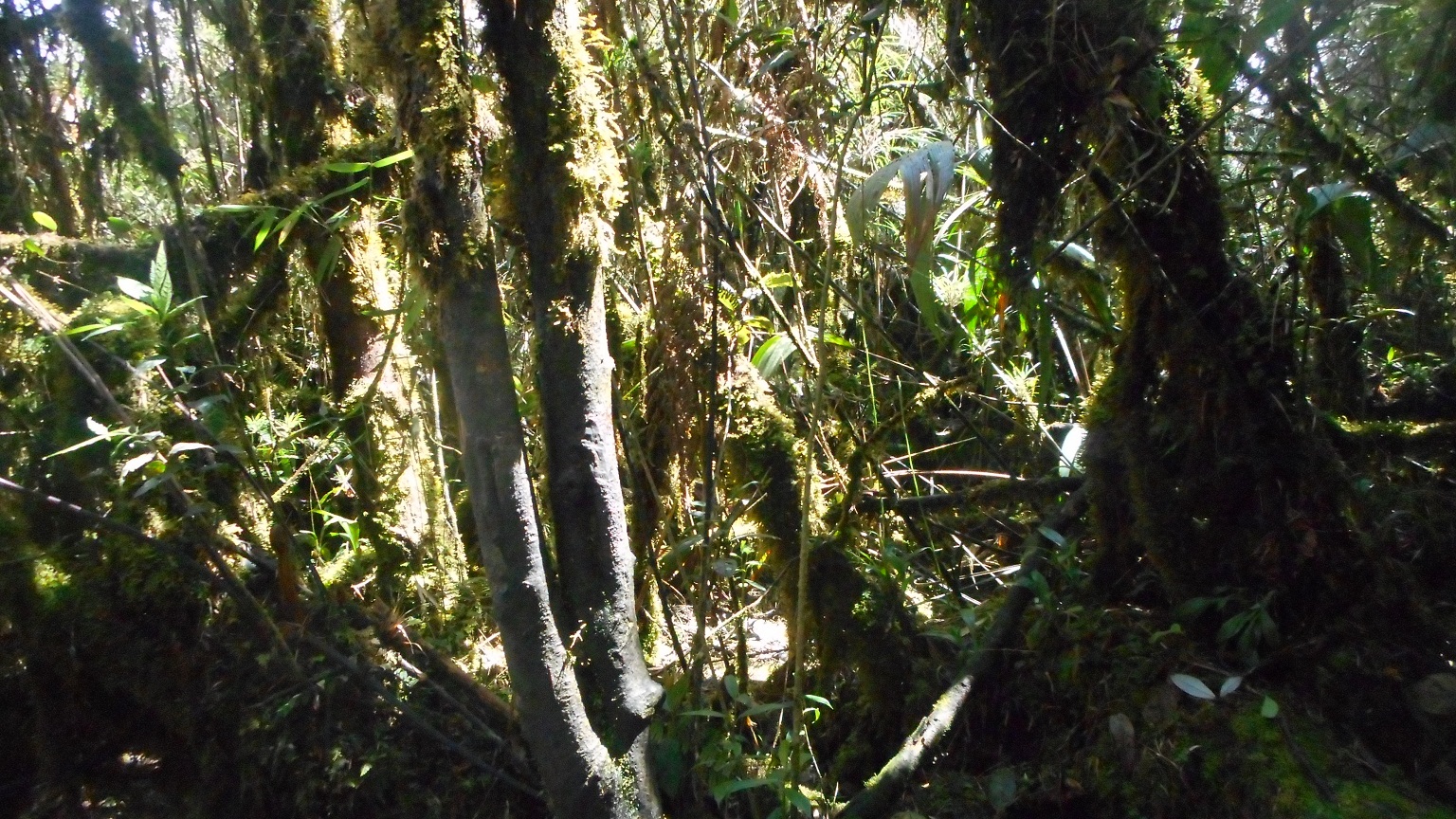
The forest begins before you can see it. Flying west from Medellín toward the Pacific coast, the Andes drop away into a slope so steep and so continuously wet that it holds its own weather system — a permanent column of vapour rising off the Atrato basin, pressing against the cordillera, condensing, falling again. From the air the canopy looks upholstered, every surface thick with moss and bromeliad, the whole thing steaming. On the ground, ankle-deep in the runoff of a river that hasn't stopped raining into itself in weeks, the light is the colour of an aquarium. It is roughly 18 degrees Celsius at 1,200 metres. It is always roughly 18 degrees Celsius.
This is the Choco biogeographic region, the Pacific slope between the Andes and the Colombian and Ecuadorian coast, and by rainfall it is the wettest forested place on Earth. Certain stations record twelve to thirteen metres of annual precipitation — not seasonal deluge but a near-continuous condition. The dry season, such as it is, means the rain slackens for a few weeks in January. What this produces, over millions of years of undisturbed pressure, is endemism on a scale that still does not have good numbers: botanists have formally described only a fraction of the vascular flora. What it has produced for collectors is the single greatest concentration of the plants they are actually chasing.
A Forest Built by Constancy
Most tropical forests have a pulse — wet season, dry season, a rhythm plants key their phenology to. The Choco has almost none. Rain falls roughly 300 days a year. Humidity in the understory rarely drops below 85 percent and frequently sits above 95. The soil is perpetually saturated, which is why the larger trees have developed buttress roots the size of walls, and why epiphytes colonise every horizontal surface within weeks of exposure. The constancy is the point: evolution here selected not for drought tolerance or seasonal dormancy but for capturing the most light from the least of it, because permanent cloud cover and a multi-storey canopy together reduce understory photosynthetically active radiation to something between two and five percent of what falls on the canopy top.
It is this combination — extreme moisture, cool stable temperature, and extreme shade — that explains velvet. The microscopic papillae covering the adaxial surface of Anthurium warocqueanum or Philodendron gloriosum leaves are not decorative. They increase the effective surface area available to capture scattered, low-angle light. They also refract what little light arrives, bouncing it laterally across the mesophyll rather than letting it pass straight through. Velvet leaves in the Choco are a photonic adaptation to an environment of permanent dim green twilight. Put the same leaf under direct equatorial sun for two hours and the papillae concentrate light into burn points. The leaf crisps. This is not a dramatic exaggeration — it is simply what happens, and it is why these plants require what they require in cultivation.
The geography compounds everything. The Andes act as a barrier to the drier air of the Amazon basin to the east. Pacific moisture from the ITCZ rolls in with nothing to stop it. The result is that the Choco sits in a permanent orographic trap, clouds building against the cordillera's western face, dumping rain, drifting back up the slope, condensing again. The plants that live here did not adapt to occasional flooding. They adapted to water as a baseline state.
In the Choco the question is not whether the forest is wet. The question is in which direction the water is currently moving.
The King in Its Element
Anthurium veitchii is the most theatrical of the Choco's anthuriums in cultivation, and in the forest it is, if anything, more extreme. The leaves hang — pendant, strap-shaped, corrugated lengthwise in ridges that run the full two-metre span of a mature blade — from cliff faces and the vertical buttresses of large trees, almost always in the spray zone of waterfalls or seeps where the rock face weeps continuously. The pendant habit is not arbitrary. In a saturated understory, a horizontal surface accumulates standing water and fungal load; a vertical or pendant blade sheds both. The corrugated ridges channel water away from the midrib, where standing moisture would invite rot, toward the drip-tip and off the leaf entirely.
In cultivation A. veitchii is frequently grown mounted or in baskets precisely because the leaves need somewhere to hang. Growers who try it in pots find the new leaves crumple against the rim and corrugate unevenly, stressing the petiole. The plant wants to express length downward. In the Choco it achieves this from rock outcroppings fifteen metres above a canyon floor, the corrugated straps catching the mist that rises off the water below. No cultivated specimen quite reaches that scale, but the biggest greenhouse-grown plants come close, and they do it in conditions that approximate the cliff face: very high humidity, very bright indirect light from above, and a substrate — usually coarse tree-fern or chunky orchid bark — that never stays wet but never fully dries either.
The Queen's Velvet
Anthurium warocqueanum grows somewhat higher on the slope, often between 1,000 and 1,800 metres, where the cloud is so persistent that direct sun may not reach the understory for days at a stretch. Its leaves — dark green to near-black, arm-length on a mature plant, the silver-white primary veins raising slightly from the surface — are among the most immediately recognisable in the family. The darkness of the blade is the point: a high concentration of chlorophyll in the palisade mesophyll, combined with the velvet papillae scattering available light laterally through the tissue, makes maximum use of photons that have already passed through a hundred metres of canopy.
Unlike veitchii, warocqueanum tends to grow as a hemiepiphyte on mossy tree trunks, the roots ramifying into the bark layer and into accumulated humus at the trunk's base. This means the roots are simultaneously in very high-humidity air and in a substrate that — despite the ambient saturation — drains freely because it is essentially a mat of fibrous organic material rather than soil. This distinction matters in cultivation. The plant wants its roots never to sit in standing water. Mounted on cork or grown in a mix of fine bark, perlite, and sphagnum, it performs considerably better than it does in dense potting soil, regardless of how much the grower mists. The forest teaches the same lesson the label on the pot should: it is aerated moisture, not stagnation.
Crawling Through the Leaf Litter
Philodendron gloriosum does something the climbing philodendrons do not: it crawls. The rhizome moves horizontally across the forest floor, or along mossy fallen logs just above it, the internodes extending laterally before each new leaf unfurls. In a forest floor that is permanently wet and shaded, where climbing would mean competing for trunk space already claimed by established hemiepiphytes, horizontal growth is an alternative strategy — spreading outward into unoccupied patches of substrate rather than upward into a crowded vertical niche.
The leaves are heart-shaped, velvety, with chalk-white primary venation that stands out even in low light. The white veins may function partly as visual markers — certain pollinators and seed dispersers orient to high-contrast patterns — but the velvety surface is the same light-trapping adaptation seen in the anthuriums. In cultivation gloriosum behaves exactly as its rhizomatous habit predicts: it moves. Growers who pot it in a standard round container find the rhizome pressing against one side within a season, the plant actively trying to exit. Long, shallow troughs or wide flat pans accommodate it better. The substrate should be chunky, airy, and fast-draining — the forest floor of the Choco is deep leaf litter over porous volcanic rock, not compacted clay — and the rhizome itself should not be buried.
The Black-Gold Climber
At the opposite end of the vertical axis from gloriosum, Philodendron melanochrysum goes up. Named for the dark iridescent sheen of the juvenile blade — melano for black, chrysum for gold, a reference to the bronzy-golden iridescence under certain light — it is a hemi-epiphytic climber that produces juveniles with small, dark, pendant leaves before maturing, on suitable hosts, into large velvety blades that can exceed sixty centimetres in length. The shift from juvenile to adult form is triggered partly by finding a suitable climbing surface and partly by conditions of sufficient humidity and root establishment.
In the Choco melanochrysum climbs the mossy trunks of mid-storey trees, the roots finding purchase in the bark's moisture-retaining surface. Growers replicate this with moss poles or tree-fern totems kept consistently moist — not wet, not dry, but the texture of a wrung-out sponge. A dry moss pole slows the transition to adult leaves noticeably. The reward for getting the conditions right is the full adult blade: deep green, velvety, with the faint golden iridescence that gives the species its name most visible when a shaft of light catches it at an angle. In a forest where that kind of shaft is rare, the adaptation to make use of it is striking.
Endemism Without a Census
The Choco's botanical diversity has no reliable final number because so little of it has been formally surveyed. The region is estimated to contain somewhere between 8,000 and 10,000 vascular plant species, with endemism rates in some groups exceeding 25 percent. For aroids specifically, the western Andes and Pacific slope constitute one of the primary centres of Anthurium diversification — the genus is largest in species count in the Neotropics, and the Choco and adjacent cloud forests hold a disproportionate share of the velvet-leaved, corrugated, and strap-leaved sections that collectors prize.
Most of this forest is roadless. Access is by river, on foot, or by small aircraft to isolated airstrips. Botanists who have worked there describe logistics that make standard fieldwork look simple: equipment that rusts overnight, specimens that rot before they can be pressed, leeches, and the perpetual navigational difficulty of a forest where visibility is measured in tens of metres and GPS signals attenuate in the wet canopy. Collecting expeditions have historically been short, targeted, and incomplete. What is known about species distribution is largely extrapolated from a handful of collection points and herbarium specimens that sometimes date to the Victorian-era expeditions that first described A. veitchii to European horticulture — the Veitch nurseries of Chelsea, for whom the species is named, sourced their original specimen from a collector working this region in the 1870s.
This incompleteness is not only scientifically significant. It means that what collectors are growing — the plants that appear on auction platforms, change hands between hobbyists in the US and Europe, and are propagated across the hobby — represents a tiny sample of what the Choco actually contains. The described species are the ones that happened to be near a trail, near a river, or near a collector with the resources to get them out. The rest remains in the rain.
Why You Want to Grow Them Anyway
There is a practical reason to understand the Choco's conditions before growing its plants, and it is this: the forest tells you what the plant expects, and the plant has no mechanism to lower those expectations. Anthurium warocqueanum did not evolve a tolerance for 40 percent humidity because no 40-percent-humidity environment was available to adapt to. It evolved in a place where 40 percent would be an extreme drought. Knowing that, the grower who invests in a humidifier, an airy bark-based mix, and consistent warmth is not indulging the plant — they are approximating its baseline.
The appeal of these plants is not separate from their difficulty. A two-metre pendant A. veitchii leaf or a warocqueanum blade with full adult silver venation is compelling precisely because it is specific — it is the product of a particular forest, a particular rainfall regime, a particular evolutionary pressure acting over a long time. Growing it well is a form of understanding what the Choco actually is: not a generic tropical forest but a highly specific, still largely unmapped place where evolution ran long and wet and produced things that don't grow anywhere else.
The plants are available. The forest is not — not easily. But the collector who grows melanochrysum up a misted moss pole in a spare bedroom in Ohio, or who keeps a gloriosum rhizome threading its way across a shallow trough in a grow tent in Edinburgh, is maintaining a connection to one of the most extreme and least-visited forests on the planet. That is not a small thing. The Choco keeps raining. The plants keep growing.