Somewhere above the Kinabatangan floodplain, the land tilts upward and the soil changes color. Red laterite gives way to pale, almost ashy ground — serpentine, laced with heavy metals, hostile to almost every broad-leaved plant that tried to colonize it. The trees that made it here are stunted and widely spaced. Between them, in bright gaps, something with enormous paddle-shaped leaves the color of hammered copper sits in the loose gravel as if it arrived by design. Which, in a sense, it did. Given long enough, stone becomes a selection pressure, and Borneo has had more time than almost anywhere.
Borneo's rainforest is conventionally dated at 130 million years old — older than the divergence of India from Gondwana, older than most of the world's mountain ranges. The island has never been glaciated, never dried to savanna, never fully submerged. It sat, more or less intact, through every mass disruption that reset the flora of other continents. What that continuity produces is not just age but specificity: plants so tuned to particular substrates, particular river corridors, particular elevations on particular ridges that moving them fifty kilometers in any direction would kill them. That is the logic that runs through every peculiar collector's plant with a Borneo provenance, and understanding it changes how you look at the leaves on your shelf.
Limestone and the Art of the Impossible Substrate
Kalimantan and the Malaysian states of Sabah and Sarawak together cover an island roughly twice the size of California. Beneath much of it lie karst formations — ancient coral reefs pushed above sea level, dissolved by rainfall into the vertical towers and cave systems that define the Mulu and Gomantong landscapes. Limestone karst is alkaline, porous, and thin. Rainfall drains through it almost instantly. The surface layer, where it exists at all, is a few centimeters of humus clinging to bare rock. Most plants cannot survive this; the ones that can have spent millions of years learning how.
The rheophytic begonias are the starkest example. Rheophytes are plants that grow directly in or beside fast-moving water, on rock surfaces scoured seasonally by floods. Borneo's rivers — the Rajang, the Kinabatangan, the Padas — run off steep terrain and flood violently. The rock faces beside them are alternately submerged and bone-dry, blasted by current and baked by equatorial sun. Begonia fluviatilis, Begonia rajang, and dozens of their relatives have answered this with narrow, strap-like leaves that offer minimal resistance to water, roots that grip mineral surfaces rather than seeking soil, and a tolerance for desiccation that looks nothing like the soft-textured begonias in a typical collection. They are not adapted to difficult conditions; they are purpose-built for them, over a timescale that dwarfs human agriculture.
The karst also produces what botanists call ultraspecific endemism — species recorded from a single cave entrance, a single cliff face, a single hill. Begonia cavernícola is the textbook case: found in Mulu cave systems and essentially nowhere else. The isolation that makes Borneo so rich is also what makes its flora so fragile. Remove the substrate, and the species goes with it.
Borneo has had 130 million years to make specialists, and it used every one of them — one ridge, one substrate, one species at a time.
Serpentine, Heavy Metals, and the Ultramafic Specialists
If karst is demanding, ultramafic soil is punishing. Derived from the mantle rocks that occasionally push through the crust — peridotite, dunite, serpentinite — these soils carry elevated concentrations of nickel, chromium, and magnesium while being critically low in calcium, phosphorus, and potassium. Most plants are poisoned or simply starved on them. The vegetation that colonizes ultramafic outcrops on Kinabalu and the Ultramafic Belt running through Sabah is measurably different from surrounding forest: shorter, more open, and dominated by specialists that have evolved metal-tolerance mechanisms over deep time.
Alocasia species appear in this context in a way that surprises collectors used to thinking of the genus as a shade-loving understory plant. Several Bornean Alocasia inhabit rocky, open, high-light environments on ultramafic slopes — not because they prefer stress, but because competition has been eliminated for them. When the toxic substrate kills everything else, a plant with even modest tolerance inherits the gap. Over generations, modest tolerance becomes genuine adaptation. The result is Alocasias with unusually thick, waxy leaf surfaces, compact rhizomes suited to shallow rocky pockets, and a willingness to tolerate bright light that their deep-jungle cousins lack. Their morphology was written by the rock.
Mount Kinabalu concentrates this effect dramatically. At 4,095 meters, the tallest peak between the Himalayas and New Guinea, it compresses every soil type and climate zone into a single massif. Ultramafic bands cross it at mid-elevation. The endemic plant count is extraordinary: botanists estimate more than 5,000 vascular plant species on or around the mountain, hundreds found nowhere else. The same forces that make the soil hostile create corridors of speciation everywhere the substrate changes.
Hoya callistophylla: What a Leaf Knows
Hoya callistophylla is native to Borneo's lowland and hill forest, found in Sarawak and Kalimantan on tree trunks and limestone rock faces, often in moderate to bright light. Its leaves are what collectors notice first: broadly elliptic, heavily textured, and traversed by a network of dark-green veins so pronounced they look stamped in. The venation is not decorative. In epiphytes and hemi-epiphytes growing on rock or bark, leaf venation plays a role in both structural support and water movement — getting the most out of infrequent moisture before it runs off the substrate and disappears.
Hoyas in Borneo have speciated extravagantly. The island hosts well over 100 described Hoya species, with new ones still being described, and the range of leaf texture, thickness, and venation across them is a record of different microhabitats: the high-humidity interior, the seasonally drier limestone margins, the exposed ridgelines. Hoya callistophylla sits at the bolder end of that spectrum — a plant that announces its substrate loudly in its leaf architecture. Grow it in bright indirect light with good airflow and a very coarse, fast-draining mix, and it behaves consistently: roots that hate to sit in moisture, vines that climb readily, and leaves that develop their deepest vein color when the light is adequate rather than dim.
The genus's relationship with limestone is worth noting because it conditions how collectors should think about care. Many Bornean hoyas, including callistophylla, grow on surfaces that drain instantly and may experience dry periods. They are not built for consistently wet media. The collectors who lose them fastest are the ones who treat them like tropical aroids requiring constant moisture. They are not. They are rock-face plants in a collector's pot.
The Pitcher Plant Aside: When the Soil Feeds the Plant Backward
No account of Borneo's nutrient-poor substrates is complete without Nepenthes. The island hosts more than 40 species of pitcher plants, from the modest Nepenthes gracilis of the lowland margins to Nepenthes rajah on Kinabalu's ultramafic slopes — a species producing pitchers large enough to drown a rat, which they occasionally do. Rajah is not a curiosity; it is a solution. On ultramafic soils where nitrogen and phosphorus are scarce, catching and digesting animal protein — insects, the occasional vertebrate, substantial quantities of bat and treeshrew feces via a mutualism that reads like something imagined — fills a nutritional gap the soil cannot.
What makes Nepenthes vivid for the collector's understanding of Borneo is the principle it illustrates: the forest is not simply a lush, endlessly productive system. Large portions of it are growing on rock that offers almost nothing, and the diversity is a catalog of solutions to scarcity. The rheophytic begonias grip mineral surfaces. The hoyas time their root activity to infrequent moisture events. The alocasias tolerate heavy metals their competitors cannot. And the pitcher plants invert the usual relationship between soil and plant entirely. Every strange adaptation in this forest has a budget, and the budget is set by geology.
130 Million Years of Isolation: The Engine of Specificity
The age of Borneo's forest is not a single, unbroken stasis — the climate shifted, sea levels rose and fell, connecting and severing the island from Sumatra and the peninsula. But crucially, the forest never collapsed. During the glacial maxima that turned Australian rainforest into desert and devastated the tropical forests of Africa, Borneo's forest contracted but persisted, concentrated in refugia from which it re-expanded. Each contraction-and-expansion cycle was another round of isolation and speciation. Species that diverged during one glacial period did not necessarily reconnect during the subsequent interglacial. The result is extreme lineage depth: old species, old genera, old radiations overlapping in a single landscape.
This is why Borneo punches so far above its weight in endemic species. The island covers roughly 743,000 square kilometers — not enormous by continental standards — yet hosts an estimated 15,000 plant species, around 6,000 of which are endemic. For collectors, endemic means something specific: a species found here and nowhere else, which evolved here and is adapted to conditions here. When you grow a Bornean plant, you are maintaining a lineage that exists because this particular island stayed forested long enough to let it differentiate fully from everything else.
The flipside is that many of these species have very small ranges. A begonia endemic to a single river system, a hoya recorded from one limestone hill — these are not robust generalists. Deforestation in Borneo has already extinguished species before they were formally described. The collectors who take propagation seriously are not being sentimental; they are maintaining genetic material with genuinely nowhere else to go.
Growing the Forest's Logic at Home
The plants that Borneo's geology produced are not difficult to keep alive once you understand what shaped them. Hoya callistophylla wants a substrate that drains in seconds — perlite-heavy, bark-heavy, with minimal peat — and enough light to develop the venation it's known for. Bright indirect light, the kind that produces a faint shadow, is the threshold. It tolerates humidity in the 50–70% range without drama, and it is more forgiving of dry spells than most hoyas from high-humidity interior forest.
Rheophytic begonias require the opposite of their soft-tissued relatives. They want excellent airflow, fast-draining gritty substrate, and a willingness on the grower's part to let the top layer dry before watering. Many collectors find them easier than standard begonias precisely because root rot from overwatering — the most common begonia killer — becomes much harder to achieve when the mix is right. Keep humidity above 60%, give them bright indirect light, and resist the urge to pack them in dense media. They are river-rock plants; give them something analogous.
Bornean Alocasia species vary more widely by species, but the ones from ultramafic and open habitats generally want better light and better drainage than the Amazonian alocasias most growers know. If your Alocasia from Borneo is stretching toward the light source and producing thin, pale leaves, it wants more brightness and less moisture. These are not plants of the deep understory. They grew on rock faces where the canopy was open and the soil was twenty millimeters deep.
The Draw: Why This Forest Matters Beyond the Collection
Borneo is the single most compelling argument that geology makes biology. The plants collectors prize from this island — the dark-veined hoyas, the stream-rock begonias, the heavy-leaved alocasias — are not beautiful in a general sense. They are beautiful in a specific sense: shaped by limestone, serpentine, and river current over timescales that make human horticulture look like an afternoon. When you understand what produced the traits, the traits stop looking decorative and start looking inevitable.
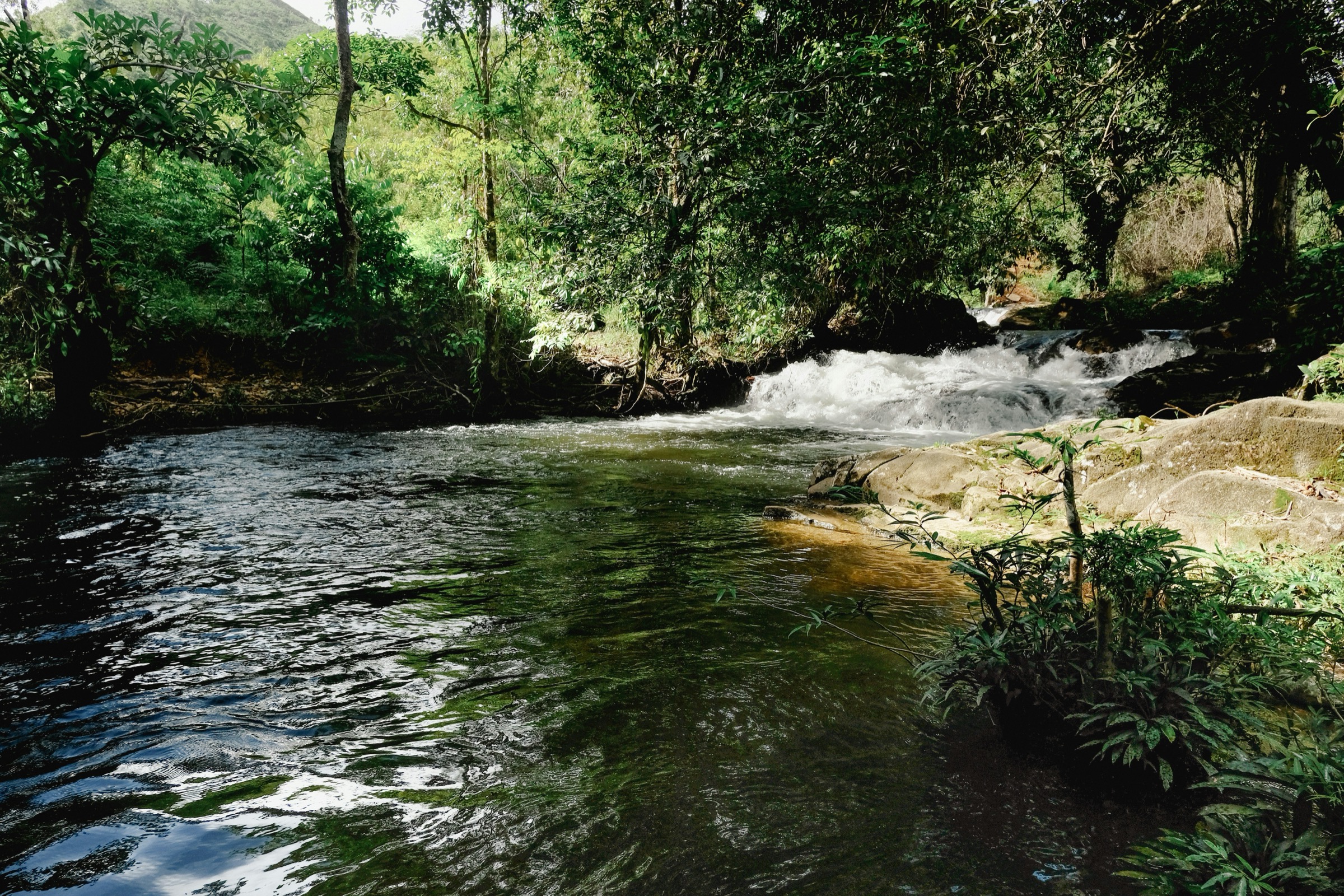
The forest itself, if you are lucky enough to see it, does not look like other tropical forests. The karst towers rising from the Sarawak lowlands are vertical limestone, dense with ferns and hoyas on every ledge. The ultramafic slopes on Kinabalu are open and almost mineral in texture, punctuated by pitcher plants and strange low-statured palms. The rivers run clear in the dry season and opaque with suspended soil during the floods, and on their banks the rheophytes press flat against the rock as if they know what's coming. It is a landscape that spent 130 million years making choices, and the plants are the record of every one.
Grow the plants because they are interesting. Grow them because a Hoya callistophylla on a chunk of cork bark, pinned beside a bright window, will develop venation so pronounced it looks like a hand-drawn illustration of a leaf. But also understand what you're looking at: a piece of an island that refused to stop being a forest, and that turned that refusal into something extraordinary.