The state of Espírito Santo occupies a thin wedge of Brazil's eastern coast, squeezed between the highlands and the Atlantic. It is not famous. Tourists come for beaches; cargo ships load iron ore at the port of Vitória. But somewhere in the forested hills of the municipality of Domingos Martins — a precise hillside that botanists know and poachers know and obsessive collectors have memorized the way gamblers memorize card counts — a handful of adult Philodendron spiritus-sancti still grow. Fewer than a dozen wild plants confirmed in surveys. The most-wanted aroid in the hobby, and it exists in nature as a tiny relict population in a forest that has itself been reduced to relict fragments.
The Mata Atlântica — the Atlantic Forest — once ran the full length of Brazil's eastern coast, from Rio Grande do Norte in the northeast down to Rio Grande do Sul in the south, pressing inland across the escarpments and valleys of the Serra do Mar and Serra Geral. At its peak it covered something close to 1.3 million square kilometers. Today, depending on how you count fragments and secondary regrowth, it is down to roughly seven percent of that original extent. What is left is not one forest but hundreds of islands of forest, separated by pasture, cane fields, eucalyptus plantations, and cities. The number that stays with you: seven percent. The number that matters just as much: the Mata Atlântica hosts more than 20,000 plant species, roughly 8,000 of them found nowhere else on earth.
Why a Coastal Mountain Range Makes Monsters of Endemism
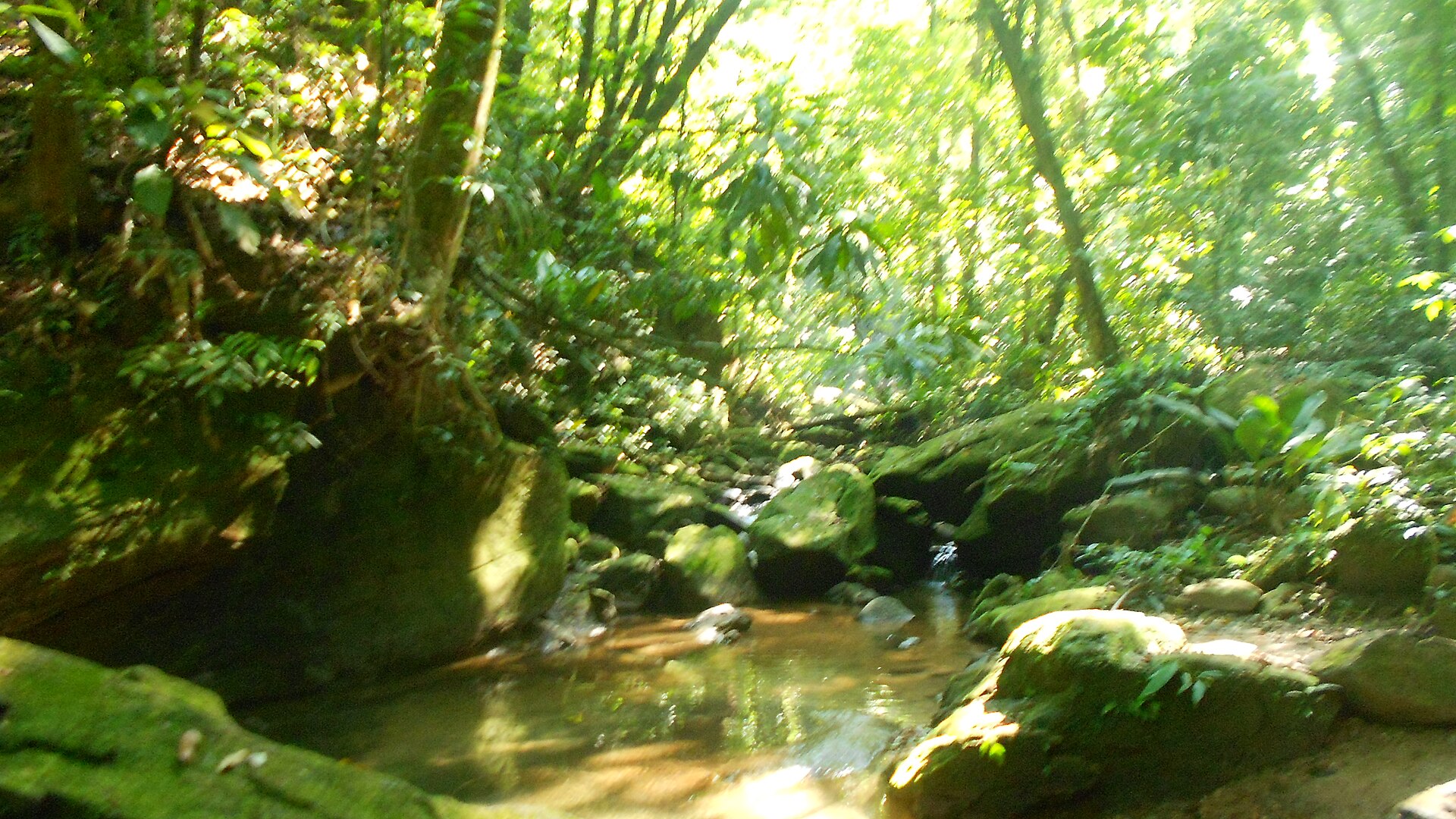
Geography did this. The Serra do Mar rises almost directly from the coast, in places within twenty kilometers of the Atlantic, creating a spectacular orographic trap: moisture-laden trade winds hit the escarpment, cool rapidly, and drop enormous quantities of rain on the seaward slopes. Some stations in the Serra da Mantiqueira and Serra dos Órgãos receive over 3,000 millimeters annually, concentrated enough to sustain a true rainforest canopy at elevations from sea level up past 1,500 meters. That vertical compression — beach forest shading into montane cloud forest within an hour's walk — stacks different climatic zones almost on top of each other.
The consequence for plant evolution is profound. A species that colonizes one humid valley in Espírito Santo faces a dry ridge, then another humid valley, and the populations on either side of that ridge may be effectively isolated for thousands of years. Long enough to speciate. Long enough to develop a leaf shape, a petiole color, a venation pattern found on that drainage and nowhere else. The Atlantic Forest produced hyperlocal endemism at a scale that still startles botanists — not species endemic to Brazil, but species endemic to a single watershed, a single mountain, a single hillside.
Philodendron alone contains over 500 described species, and Brazil's Atlantic Forest holds a disproportionate share of the rarest. The conditions that produced them — fragmented topography, persistent humidity, warm temperatures with almost no frost — are exactly the conditions a collector is trying to replicate in a grow tent in Ohio or a bathroom in Rotterdam.
The most-wanted aroid in the hobby exists in nature as a tiny relict population in a forest that has been reduced to relict fragments.
Spiritus-Sancti: A Name That Is Almost a Eulogy
Philodendron spiritus-sancti was described from Espírito Santo — the state's name translates as Holy Spirit, which is where the epithet comes from, not from any mystical reverence for the plant itself, though the hobby has since supplied plenty of that. The leaves are long, pendulous, and arrow-shaped, reaching 60–90 centimeters on a mature specimen, with a glaucous, matte surface and a deep central rib. It is not showy in the way a velvet anthurium is showy; its power is in proportion and architecture. A large plant in good health looks like something from a Rousseau painting: deliberate, archaic, a little solemn.
What makes it functionally extinct in habitat is not a single catastrophic event but the slow arithmetic of forest clearance. Espírito Santo had lost approximately 87% of its original Atlantic Forest cover by the late twentieth century. The hillside population of spiritus-sancti survives in what is now a protected area, but the plants are isolated, the population is not self-sustaining at meaningful scale, and collection pressure from wild harvest over decades has not helped. The plants in cultivation today — and there are more every year, as tissue culture makes the species accessible — descend from a small number of specimens removed from the wild, some legitimately, some not, before formal protection was established.
The collector community's fixation on this species is, in a strange way, its best conservation news. Legal tissue-cultured plants are commercially available in small numbers. Demand has not disappeared, but the ethical pathway exists. No serious grower needs a wild-collected plant. The argument for growing one is increasingly an argument for keeping the species alive in cultivation while its habitat remains under pressure — which is a more honest framing than pure aesthetics, and also true.
Billietiae and the Orange Petiole as Adaptation
Philodendron billietiae gets less reverence than spiritus-sancti because it is accessible — tissue-cultured plants are common, prices have dropped to reasonable — but it deserves more attention than it receives. Native to Brazil's Atlantic Forest and also recorded in French Guiana and Guyana, it is a hemiepiphyte that climbs in the understory, and its most immediately striking feature is the petiole: a saturated orange-yellow, sometimes approaching burnt apricot, that contrasts sharply against the long, wavy-margined dark green blade.
That petiole color is not ornamental in any human sense. Pigmentation in aroids is often tied to UV exposure, physical protection, or simply phylogenetic accident — the precise adaptive function of billietiae's orange petioles hasn't been established with certainty. What is established is that this species tolerates a wider range of humidity than many Atlantic Forest aroids, which tracks with its broader native range. In cultivation it handles the high-humidity, bright-indirect-light conditions that most serious growers maintain without complaint, rewarding them with fast growth and leaves that can reach 90 centimeters on a mature climbing plant. It is one of those species that earns the shelf space.
The Brazilian Begonias: Three Faces of the Same Forest
Begonias in the Atlantic Forest are a separate obsession, and three species from that system have earned particular attention among collectors who work with foliage. They are not related in any simple way — the genus Begonia contains over 2,000 species — but they share the Atlantic Forest's logic of extreme local adaptation.
Begonia listada comes from the coastal forest of southeastern Brazil, and its leaf is immediately recognizable: dark green, heavily velveted, with a pale lime-green stripe running from petiole to apex along the midrib, and secondary herringbone veining in the same pale tone. The stripe is not variegation in the genetic sense but a stable pigmentation pattern — it does not revert or sector. In habitat it grows in deep shade on moist forest floors, which is why in cultivation it asks for low light, high humidity, and almost no direct sun. The velvet texture is a shade adaptation, maximizing surface area for light capture.
Begonia venosa is a startling contrast. It comes from the caatinga and coastal scrub of Bahia and Pernambuco — drier, harsher, more seasonal habitats at the northern edge of the Atlantic Forest's influence. Its leaves are thickly felted in silver-white trichomes, a xerophytic strategy: the hairs reflect intense sun and slow water loss. In cultivation this means bright light, significantly drier conditions between waterings, and better airflow than you'd give listada. Same country, same general biome, entirely different plant because entirely different microhabitat.
Begonia paulensis is the rarest of the three in cultivation. From São Paulo state, it produces deeply quilted, bullate leaves with a reticulated network of veins that create a texture like hammered metal — not velvet, but three-dimensional in a different way. It grows at higher elevations in the Serra do Mar, where temperatures are cooler and mist is common. In a grow setup it prefers lower temperatures than most tropical begonias, and it will sulk in a warm, stale room. The quilt texture is almost certainly an adaptation to moving air and dripping condensation — channels for water management on a leaf that faces daily mist and rain.
What Fragmentation Does to a Genome
The seven-percent figure is not only a conservation tragedy. It is also, paradoxically, a genomic pressure cooker. Small, isolated populations accumulate genetic drift. Traits fix rapidly. A species stranded on one hillside when the forest around it disappears is not gradually blending back into a broader gene pool — it is intensifying. This is one reason why the remaining fragments of the Mata Atlântica contain such extreme morphological diversity: the survivors are the products of thousands of years of isolation even before modern deforestation, and fragmentation has compressed that process.
For collectors, this matters because the rarest Atlantic Forest plants are not just rare by circumstance — they are rare because they were always narrow endemics, adapted to conditions that exist in a small geographic window. Spiritus-sancti did not evolve to be common. It evolved for one hillside in Espírito Santo, for the specific light levels and humidity and substrate of that system. Growing it well requires understanding what that hillside probably offers: bright, diffuse light filtering through forest canopy, a chunky, fast-draining substrate that stays moist but never anaerobic, warm days and slightly cooler nights, and air that actually moves. Replicating a microhabitat is always an approximation, but knowing the origin sharpens the approximation.
Conservation and the Collector's Complicity
The Mata Atlântica's fragmentation is not finished. Development pressure on Espírito Santo and São Paulo continues. Protected areas exist — the Reserva Natural Vale in Espírito Santo is one of the most significant private forest reserves in Brazil, covering over 22,000 hectares and protecting habitat where spiritus-sancti and related species persist — but protected boundaries are contested and enforcement varies. The forest that made these plants is still contracting.
Collectors occupy an uncomfortable position in this story. Demand for rare Atlantic Forest species drove wild collection for decades, and the plants in cultivation today carry that history. The tissue culture revolution has changed the calculus: a lab-propagated spiritus-sancti does not represent a plant removed from Espírito Santo, and buying one does not fund further removal. But provenance matters, and the collector who claims to care about the species should also care about which vendors can trace clean propagation chains. The honest version of the hobby acknowledges both the beauty and the damage, and directs money accordingly.
Supporting organizations working in the Mata Atlântica — SOS Mata Atlântica is the most prominent — is not a gesture separate from the hobby. It is part of the same logic. The plants on your shelf are ambassadors for a forest that most people have never heard of, in a Brazilian state that isn't on any tourist map. That obscurity is precisely what let a plant like spiritus-sancti evolve undisturbed for millennia, and it is precisely what let the forest disappear without most of the world noticing.
Why You Should Grow Them Anyway
There is a case — a real one, not sentimental — for growing Atlantic Forest plants seriously. Every well-grown specimen is an argument that these species have value outside their habitat. Every collector who understands the provenance, maintains a clean sourcing record, and grows the plant to maturity is doing something the species needs: demonstrating that it survives.
Start with billietiae if you haven't already. It is honest and fast and will show you what a mature Atlantic Forest hemiepiphyte does when it has a pole to climb. Add Begonia listada if you can hold humidity above 70% — its velvet and its stripe are unlike anything else in the genus at that price point. If you can find tissue-cultured venosa from a reliable lab, its silver-felted leaves will force you to rethink how you water. And if you ever encounter a legally sourced spiritus-sancti from a reputable tissue culture operation, buy it, grow it well, and understand what you're holding: the product of a nearly vanished forest, a species that exists in cultivation because the hobby decided it was worth saving. That is not a small thing. It is, arguably, the whole point.