There is a particular kind of dread that comes with buying a variegated plant and watching it revert. You paid serious money for a Monstera deliciosa 'Thai Constellation' cutting, you potted it up in a chunky mix, you positioned it under a grow light with the care of a jeweler setting a stone — and then three new leaves emerge green. Clean, factory-floor green. The variegation didn't leave a note. It just left. This is not a theoretical anxiety. It happens often enough that experienced collectors treat reversion as a baseline risk, something to price in alongside soil and electricity.
Large-leaf variegated philodendrons occupy a different position in that calculus. The group — anchored by plants like Philodendron 'White Wizard', Philodendron 'White Knight', and the broader erubescens hybrids that have been selected and stabilized over decades of ornamental cultivation — has developed a reputation among serious growers for doing what variegated plants rarely do: holding their pattern through flush after flush, under ordinary indoor conditions, without demanding perfection. That stability is not accidental. Understanding where it comes from changes how you think about the plant, and about variegated aroids more broadly.
What Variegation Actually Is, and Why It Matters Here
Variegation in aroids is not a single phenomenon. Monstera 'Thai Constellation' carries its cream sectors because of a somatic mutation that originated in tissue culture — a chimeral condition locked into the plant's meristematic tissue but distributed unevenly, which is why the pattern shifts between leaves and why some cells revert to full chlorophyll production under stress. Monstera 'Albo Variegata' is a chimera of a different type, unstable by nature, its white sectors produced by a population of plastid-deficient cells that can be outcompeted by green cells whenever the plant prioritizes growth over pattern. The variegation is real; the tenure is uncertain.
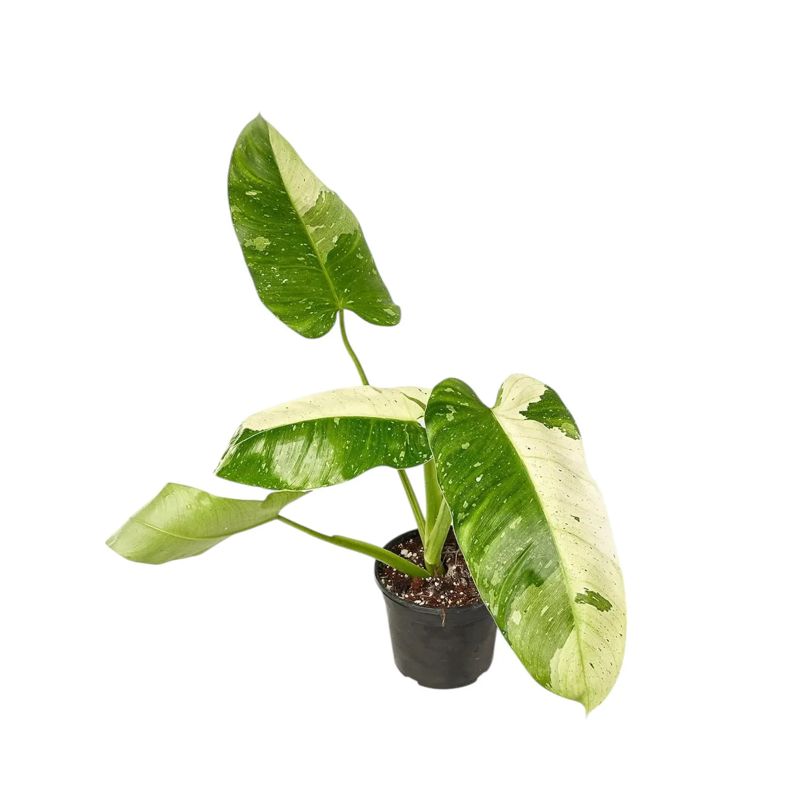
The variegation seen in the erubescens hybrid group works differently, and the distinction is meaningful. These plants — including 'White Wizard', with its white-to-cream sectoral and speckle variegation against a deep green blade, and 'White Knight', which adds the burgundy-flushed stems and sheaths that make it immediately identifiable — carry chimeral variegation that has been selected through vegetative propagation over many generations. The pattern is not guaranteed uniform, but the tendency to produce variegated leaves is sufficiently embedded in the meristem that outright reversion is uncommon under reasonable conditions. You are not betting on a single cell line. You are working with a plant that has already proved itself across many cycles of growth.
This is what collectors mean when they say a variegated philodendron is 'stable.' It does not mean every leaf will be fifty percent white. It means the plant has a track record.
Stability in a variegated plant is not luck. It is the outcome of selection pressure applied over generations of cultivation.
The Erubescens Lineage and How We Got Here
Philodendron erubescens, the species that anchors most of these hybrids, is native to Colombia and Costa Rica, growing as a hemiepiphyte in humid montane and lowland forest. The species produces large, arrow-shaped leaves — cordate at the base, glossy, with a coppery flush on new growth that gives it the name erubescens (blushing). The petioles are D-shaped in cross-section, a small diagnostic detail that distinguishes true erubescens lineage plants from some of the looser 'large-leaf philodendron' trade designations that circulate online.
Commercial selection of variegated erubescens hybrids has been ongoing since at least the mid-twentieth century, primarily in European and later Asian ornamental horticulture. 'Red Emerald', 'Green Emerald', and 'Imperial Red' all trace to this lineage, bred for foliage size and color intensity in non-variegated forms. The white-variegated selections emerged from the same breeding pool, identified as chimeral sports and propagated vegetatively to preserve the mutation. By the time 'White Wizard' reached wide collector circulation in the late 2010s, it had already passed through many hands and many growth cycles, which is precisely why it behaves the way it does. The instability had largely been culled.
'White Knight' follows a similar path but with an added trait: the burgundy-to-near-black pigmentation of the stem, cataphylls, and petiole sheaths. That coloration is anthocyanin-based and consistent across the clone, unrelated to the variegation itself, which means a 'White Knight' with minimal leaf variegation still produces those dark stems. It is a plant with two distinct ornamental characters, either of which would make it worth growing.
Leaf Size as a Functional Trait
The large paddle leaf is not an aesthetic accident. In their native habitat, hemiepiphytic philodendrons begin life on the forest floor, where light is scarce, and climb toward the canopy, where leaves can expand to maximize photosynthetic surface area. Erubescens in cultivation can produce leaves exceeding forty centimeters in length on a mature, well-fed plant with something substantial to climb — a moss pole, a coco coir board, a section of tree fern. The leaf does not reach that size without upward movement; a plant kept trailing in a hanging basket produces smaller, less differentiated foliage indefinitely.
For a variegated collector, leaf size amplifies the visual impact of each variegated sector. A ten-centimeter leaf with thirty percent white coverage is pleasant. A forty-centimeter leaf with the same coverage ratio is extraordinary. This is why the large-leaf erubescens group rewards the grower who provides a climbing structure early, before the plant is forced to establish a trailing habit that limits expression. The investment in a proper support is not optional if you want to see what the plant can actually do.
Size also means that each leaf represents a meaningful growth investment by the plant. Philodendrons in this group typically push one to three leaves per month under good conditions — bright indirect light, temperatures between 18 and 28 degrees Celsius, humidity above sixty percent — which means patience is built into the experience. A bad leaf hurts more than it would on a fast producer like P. hederaceum. But a great leaf, a wide blade with clean white half-sectors running from midrib to margin, is the kind of thing that stops people mid-sentence when they walk into your growing space.
Care That Respects the Plant's Origins
Growing any erubescens hybrid well starts with the substrate. These are hemiepiphytes — their roots evolved to grip bark and organic debris, not to sit in dense, moisture-retentive soil. A mix heavy in perlite, orchid bark, and chunky coco coir drains fast enough that the roots get the wet-dry cycle they need without sitting in saturation. Some growers run near-full bark mixes with a small amount of worm castings for nutrition; others use a commercial aroid mix as a base and amend heavily. What the roots cannot tolerate is compaction and persistent moisture. Root rot in a large variegated philodendron is a slow disaster, because by the time the leaves show stress, the root system has often been compromised for weeks.
Light is where many growers miscalibrate. 'Bright indirect' is standard advice, but it needs specificity: these plants do well within a meter of an east- or west-facing window, or under a quality LED grow light delivering roughly 200–400 PPFD at the leaf surface. More light intensifies the green portions of the leaf and tends to produce tighter, more defined variegation margins. Too little light slows growth and can cause the plant to push leaves that are predominantly green as chlorophyll production is prioritized. If your 'White Wizard' is reverting in appearance, check the light before you conclude the clone is failing.
Fertilization during the growing season — a balanced liquid feed at half strength every two to three weeks, or a slow-release top-dress of a complete granular fertilizer — supports the leaf size that makes these plants worth growing. Calcium and magnesium matter more than many hobbyists account for; a dedicated cal-mag supplement, especially for growers using purified water, prevents the interveinal yellowing that mimics root problems but responds quickly to supplementation.
Reading the Variegation: What Good Looks Like
Not all variegation patterns on these plants are equal, and part of the pleasure of growing them is learning to read a leaf before it unfurls completely. The cataphyll — the papery sheath that protects the developing leaf — gives early signals. A cataphyll with visible white or cream streaking often precedes a well-variegated leaf. A uniformly green cataphyll is not a guarantee of a green leaf, but it is a more neutral signal. Experienced growers watch for this and adjust their expectations accordingly.
Sectoral variegation — large, clean blocks of white occupying one half or quadrant of the blade — is generally considered more visually striking and more sought after than heavy speckle or marbling alone. A leaf with one fully white half and one fully green half, divided cleanly along the midrib, represents the best expression of the clone and is the type of leaf that circulates most on collector forums and photographs. Speckle and marbling are still legitimate variegation, but they lack the graphic weight of a clean sector.
What does not happen in a well-maintained 'White Wizard' or 'White Knight' under normal conditions is wholesale reversion — a sudden shift to producing entirely green foliage across multiple consecutive leaves. If that occurs, the first thing to investigate is environmental stress: a dramatic temperature drop, root damage, or a period of very low light. Stress pushes the plant toward chlorophyll production because green tissue is metabolically more efficient. Remove the stressor, and the variegation usually returns within a few growth cycles.
The Joy of a Plant That Doesn't Betray You
There is something worth naming about what it means to grow a variegated plant you can trust. The collector market for rare aroids runs partly on scarcity and novelty — the next undescribed species, the newest tissue-culture release, the cutting that nobody outside three vendors has seen yet. That cycle has its pleasures. But it also creates a relationship with your plants that is more speculative than horticultural. You are waiting to see what the plant becomes, whether the investment holds.
Large-leaf variegated erubescens hybrids offer a different relationship. You know what 'White Wizard' does. You know what a mature specimen climbing a two-meter moss pole looks like. You have seen the photographs, you have read the grow logs, and you have reasonable confidence that if you provide adequate light, a fast-draining substrate, and something to climb, the plant will meet you where you are. The variegation has been proven across enough growers and enough growth cycles that it functions less like a gamble and more like an agreement.
That is rarer than it sounds in this hobby. Most of the plants that generate the most excitement carry the most uncertainty. The large-leaf variegated philodendron — unglamorous by comparison to a freshly discovered velvet anthurium or an undescribed Monstera from a remote watershed — offers something the exciting plants often don't: a reasonable expectation of a beautiful outcome. For a grower who has watched enough reverted albos leave their collection in disappointment, that is not a small thing.
Where These Plants Sit in a Serious Collection
A mature, climbing 'White Wizard' is not a beginner plant in the sense that it requires attentive care and room to express itself — but it is absolutely a plant for someone who has grown past the beginner stage and wants a reliable anchor piece that will grow with them for years. Unlike many of the rarer velvet philodendrons, which are slow, particular about humidity, and difficult to source as established plants, the erubescens variegates grow at a pace that rewards regular attention without punishing a skipped watering.
They also photograph exceptionally well, which matters to collectors who document their collections seriously. The high contrast between deep green and clean white, amplified by the glossy blade surface, reads clearly in almost any lighting condition. A backlit 'White Knight' leaf, with its dark stem and half-white blade, is the kind of image that communicates the appeal of the hobby to someone who has never touched an aroid. That accessibility is not a mark against the plant. It is part of what makes it a good ambassador for serious growing.
The large-leaf variegated philodendron does not need to be the most exotic thing in your collection. It needs to be the plant that comes through every time — the one that produces a stunning leaf while something rarer sulks in high humidity and refuses to push growth. Every serious collection benefits from at least one plant that doesn't make you worry. This is that plant.