A cutting arrives wrapped in damp sphagnum and optimism. The label says 'White Princess', but the petiole is round, not D-shaped, and the new leaf is pushing out with more cream than white. You stare at it the way you stare at a passport photo that might be you. Something is slightly off, and you can't immediately say what.
This is the particular frustration — and, honestly, the pleasure — of collecting white-variegated philodendrons. The named cultivars stack up: White Princess, White Knight, White Wizard, White Queen, Snowdrift, Gabby, Kacha White. Some are formally distinct. Some are tissue-culture selections that have drifted. Some are trade names applied loosely by vendors who may never have grown the parent plant. The collector who wants to understand what they're actually holding has to read the whole plant, not just the color of the splash.
What White Variegation Actually Is
Variegation in philodendrons is not a single mechanism. The white you see in a White Princess or White Wizard is sectoral chimeral variegation — a stable (or semi-stable) genetic condition in which certain cell lineages carry a mutation that blocks chlorophyll production. The affected tissue grows out white or cream, sometimes in hard-edged sectors, sometimes as marbling that bleeds into the green. Because the chimera lives in the growing tip, not uniformly through every cell of the plant, each new leaf is essentially a small gamble. You can get a heavily variegated leaf followed by a nearly full-green one, or a pure-white leaf that will die before it hardens off.
This is different from the yellow or lime variegation caused by viral infection — Pothos Yellow Mosaic Virus occasionally gets misread as a desirable trait — and different again from the natural silver tessellation of species like P. gloriosum or P. mamei, which is a structural surface feature, not a pigmentation deficit. The white in a chimeral philodendron is an absence: no chloroplast, no green. What that absence reveals about a plant's parentage, though, is where the taxonomy gets interesting.
Because chimeral variegation is maintained through vegetative propagation and can be disrupted by tissue culture (TC plants frequently revert to green or produce unstable half-and-half plants for several generations), the white-philodendron trade runs almost entirely on cuttings. A cutting from a stable, heavily variegated mother plant commands a premium not because the seller is being precious, but because TC origin genuinely changes what you're getting.
The white in a leaf is an absence — no chloroplast, no green — but what that absence reveals about the plant's parentage is everything.
The Green Originals: What Each White Comes From
Understanding the white cultivars means knowing the green species underneath. Philodendron erubescens — a Colombian species with glossy, arrow-shaped leaves, red-flushed undersides, and a penchant for climbing — is the common ancestor of at least three of the major whites. It is a vigorous grower in cultivation, less demanding about humidity than many Andean species, and its red petioles and cataphylls are a visual tell that persists, in diluted form, even into its variegated selections.
White Knight is widely accepted to be a chimeral form of P. erubescens. The giveaway: its petioles are green with reddish-purple blotching, and the cataphylls are distinctly brownish-red. New leaves push a bronzy-red before they harden to dark green and white. If your 'White Knight' has fully green petioles with no red undertone, look more carefully at what you're holding. White Princess is also erubescens-derived, but the variegation tends to be softer, the petioles are lighter green, and the growth habit is generally more compact and slower — some growers believe the Princess selections come from a different cultivar or clone of erubescens than the Knight, though no formal documentation separates them.
White Wizard complicates the story. It looks, superficially, like a Knight or Princess variant: dark green leaves, white sectors. But the petioles are entirely green — no red blotching — and the plant's internodes are longer, giving a more vining, less self-heading posture. The leading theory is that Wizard is a chimeral sport of P. erubescens as well, but from a green-petioled form, or possibly a hybrid with another species in the erubescens complex. No one has published the chromosome work. The honest answer is that the parentage is inferred from morphology, not proven.
The Look-Alike Maze
The confusion is real and it is compounded by the naming practices of the ornamental trade. 'White Queen', 'Snowdrift', 'Gabby', and 'Kacha White' all exist in commerce, often without traceable origin stories. Gabby is distinctive enough that experienced growers can usually spot it: the variegation is irregular and splashy in a way that suggests a different chimeral layer than the Princess/Knight/Wizard cluster, and the leaf shape is slightly more elongated. Snowdrift appears on Etsy listings in quantities that suggest either remarkable fecundity or enthusiastic relabeling.
The practical problem for a buyer is that a cutting from a young plant, or from a plant cycling through a green phase, may look nearly identical across several of these cultivars. A White Knight producing a nearly solid-green leaf and a White Princess producing a nearly solid-green leaf are almost indistinguishable to anyone who isn't looking at the petiole and cataphyll color with real attention. This is why the guidance to 'buy from reputable sellers' is not empty rhetoric — a vendor who has grown a mother plant through multiple seasons knows whether the variegation returns, whether the plant reverts under stress, and what the stable expression looks like.
One useful field distinction: check the petiole cross-section. P. erubescens typically has a D-shaped or semi-terete petiole, flattened on the adaxial surface. The degree of flattening varies, but you can feel it. Some of the looser trade 'whites' with fully round petioles may be hybrids or misidentified species entirely — P. hederaceum sports and selections occasionally get pulled into the 'white philodendron' conversation despite being a different species with markedly different leaf texture and scale.
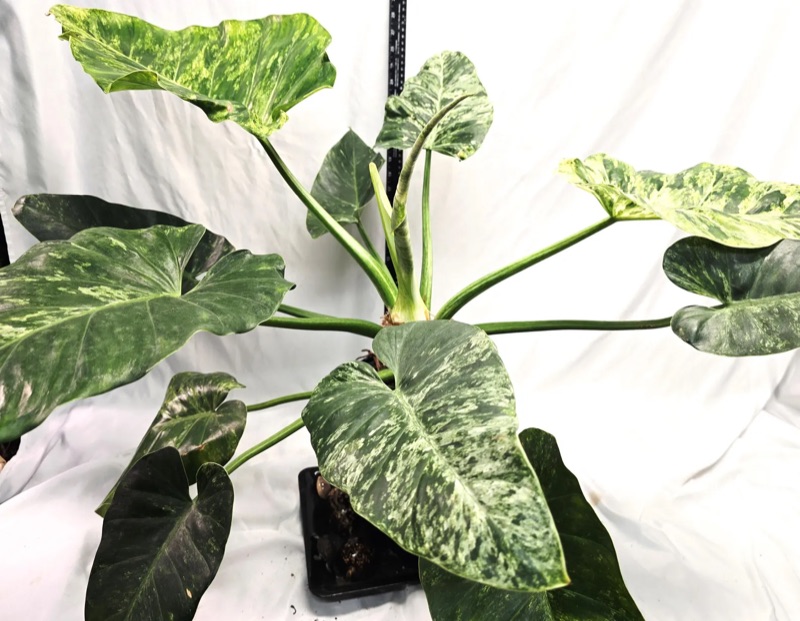
Growing Them: Where the Care Actually Differs
White-variegated philodendrons are not, as a category, more delicate than their green counterparts. They are, however, less forgiving of the specific conditions that stress the variegated tissue. A full-green erubescens can tolerate a dry root zone and recover. A heavily variegated White Knight cutting through a white-dominant phase is running on reduced photosynthetic capacity — the white sectors produce no energy — and a moisture deficit on top of that will show up fast as browning at the white margins.
The substrate matters more than it does for a robust green climber. A chunky mix — bark, perlite, a little coco coir — that holds moisture without sitting wet keeps the roots active without starving the leaves. Humidity above 60% is where these plants run best; below 50% and the white margins tend to crisp. Bright indirect light is the reliable standard, but the specific instruction is: more light than you'd give a full-green philodendron, because the plant has less chlorophyll to work with. An east-facing window with three or four hours of gentle morning sun is a reasonable target in most US interiors.
One grower habit worth adopting: when a heavily variegated or nearly-white leaf unfurls, do not mist it and do not let water sit on the surface in low-airflow conditions. White tissue has no waxy protection from fungal pressure that the green sectors have. A small clip-on fan on the lowest setting directed past — not at — the plant does more for longevity of the white sections than any foliar spray.
Stability, Reversion, and the TC Question
The hardest conversation in the white-philodendron market is about tissue culture. TC propagation allows large quantities of a named cultivar to be produced quickly and shipped globally, which is why TC White Princess material has become affordable. The problem is that chimeral plants often do not come through TC true-to-type. The chimeral layers can separate, producing solid-green plants, or they can recombine unpredictably, producing plants with unstable variegation that runs toward solid-cream leaves (pretty, but non-viable) or reverts to green after a few seasons.
This does not mean all TC white philodendrons are bad. It means the buyer needs to know what they're purchasing. A TC plug that has been grown on for six months by a knowledgeable grower and confirmed stable is a different thing from a fresh-from-lab plantlet sold before its variegation pattern is established. The collectors who have been burned — and there are many — bought the latter and grew out a fully green plant after a year of anticipation.
Cutting-propagated plants from a known stable mother remain the benchmark. If a seller can tell you that the mother has been producing consistently variegated offshoots for two or more seasons, that is meaningful information. If the seller cannot tell you anything about the mother plant's history, the price should reflect that uncertainty.
Reading the New Leaf
Experienced collectors read new growth the way other people read weather. A new leaf emerging from a White Knight that is pushing pure white — no green at all — is worth monitoring, not celebrating. A pure-white leaf has no photosynthetic ability; it will mature and harden, but it will not contribute to the plant's energy budget. If several consecutive leaves are white-dominant, the plant may be cycling into an unstable phase. Pruning back to a more balanced node and giving the plant strong indirect light often corrects course.
The ideal new leaf, on any of these cultivars, is one that is roughly half-and-half or better: green enough to photosynthesize, variegated enough to justify the name. A leaf that is 30% white with clean sectoral definition — not mottled, not washed out, but a clear boundary between white and green — is a sign of a stable chimera doing what it should. Some collectors find the mottled, marbled pattern more beautiful; stability-wise, the hard-edged sector is usually the safer expression.
There is a particular pleasure in getting this right over time. A White Princess that you have dialed in — right light, right moisture, right airflow — that pushes out a leaf with a white half and a dark-green half, blade fully expanded, no browning, cataphyll a clean pale green: that plant is telling you something. It's telling you the conditions are correct, that the chimera is settled, that you have understood what the plant needs. That's the moment the whole tangled family tree of named whites stops being frustrating and starts being worth it.
Worth Chasing, Worth Skipping
The honest collector's ranking is approximate and personal. White Knight is the most visually dramatic of the major whites when it's performing — the dark green and white contrast is stark, and the red cataphylls add color interest the others lack. White Princess is the most reliably compact, easiest to manage in a limited space, and the one most likely to hold stable variegation over time in average home conditions. White Wizard has the most graceful climbing habit and suits a moss pole or coir totem better than the other two.
Gabby is worth growing if you can source a cutting from a grower who knows what they have — the irregular variegation is genuinely different and interesting, not just a renamed Princess. The trade-named proliferations — 'Snowdrift', 'White Queen', and the rotating cast of other epithets — deserve skepticism proportional to the price being asked and the evidence the seller can provide about origin.
The white-philodendron family is not a family where you need to own all of them. One well-grown, correctly identified White Knight pushing a new half-and-half leaf on a four-foot totem tells you more about what these plants are capable of than a shelf crowded with mislabeled cuttings in various states of reversion. Know what you're buying, know the green species underneath, read the petiole. The snow on the leaf is the starting point, not the whole story.