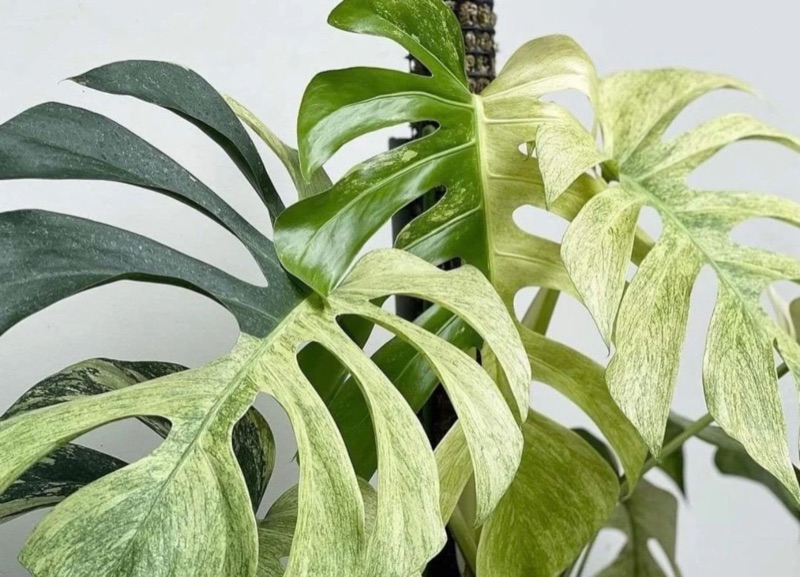
Somewhere in a greenhouse in Thailand, or Indonesia, or maybe a basement in the Netherlands, a Monstera deliciosa is doing something that looks, at first glance, like an accident. Its leaves are not the blinding white of an albo, not the radioactive yellow of an aurea. They are green and then more green — a cool, pale, celadon-against-jade pattern that some collectors call mint and others call ghost and still others call whatever they need to call it to justify what they paid. It photographs beautifully. It reverts constantly. It is, by almost any measure, the most contested cultivar in a genus already crowded with contested cultivars.
The collector forums call it Monstera deliciosa 'Mint'. Whether 'Mint' is a real, stable, reproducible selection or a loose umbrella term for any deliciosa with unusually pale green variegation depends entirely on whom you ask — and how recently their cutting reverted to solid green.
What Green-on-Green Actually Means
Standard Monstera deliciosa variegation is chlorophyll loss. In the albo — properly Monstera deliciosa 'Albo Variegata' — sectors of cells fail to produce chlorophyll at all, leaving white or cream patches that are technically dead tissue performing no photosynthesis. The plant survives because enough green sectors do the work. In the Thai Constellation, a tissue-culture-induced chimera from Thailand's Agricultural Research Station, the distribution is more even, the cream speckled rather than blocked, and the pattern is somewhat more stable across propagations because it arose in callus culture rather than spontaneous mutation.
Mint variegation is neither of these things. The cells in a 'Mint' leaf still contain chlorophyll. The pale zones are not white but a washed, reduced green — sometimes nearly grey-green, sometimes genuinely celadon, sometimes described by sellers as 'seafoam.' Botanically, this appears to be a reduction in chloroplast density or chlorophyll concentration rather than full chloroplast absence. The leaf is photosynthetically functional throughout. This matters because it means mint variegation is inherently harder to see, harder to photograph honestly, and vastly harder to verify between the cutting stage and the first mature leaf.
The distinction also matters for stability. When chlorophyll is absent, the tissue is white and stays white. When chlorophyll is merely reduced, external conditions — light intensity, temperature, the plant's nutritional status — can shift the expression. A mint leaf grown in high light may look noticeably different from the same plant's output in lower light. This is not a bug in 'Mint' specifically; it is an inherent property of this class of variegation.
A cultivar that reverts is still a cultivar. A cultivar no one can reliably propagate is something closer to a rumor with roots.
The Origin Problem
No one has a clean origin story for deliciosa 'Mint'. This is, in the aroid hobby, not unusual — variegated Monstera sport constantly, and most named cultivars began as a single observed mutation in a nursery or a collector's collection. The albo is believed to have originated in a Japanese nursery sometime in the mid-twentieth century, though documentation is sparse. Thai Constellation has a documented point of origin. 'Mint' has neither.
What circulates instead is a layered mythology. The most common version holds that true 'Mint' came out of Southeast Asia in the mid-2010s, riding the same wave of collector mania that spiked albo prices above a thousand dollars per cutting and made the phrase 'tissue culture available' sound like a threat. Some accounts place the original sport in a Thai ornamental nursery. Others attribute it to Indonesian collectors. A few insist the plants now sold as 'Mint' in the US and Europe are not a single lineage at all but a catch-all for any deliciosa with pale green variegation that a seller found more poetic than 'sport.'
The absence of a registered cultivar name through any horticultural authority — the International Aroid Society has not formally registered 'Mint' as of this writing — means the name is purely colloquial. This is not automatically damning. Many legitimate collector plants predate the formal registration systems that apply to them. But it does mean there is no standard, no type specimen, no authority to which a buyer can appeal when their 'Mint' cutting produces a leaf that looks, generously, like a regular deliciosa in need of more light.
The Reversion Question
Every conversation about 'Mint' eventually arrives here. Reversion — the loss of variegation, the plant reverting to solid green — is a known risk in all chimeral and unstable variegated plants. In the albo, reversion typically looks like a fully green stem section taking over after propagation at the wrong node. In 'Mint', reversion is more insidious because the variegation is subtle enough that early reversion can look like normal variation in expression.
Experienced growers report that 'Mint' reverts at a rate that makes long-term cultivation genuinely difficult. A plant purchased with three visibly variegated leaves may, by the sixth or seventh node, be producing leaves indistinguishable from deliciosa 'Borsigiana' at full maturity. The cause is almost certainly the instability of the underlying mutation — if the pale expression depends on a single gene or epigenetic state rather than a stable chimeral arrangement of distinct cell lines, any given cell division can lose it.
There are growers who report maintaining 'Mint' expression across many nodes by keeping the plant in moderate, consistent indirect light — around 200 to 400 foot-candles — with stable temperatures between 20 and 26 degrees Celsius, airy substrate kept evenly moist rather than wet-dry cycled, and relatively low fertilizer inputs. The logic is that stress pushes the plant toward green-up. Whether this is a real mechanism or superstition dressed in husbandry clothing is not settled. What is settled is that nobody has published a propagation protocol that reliably yields 'Mint' offspring from a 'Mint' parent.
What You're Actually Buying
The current market for 'Mint' is a case study in information asymmetry. A seller with a variegated cutting knows everything about that specific cutting: its recent light conditions, how many variegated leaves it has produced, whether it has shown any signs of greening. A buyer receives a cutting and a photograph. If the photograph was taken in the right light — and pale green variegation photographs extraordinarily well in the blue-shifted light of a grow tent — the gap between image and reality can be significant.
This is not to say fraud is universal in the 'Mint' market. Many sellers are honest hobbyists moving a cutting from a plant they love, representing it accurately and pricing it accordingly. But the name 'Mint' is not protected, the trait is not reliably verifiable at point of sale, and the market has established pricing based on the assumption of a stable cultivar that the plant has never reliably been. In the US, unrooted 'Mint' cuttings with visible variegation have sold between two hundred and eight hundred dollars depending on leaf count and pattern quality. A reverted cutting is worth nursery-run pricing — maybe ten dollars.
Buyers who approach 'Mint' as a gamble rather than a purchase seem to fare better emotionally. The ones who know the odds, choose a cutting with strong variegation on multiple leaves, and have a plan for the plant whether or not it holds its color — those are the collectors who get something real out of the transaction, regardless of what the leaves do in six months.
The Case for Taking It Seriously Anyway
It would be easy to conclude that 'Mint' is simply hype wearing a pretty name. That is not quite the right read. The variegation, when it's expressing, is genuinely unlike anything else in the deliciosa complex. White variegation has a graphic, high-contrast quality that reads from across a room. Mint variegation is quieter — it requires proximity, it rewards attention, it looks different under different light sources in a way that is almost optical-illusion disorienting. There is a legitimate aesthetic argument for it that has nothing to do with rarity pricing.
There is also a real horticultural question embedded in 'Mint' that deserves serious attention rather than dismissal: what is the mechanism, and can it be stabilized? The Monstera genus has produced enough stable chimeral variegations — the albo, the Thai Constellation, the less common deliciosa 'Aurea' — to suggest that mint-class expression is not inherently doomed. If the mutation underlying pale green variegation were ever characterized at the cellular or molecular level, selective propagation or even directed tissue culture might produce something stable. Nobody has funded that research. The collector market is not set up to fund it. But the question is real.
The most honest position is probably this: 'Mint' describes a phenotype, not a cultivar. There may be plants within the pool currently sold under that name that share a common lineage and a common mutation. There may also be plants that are sporting deliciosas, albos with unusual expression in certain conditions, or ordinary variegated plants caught in flattering light. The name collapses all of them together, which serves no one — not the seller who has a genuine plant, not the buyer trying to make an informed decision, not the hobby that would benefit from clearer language.
Growing It, If You Have It
Assuming you have a plant that is expressing mint variegation and you want to keep it that way, the care logic is not dramatically different from standard deliciosa husbandry with a few specific adjustments. Substrate should be chunky and airy — a mix of orchid bark, perlite, and coco coir in roughly equal parts drains well and prevents the root rot that causes the stress response most likely to trigger greening. Pot size should be conservative; deliciosa in too large a container tends to chase roots rather than push leaves.
Light is the most contested variable. The instinct is to give a pale-variegated plant less light to protect what little chlorophyll it has. This is correct for white variegation, where bright light can scorch chlorophyll-free tissue. For mint variegation, moderate bright indirect light — the kind a north-facing window with no obstruction provides, or a grow light dialed to around 250 foot-candles — seems to support expression without triggering the chlorophyll upregulation that full shade can cause. Avoid direct sun and avoid deep shade equally.
Fertilize lightly and consistently rather than heavily and episodically. A balanced liquid fertilizer at quarter strength weekly during the growing season seems to avoid the flush-growth that sometimes accompanies reversion. Temperature stability matters more than the specific temperature, provided you're in the 18-to-28 Celsius range. And when a node produces a fully green leaf: assess the stem below it, consider whether you want to take a cutting from the last variegated node and restart, and do not expect the plant to find its way back on its own. It rarely does.
The Line Between Real and Rumor
Every plant genus has its mythology — the species no one can confirm from a reliable source, the cultivar name that means three different things depending on the country of origin. In the Anthurium world, 'dressleri' has become almost a genre of wishful thinking, applied to plants from multiple species and hybrids that share the general aesthetic a collector wants. In hoyas, 'silver pink' has been used for plants that are nothing alike. 'Mint' is Monstera's version of this problem.
What makes it different from outright fabrication is that the phenotype exists. There are plants producing pale green variegation that is genuinely beautiful and genuinely unusual. The problem is the infrastructure around those plants — the naming, the pricing, the implicit promise of stability — has outpaced what the plant itself can deliver. A cultivar that reverts is still a cultivar. A cultivar no one can reliably propagate is something closer to a rumor with roots.
The collectors most at peace with 'Mint' are those who treat it the way experienced growers treat any unstable variegation: as a condition, not a guarantee. You buy the current expression. You maintain the conditions most likely to preserve it. You accept that the plant has its own agenda. That stance requires a tolerance for uncertainty that is, in the end, probably just the price of working with plants that evolved for a Panamanian rainforest and not a grow tent in Columbus, Ohio. The mint unicorn is real enough. Whether it stays real is a different question entirely.