The road southeast from Pattaya runs flat and sun-hammered until the entrance gate of Nong Nooch appears, framed by a long ceremonial drive flanked by royal palms standing at attention. What follows, once you pass through, is the kind of sensory recalibration that takes a few minutes to absorb: the temperature drops a degree or two under canopy, the air thickens with humidity, and the scale of the plantings — row after immaculate row, valley after valley — becomes clear only gradually, the way a very large room does when your eyes adjust to the light.
Most visitors arriving at Nong Nooch come for the cultural performances, the elephant shows, the elaborately sculpted topiary gardens, and the themed walking circuits that draw tour buses from Pattaya daily. That audience is underserved by a description of what's actually growing here. Behind the pageantry sits one of the world's most significant ex-situ collections of cycads, a palm collection of genuine scientific weight, and tropical plantings that include the orchids, aroids, and epiphytes of the Thai tropics in concentrations you won't encounter at most gardens anywhere.
How Nong Nooch Came to Exist
The land was originally a fruit plantation — coconuts and other tropical crops on gently rolling terrain near the village of Nong Nooch, about 15 kilometers southeast of Pattaya in Chonburi Province. In the 1950s, Pisit and Nongnooch Tansacha acquired the land for agricultural use. Their daughter, Kampon Tansacha, eventually transformed it into something else entirely — a botanical garden on a scale that Thailand had not seen, opened to the public around 1980. Kampon Tansacha's vision was explicitly ornamental and educational in equal measure, and his subsequent decades of collecting plants from across the tropical world gave Nong Nooch its current scientific depth.
The property now covers roughly 500 acres, which places it among the largest tropical gardens in Southeast Asia by area. That scale is not incidental — it allows for planting at densities and with specimen sizes that smaller institutions simply cannot manage. Mature Cycas with trunks two meters tall, palms that have been in the ground for decades, orchid collections that require their own dedicated structures: none of this is achievable without both space and time, and Nong Nooch has had both.
The garden's growth ran parallel to a rising international interest in ex-situ conservation — the idea that living collections in safe, well-managed gardens serve as insurance for species being lost in the wild. By the time that philosophy became a formal priority for botanical institutions, Nong Nooch already had decades of planted specimens that no new garden could quickly replicate.
The cycad collection at Nong Nooch is not a backdrop — it is a living archive of plants that predate the flowering world.
What Cycads Actually Are, and Why It Matters That Someone Is Growing Them
Cycas, Encephalartos, Dioon, Zamia — the cycads are a lineage that was already ancient when the first flowering plants appeared. They are gymnosperms, seed-producers that predate both conifers and angiosperms in the fossil record, and they persisted through mass extinctions that cleared much of what was living at the time. The plants growing in Nong Nooch's cycad valley are not living fossils in the poetic sense — they are actual representatives of a lineage that has been doing this, more or less, for over 250 million years.
What makes that remarkable in a conservation context is that cycads are now among the most threatened plant groups on Earth. They are slow-growing — a trunk two meters tall may represent a century of growth — and they are heavily trafficked. Collectors prize them for the same reasons that make them so vulnerable: their age, their rarity, their appearance. Wild populations of Encephalartos species in southern Africa have been stripped from landscapes by collectors. Some Cycas species in Southeast Asia and the Pacific have been reduced to small remnant populations. A single large specimen represents decades of irreplaceable growth, which is why a well-documented living collection at a stable institution has real scientific value.
Nong Nooch's cycad collection spans multiple genera and a wide range of species, including representatives from Africa, the Americas, and Asia. The planting is organized so that visitors move through them at ground level, which means you are standing next to — not looking at through glass — plants that may be older than any building on the property. For a collector who has been nursing a Cycas cutting for five years and watching it produce one new frond per season, the specimens here reframe the scale of what you're working with.
The Palm Collection and Its Scientific Weight
Palms and cycads share a superficial look — a crown of fronds atop a trunk — but are about as distantly related as vascular plants can be. What they share at Nong Nooch is serious curatorial attention. The palm collection here is extensive in both species diversity and specimen age, with material that includes species rarely seen in cultivation elsewhere in the region.
For collectors of aroids and epiphytes, palms may seem peripheral, but they are not. In the Thai tropics, palms are ecological infrastructure. They are nurse plants for hemiepiphytes, substrate for ferns and mosses, canopy structure for the understory organisms that serious collectors actually grow. Understanding palms as habitat — not just as ornamental subjects — changes how you read a tropical garden. At Nong Nooch, that relationship is visible: the bases of mature palms support ferns, the canopy gaps determine what grows beneath, and the overall planting is a functional facsimile of layered tropical forest.
The garden has developed relationships with botanical institutions internationally, which has shaped the provenance of some of its rarer material. This matters because provenance in living collections is everything — a cycad with documented wild-collection data attached is a research asset; one without is just a plant. Nong Nooch's scale and longevity have allowed it to participate in that documentation in ways that newer gardens cannot.
The Orchid Houses and the Plants Collectors Recognize
Thailand is not incidentally important to orchid culture — it is central to it. Dendrobium, Vanda, Rhynchostylis, native Thai species and their hybrids have shaped the global cut-flower trade and ornamental horticulture for generations. Nong Nooch's orchid displays draw on that local lineage, with plantings that lean into the country's horticultural identity. The scale is theatrical in the way Thai floriculture often is, but the underlying plant material is regionally authentic.
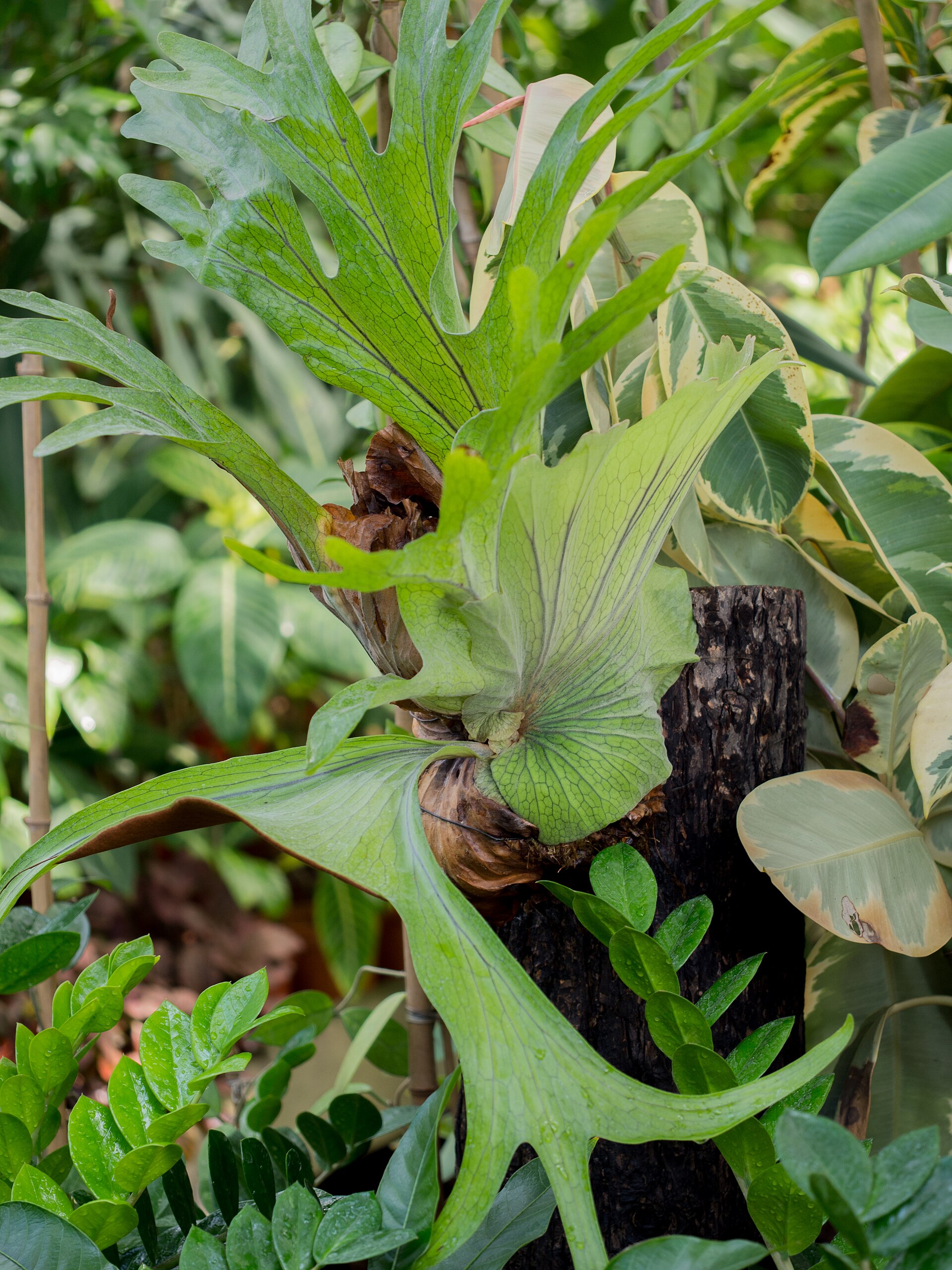
For collectors whose primary interest is aroids, the connection here is the climate. The conditions that produce orchids in this part of Thailand — warm nights that don't drop below about 20°C, high ambient humidity, rainfall that has a seasonal rhythm rather than a constant drench — are the conditions that produce the aroids of mainland and island Southeast Asia. Walking through tropical plantings designed for this climate makes the physiological requirements of the plants you're growing at home legible in a way that no amount of reading fully replicates. Rhaphidophora species climb palms and concrete walls alike. Ferns sprawl from the bases of specimens. Epiphytic growth is opportunistic and abundant.
There are aroids in the general tropical plantings at Nong Nooch, as there are at any large tropical garden — philodendron species used as ground cover or climbing specimens, the inevitable Monstera deliciosa used in ornamental beds, and representatives of genera familiar to any serious collector. These are not the focus of the collection in the way cycads and palms are, but for a visitor who grows aroids, they function as field reference: growth habit under genuine tropical conditions, natural climbing behavior, the leaf size that species achieve when not constrained by a pot.
The Tension Between Spectacle and Science
Any honest account of Nong Nooch has to sit with this: it is primarily a tourist destination, and a very successful one. The daily cultural shows, the sculpted European-style topiary gardens, the manicured beds of Bougainvillea — these are the draw for most of its visitors, and they have funded the operation across decades. Without the revenue from mass tourism, the conservation collections would not exist in their current form. The spectacle and the science are not in tension so much as they are mutually dependent.
That said, there is a real difference between moving through the themed garden circuits and making time for the cycad and palm valleys. The latter require some willingness to slow down and look, which runs counter to the pace of a guided tour group. Visitors who arrive knowing what they're looking for — and that includes anyone who has spent time tracking down Encephalartos hybrids online or growing Cycas in a container garden — will find the cycad collection arresting in a way that casual visitors simply don't register. That asymmetry is not a flaw in the garden. It is a feature of all serious collections: they reward preparation.
The question of what botanical gardens are for — spectacle, science, conservation, education, revenue — is one that every major institution is working through. Nong Nooch's answer has been to pursue all of these simultaneously, with the result that it is genuinely excellent at several of them. That it is also very good at elephant shows does not diminish the cycads.
What Not to Miss, and How to Think About the Visit
The cycad valley is the non-negotiable. Set aside enough time to walk through it slowly, and if you can identify genera by habit, bring that knowledge — it changes what you see. The difference between a mature Cycas rumphii and a large Dioon is immediately visible once you're looking for it, and the collection here is varied enough that you'll encounter both.
The palm collection deserves similar attention, and the two are best visited together as an extended morning walk before tour group traffic peaks. The orchid displays are worth the time if Thai orchid culture is interesting to you, and the general tropical plantings around the garden are worth slower attention than most visitors give them — the epiphytic growth on established specimens is often genuinely good.
Practically: Nong Nooch is large enough that trying to see all of it in one visit produces fatigue without depth. A collector's visit should probably sacrifice two or three of the themed garden circuits to spend adequate time in the sections that matter most. The climate in this part of Thailand is demanding — the garden sits in tropical lowland conditions — so early arrival before midday is not optional so much as physiological.
The broader point is this: Nong Nooch exists at an unusual intersection — a place that is simultaneously one of Thailand's most-visited tourist attractions and one of the world's most important living cycad collections. Those two facts coexist because someone spent decades building both things at once. For a collector who has spent hours sourcing a single uncommon Cycas or waiting for an Encephalartos offset to be of tradeable size, standing in the cycad valley here is a reminder of what these plants actually are and what it takes to keep them.
Why a Collector Should Make the Trip
Pattaya is not a destination most serious plant collectors have on their lists, which is exactly the reason this is worth noting. Nong Nooch is within easy reach of Bangkok — roughly two hours by road — and the garden is accessible as a day trip or an overnight stop. The entry price is modest by international botanical garden standards. And what you get for it is time among living specimens that no temperate garden can replicate: cycads in the ground that have been growing for decades, palms at mature scale, tropical epiphytes behaving as they would in the wild.
For collectors of aroids specifically, the value is partly aspirational and partly practical. Seeing a Rhaphidophora species moving up a tree under the light conditions it actually wants, or observing the natural climbing behavior of a large-leaf philodendron relative, feeds back into how you manage specimens at home. The physiological logic of the plants becomes visible. That is worth the trip on its own.
Nong Nooch is not a research institution in the way that Kew or the Singapore Botanic Gardens are, and it does not present itself as one. But it has accumulated, across more than four decades of collecting and growing, a living archive that functions as one. The cycads especially represent an irreplaceable concentration of old, documented, living material. In a world where wild cycad populations continue to decline, a garden that has been quietly growing these plants since 1980 is doing something that matters — whether or not the elephant show is running next door.