You smell it before you see it. Push through the heavy glass door of the Palm House at Kew on a cold London morning and a wall of warm, saturated air hits you — the particular perfume of damp bark, decomposing leaf litter, and something green and faintly ferrous that the body reads, on some animal level, as jungle. The iron ribs arch overhead like the hull of a ship turned inside out. Condensation runs down the curved glass. A Livistona palm pushes its fan fronds against the ceiling seventy years after it outgrew any reasonable pot. For a collector who keeps a velvet philodendron alive under a grow light in a spare bedroom, this place is a provocation and a comfort in equal measure.
The Royal Botanic Gardens, Kew was designated a UNESCO World Heritage Site in 2003, a recognition less of its 132 hectares of landscaped grounds than of what those grounds represent: the hub through which the botanical wealth of the tropical world was collected, classified, and in many cases redistributed into cultivation. Kew named plants. Kew sent collectors into mountain cloud forests and river systems that had never produced a herbarium sheet. The glasshouses are where that project became physical — where a living palm from southern Africa or a cycad dug up in 1775 was given a home and kept alive through English winters by coal, cast iron, and a great deal of institutional determination.
An Upturned Ship Filled with Rainforest
The Palm House was built between 1844 and 1848, the product of a collaboration between architect Decimus Burton and the Irish ironmaster Richard Turner. Turner's contribution was structural: the curving, ship-like profile of the building was engineered rather than merely decorative. Iron, unlike timber, could be cast into long curving members, and Turner understood how to use it to span large spaces without internal columns that would interrupt the planting. The result is a nave-like central section flanked by lower wings, the whole thing glazed in a greenish-tinted glass that softens the light inside into something close to the diffuse luminosity of a forest understorey.
It is, by a wide margin, the world's most significant surviving Victorian glass-and-iron structure. That word surviving carries weight. Several comparable glasshouses from the same era were demolished or damaged beyond repair. The Palm House was itself in such poor condition by the 1980s that it required a major restoration, completed in 1990, which stripped and rebuilt much of the glazing while preserving Turner's ironwork. What stands today is as close to the original as a working building can be.
The plants inside are arranged by geography — the wings divided broadly between the New and Old World tropics, the central section given over to the tallest specimens. Cycads from southern Africa stand alongside palms from the Caribbean and Indian Ocean islands, the roster reading like a catalogue of nineteenth-century botanical ambition. Many of these plants are not young. The institution has been keeping things alive in this building, through two world wars and a restoration, for the better part of two centuries.
Push through the Palm House door on a cold London morning and a wall of warm, saturated air hits you — the body reads it, on some animal level, as jungle.
The Oldest Pot Plant in the World
In the south wing of the Palm House, attended with the quiet reverence Kew gives its most significant specimens, stands Encephalartos altensteinii — the Eastern Cape giant cycad. It was collected in South Africa in 1775 and has been growing in Kew's care ever since, making it frequently cited as the oldest pot plant in the world. It is not a large or showy plant by the standards of what surrounds it. Cycads rarely are. But the age implied by that date — brought back when the American colonies were still British, when botanical exploration was a genuinely dangerous enterprise — gives it a weight that a younger, more spectacular plant could not match.
Encephalartos is a genus that collectors encounter mostly through smaller, more tractable relatives. But standing next to the Kew specimen reframes the genus entirely. Cycads are not primitive curiosities. They are seed plants that have survived, in essentially their current form, for an extraordinarily long time. The one at Kew has now also survived the entire modern history of botanical science, sitting in the same institution where much of that science was conducted.
The Palm House aerial walkway, accessed by a spiral staircase in one of the wings, puts you at canopy height among the upper fronds of the tallest palms. It is worth the climb. The view down through overlapping layers of leaves — the structural logic of the building suddenly visible from above — is unlike anything you get at ground level. Early morning, before the tour groups arrive, is the time to be up there.
Ten Climates Under One Roof
The Princess of Wales Conservatory opened in 1987, designed by architect Gordon Wilson of the Property Services Agency and named in honour of Princess Augusta, who founded the original botanic garden at Kew in 1759, as well as Diana, Princess of Wales, who opened the building. Where the Palm House is a single sustained environment, the Princess of Wales Conservatory is a controlled experiment in compression: ten distinct climate zones managed by computer under a single angular glass roof.
The zones run from arid — cacti, succulents, the strange caudiciform plants that store water in swollen bases — through to the humid tropical zones at the wet end of the building. It is in these wet zones that the collections most relevant to aroid and epiphyte growers are housed. Orchids from Southeast Asia. Ferns from cloud forests. And aroids — not in the diversity of a specialist nursery, but in the context of a research institution that holds type specimens and maintains documented provenance.
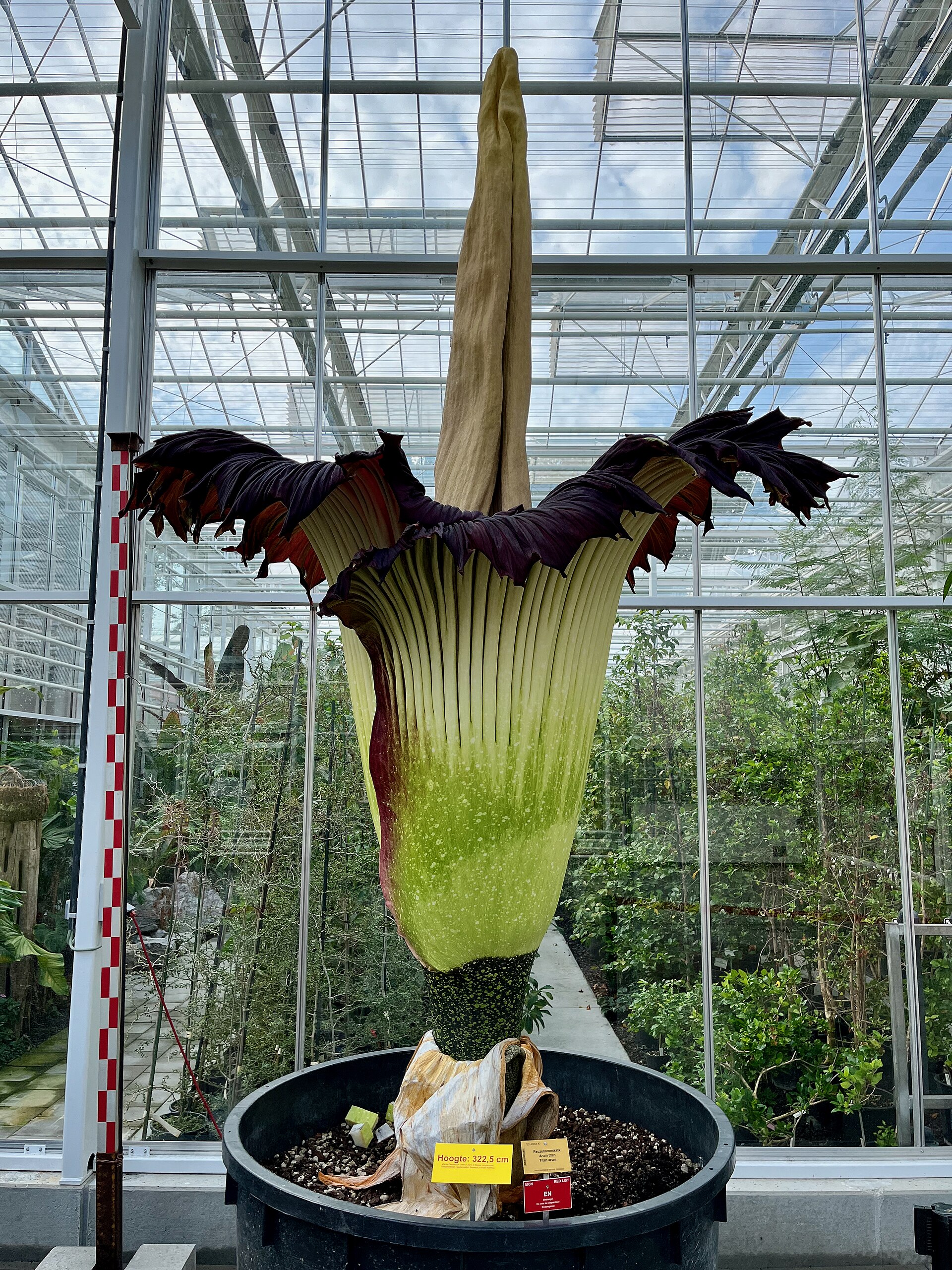
The Titan arum, Amorphophallus titanum, is the building's most famous resident, though it flowers unpredictably and infrequently enough that seeing a bloom requires either planning or luck. When one does flower, the spathe — a deep burgundy on the interior, greenish on the reverse — unfurls around a pale spadix that produces heat and releases the compound that gives the plant its common name. Kew has flowered multiple Amorphophallus titanum specimens over the decades. Each event draws crowds that queue for hours. For collectors who grow smaller members of the genus — A. bulbifer, A. konjac — the Titan arum is the genus taken to its logical extreme.
Where Names Were Made
Kew's importance to the plants collectors grow is not limited to what grows in the glasshouses. The herbarium at Kew holds millions of pressed specimens, and a significant number of the aroids, orchids, and ferns that appear in collector trade were described — formally named and published — using material that passed through this institution. The relationship between what grows in the Princess of Wales Conservatory and what sits in the herbarium a short walk away is direct and consequential.
The history of tropical plant collection, viewed honestly, is also a history of extraction under colonial conditions. The networks that sent Kew's collectors into the field — through India, Africa, South and Central America, and the Pacific — operated alongside the machinery of empire. Kew neither invented that system nor was incidental to it. The institution's living and preserved collections exist because of it. Contemporary Kew is notably engaged with questions of provenance and repatriation, but the plants in the glasshouses carry that history in their roots as surely as they carry their own genetics.
For collectors, this is relevant context rather than a reason to look away. The Anthurium, Philodendron, and orchid species that move through current trade were in many cases first documented through exactly the kind of institutional collection Kew represents. Knowing where a plant was named — and what that process involved — is part of knowing the plant.
What Else Not to Miss
The Waterlily House, a squat circular structure near the Palm House, grows Victoria waterlilies in summer — the giant Amazonian species whose ribbed undersides can support the weight of a small child. Outside of the lily season it houses other aquatic and semi-aquatic plants, but the summer display of Victoria amazonica is one of the more genuinely dramatic things in British horticulture.
The Temperate House, the largest surviving Victorian glasshouse in the world, closed for a major restoration and reopened in 2018. It holds plants from temperate regions worldwide — Chilean palms, Macaronesian flora, plants from the Cape of Good Hope — and the restored ironwork is pristine. It covers a different ecological range than the Palm House but rewards the same kind of slow walking.
The Treetop Walkway in the arboretum takes visitors eighteen metres above the ground through the oak and chestnut canopy. It is not a glasshouse experience, but for anyone interested in the vertical structure of forests — relevant context for understanding why epiphytes evolved where they did — it makes an argument that pure canopy life is worth understanding from the inside.
A Living Argument for Humidity
Collectors often describe their growing spaces in terms of what they are approximating — a cloud forest, a lowland rainforest floor, a seasonally dry forest understorey. The approximation is necessarily imperfect: a tent humidifier in a grow rack is not the same as the hydrological cycling of a forest. Kew's glasshouses make the gap between the approximation and the original legible in a useful way.
The Palm House demonstrates, at architectural scale, what it takes to maintain tropical humidity in a temperate climate. The answer, historically, involved enormous quantities of coal and a staff of dedicated glasshouse workers who managed temperature, ventilation, and irrigation manually. Today the systems are more sophisticated but the basic challenge is unchanged. Tropical plants require consistency — in humidity, in temperature, in light quality — and providing that consistency outside the tropics is an engineering problem as much as a horticultural one.
That context makes the collector's own grow setup feel less eccentric and more like a small-scale version of something people have been working on seriously for nearly two centuries. The Palm House was, in its time, the state of the art. The grow tent with its inkbird controller and ultrasonic mist maker is the current iteration of the same project: keeping alive, at personal expense and effort, a plant that has no particular evolutionary reason to tolerate where you live.
Planning a Visit
Kew is in Richmond, in southwest London, reachable by the District line tube to Kew Gardens station. The gardens are open daily, with seasonal variations in hours. Entry requires a ticket, and the glasshouses are included. Mornings on weekdays offer the most time to spend in the Palm House without competition from school groups.
The Princess of Wales Conservatory and the Palm House are the priorities for any aroid-focused visitor. Allow at least forty minutes in each. The Waterlily House is worth the short walk if visiting between roughly June and September. If the Temperate House is open, the restored Victorian ironwork alone justifies the detour.
Kew's plant sales area occasionally offers unusual material — rooted cuttings and small specimens from the living collections. The selection is unpredictable, but it is not unheard of to find things there that would not appear in a standard garden centre. Check it on the way out.