Step through the main entrance of the Enid A. Haupt Conservatory on a February morning, when the Bronx outside is the color of a wet parking garage, and the sensory shift is immediate and absolute. The air thickens. The temperature climbs. The light goes green. Above you, a vaulted Palm Dome soars roughly ninety feet to its crown, its white-painted ironwork webbing the glass like the skeleton of something enormous that grew here rather than was built. Below the dome, Sabal and Roystonea palms press toward the glazing, their fronds backlit and faintly luminous. You have walked, in about twelve steps, from a New York winter into a working approximation of the tropical world.
The conservatory opened in 1902, commissioned by the fledgling New York Botanical Garden and built by the celebrated greenhouse firm Lord & Burnham — the same company that shaped American greenhouse architecture across the Gilded Age. The Italian Renaissance inflections in the facade, the colonnaded wings, the symmetry of the eleven interlocking pavilions: all of it signals that this structure was never meant to be merely functional. It was meant to announce something. More than a century later, now bearing the name of the philanthropist Enid A. Haupt, whose generosity rescued it from near-demolition in 1978 and set it on the path to restoration, it still does.
Lord & Burnham and the Glasshouse as Ambition
The firm of Lord & Burnham was the pre-eminent greenhouse builder in late-nineteenth-century America, and the Haupt Conservatory represents something close to their highest register. The design draws on the tradition of the great Victorian iron-and-glass public houses — Kew's Palm House, the Crystal Palace — while folding in a more formal, classically symmetrical facade that suited the institutional ambition of the NYBG's founders. The Garden itself was chartered in 1891 and was explicitly modeled on the Royal Botanic Gardens at Kew, conceived as a scientific institution anchored by a world-class library, a major herbarium, and living collections serious enough to support research.
What Lord & Burnham produced was not a single greenhouse but a linked system of eleven houses of varying scale and climate, all unified under that central dome. The engineering required to sustain that span in 1902 — the curved glazing bars, the ridge-and-furrow roof sections, the cast-iron structural members — was state of the art. The building is now a National Historic Landmark, a designation that reflects not just its age but the rarity of a structure of this ambition surviving in anything approaching its original form.
By the 1970s it was not surviving well. Decades of deferred maintenance had left the ironwork corroding, the glazing failing, the climate control compromised. The NYBG faced a genuine question about whether the building had a future. Enid A. Haupt's transformative gift in 1978 answered that question, and a further restoration campaign in the 1990s brought the structure closer still to its original condition. The conservatory that visitors enter today is a restored Gilded Age building that functions as a working greenhouse — a combination that is rarer than it sounds.
Beneath a ninety-foot dome of glass and iron, the palms and aroids don't know they're in the Bronx — and neither, for a moment, do you.
The Palm Dome: What It Feels Like to Stand Inside It
The central Palm Dome is the gravitational center of the conservatory, and describing it accurately requires resisting the urge to reach for superlatives and instead just noting what is there. Palms tall enough that you must tilt your head back to see the crown. Ironwork arching overhead in a way that makes the structure feel simultaneously industrial and organic. Light that shifts with the weather outside — flat and diffuse on overcast days, striated and sharp when the sun moves through the glazing at a low winter angle.
For collectors of tropical plants, the dome functions as a useful calibration. This is what a Roystonea looks like with decades and adequate root run. This is the scale the genus is moving toward in your living room, however slowly. There is something clarifying about seeing the endpoint, the adult form of plants you are nursing through their juvenile stages in a grow tent or a south-facing window. The dome plants are not specimens you will ever replicate at home. They are more like a reference library you visit in person.
Spend time here before moving into the flanking galleries. The transition from the dome's vertical drama into the lower, denser rainforest houses changes the experience of both spaces.
The Rainforest Galleries: Where the Collector's Eye Lands
The 'A World of Plants' exhibition that runs through the conservatory divides the climate zones methodically: tropical lowland rainforest, upland rainforest, aquatic and carnivorous plants, desert. For readers who grow aroids, epiphytes, and orchids, the rainforest galleries are the reason to come.
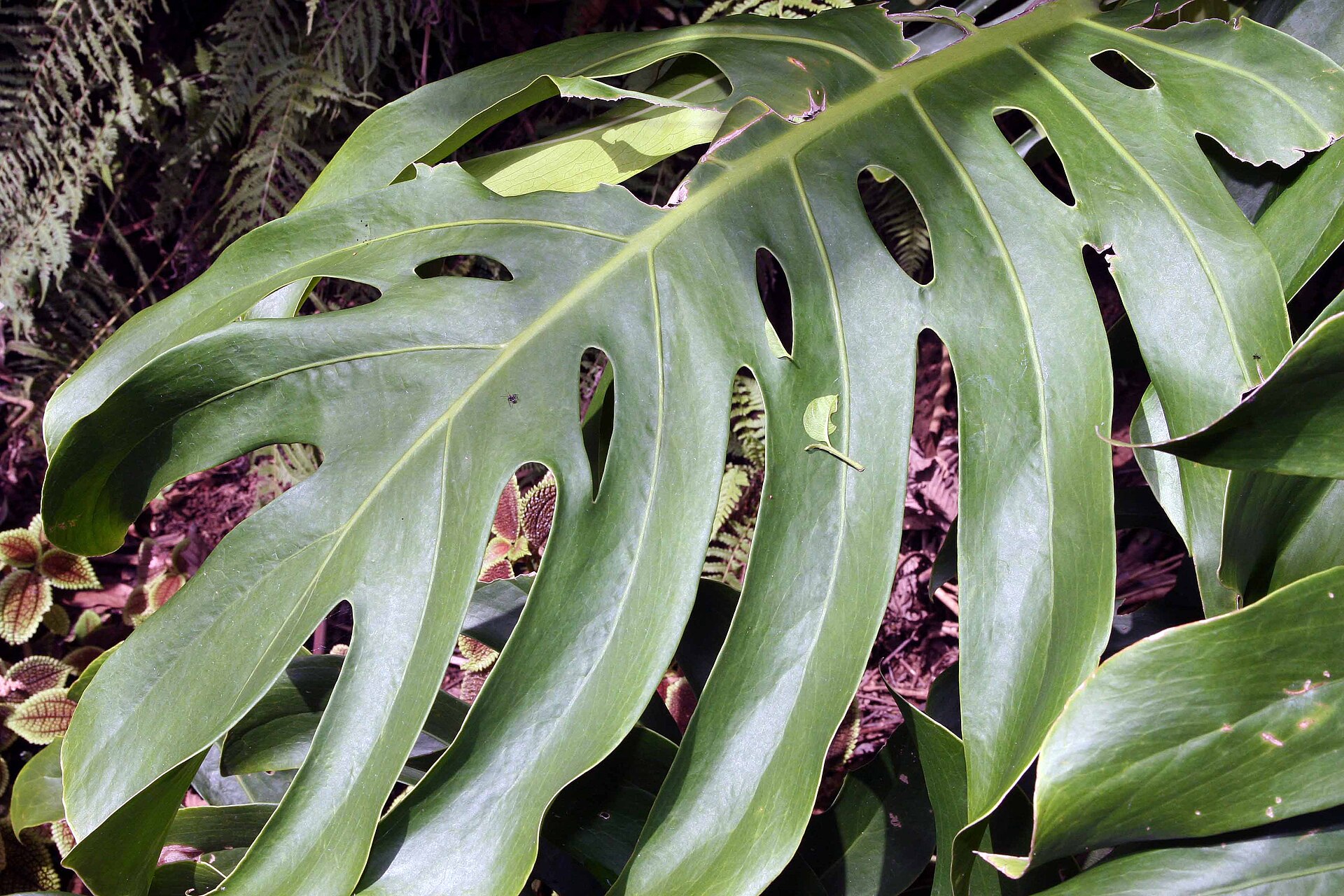
In the lowland tropical house, the planting is layered in a way that approximates forest structure — canopy trees, understory shrubs, groundcover, and the epiphytic plants colonizing every available surface. Anthuriums grow here, their spathe-and-spadix flowers exactly as they appear in species images from Colombia or Ecuador but rarely in cultivation north of a professional greenhouse. Philodendron species climb the supports, their petioles and leaf forms shifting as they mature into their adult, light-seeking morphology. For anyone who grows juvenile philodendrons at home and wonders what the full-grown plant is reaching toward, this is instructive in a way that no photograph quite replicates.
The upland or cloud-forest house shifts the humidity profile and the light quality, and with it the plant palette. This is where you find the mossy, damp-air conditions that Anthurium crystallinum and its kin come from — that combination of diffuse light, cool-leaning temperatures, and near-constant atmospheric moisture that growers spend years trying to reproduce in modified aquariums and HVAC-modified grow tents. Seeing it as an ambient condition rather than an engineered approximation is a useful corrective to the anxiety of the hobby.
Orchids are present throughout the rainforest galleries in a way that reflects their actual ecology — mounted, tucked into bark, growing in the angles of branches — rather than displayed in pots on a bench. This matters. An orchid growing mounted in moving air, its roots cycling between wet and genuinely dry, looks different and behaves differently than one in a nursery pot. The conservatory's approach to display is, quietly, a care argument.
The Orchid Show: Once a Year, the Conservatory Transforms
Every late winter and spring, the NYBG runs its annual Orchid Show, and the conservatory becomes the venue. The show has been a major draw for years, transforming the galleries with installation-scale arrangements that use orchid genera from Cattleya to Vanda to Dendrobium in quantities and configurations that a private collector would not ordinarily encounter outside a major trade show or a botanical garden in a country where orchids grow wild.
For serious growers, the show is worth attending less for the spectacle — though the spectacle is real — than for the opportunity to see how different genera perform under the conservatory's managed conditions, and to observe which species are being used in serious numbers versus which appear as novelties. The NYBG has in recent years brought in guest designers and international installations that shift the show's character year to year. The dates and themes change annually; check the NYBG calendar before planning a visit around it.
Even outside the Orchid Show period, orchid presence in the conservatory is consistent. The collection is a working scientific one, not a retail display, and that distinction shows in which species are maintained and how they are grown.
The Holiday Train Show: A Different Kind of Spectacle
Each winter, the conservatory also hosts the Holiday Train Show — a beloved New York institution in which model trains run through a landscape of miniature New York landmarks constructed entirely from natural plant materials: bark, seeds, pods, twigs, leaves. The engineering is meticulous and the botanical literacy required to build these structures is genuine; the team responsible has been refining the installations for decades.
The Train Show draws crowds that look nothing like the conservatory's usual audience, which is part of its function. It brings people into contact with the building and its plants who might not otherwise come, and some of them stay curious. For Leaf People readers the show is worth knowing about primarily as a scheduling note: if you are making a dedicated plant visit, the winter Train Show period means the conservatory will be more crowded than at other times of year. Plan accordingly — early morning on a weekday if possible.
The Library and Herbarium: The Garden Behind the Garden
The conservatory is the most immediately legible part of the NYBG for a casual visitor, but the institution behind it is something else. The LuEsther T. Mertz Library holds one of the most significant botanical collections in the world: rare botanical illustration volumes, original Linnaeus correspondence, field notebooks, and a research archive that supports scientists working on plant systematics, conservation, and ecology. The herbarium holds millions of pressed specimens, many of them type specimens — the physical vouchers that define what a species name refers to.
For collectors who have traced the taxonomy of their aroids into the literature — who have looked up the original species description of Philodendron gloriosum or followed the revisions that moved species between Anthurium sections — the NYBG's research output is already part of their practice, whether they know it or not. The institution publishes botanical monographs and maintains databases that inform the names we use. The conservatory is the visible, visitable expression of a scientific enterprise with real depth.
You cannot wander into the herbarium the way you wander into the Palm Dome, but the library's reading room is accessible to researchers, and the NYBG's digital collections make portions of their holdings available online. The point is that when you stand in the rainforest gallery looking at a labeled Anthurium, the label is backed by real taxonomic infrastructure. That is not a given at every conservatory.
Why Collectors Should Make the Trip
The practical case for visiting the Haupt Conservatory if you grow tropical plants is simple: it will change how you see your plants. Not in an abstract or inspirational sense but in a concrete, visual one. Leaf texture reads differently at scale. Growth habit is legible when a plant has had years to express it. The relationship between light quality, humidity, and leaf size — something growers argue about constantly in online forums — becomes observable when you walk from one gallery to the next and watch the foliage respond.
The NYBG is accessible by Metro-North from Grand Central Terminal, a roughly twenty-minute ride to the Botanical Garden station. For collectors in the Northeast, it is a day trip that returns value disproportionate to its cost. For collectors coming from further away, it belongs on the same itinerary as any serious plant-related travel in New York.
The conservatory is not a retail experience. Nothing is for sale under the dome. What it offers instead is context — for the plants in your collection, for the taxonomy you follow, for the conditions you are trying to approximate. That context, accumulated in an afternoon in a Victorian glasshouse in the Bronx, tends to stick.