The Presidential Palace sits at the northern edge of Kebun Raya Bogor as if it were an afterthought. What matters here is the 87 hectares of equatorial forest pressing against its walls — avenues of palms planted when Napoleon's brother was still relevant, a lily pond that makes every visiting botanist stop walking, and somewhere in the canopy shade, an Amorphophallus titanum corm waiting, unhurried, for its moment. Bogor sits about 60 kilometers south of Jakarta in the highlands of West Java, where the Ciliwung River runs cold and the Puncak hills trap enough rain to keep the whole place permanently, operatically green.
You enter through gates that have been receiving botanists, agronomists, colonial administrators, and curious travelers since 1817. The garden was founded that year by Caspar Georg Carl Reinwardt, a Dutch naturalist who had been appointed director of agriculture and sciences for the Dutch East Indies. Reinwardt's ambition was scientific and imperial in equal measure: a living laboratory for cataloguing equatorial flora and trialing crops that might sustain or enrich the colonial economy. What he seeded — literally and institutionally — became one of the most consequential gardens in the history of botany.
The Garden Reinwardt Built
Reinwardt's original vision drew on the model of Kew Gardens, then in its ascendancy as the nerve center of British colonial botany. He wanted a garden that could receive living specimens from across the archipelago and beyond, classify them, propagate them, and study their economic or medicinal potential. The site chosen beside the Buitenzorg Palace — 'Buitenzorg' meaning 'without care' in Dutch, a name that aged with all the irony one might expect — was ideal: high enough to be cooler than coastal Batavia, wet enough to sustain virtually anything equatorial.
Within decades the garden had become the institutional heart of tropical agronomy in Southeast Asia. Rubber (Hevea brasiliensis) was among the crops evaluated here before plantation cultivation spread across the region. Oil palm and cinchona — cinchona being the source of quinine, the anti-malarial alkaloid that made colonial expansion in the tropics survivable — were trialed within the grounds. The garden wasn't merely decorative. It was a working archive of what the equatorial world could produce, and it operated with the systematic rigor of a European research institution grafted onto one of the most biodiverse landscapes on earth.
Reinwardt left the Dutch East Indies in 1822, but the institution he established continued to grow under a succession of directors, including Johannes Elias Teijsmann, who served for decades in the nineteenth century and is credited with vastly expanding the palm and cycad collections. The garden's herbarium, the Herbarium Bogoriense, became a reference collection of global significance. Today that scientific lineage is unbroken: Kebun Raya Bogor operates under the Indonesian national science authority and continues active botanical research alongside its role as a public garden.
Every velvet philodendron you've grown under a grow light is a descendant, conceptually, of what Reinwardt's collectors were pulling out of Javan rainforest.
What Two Centuries Looks Like in a Landscape
Walking into Kebun Raya Bogor is a specific kind of temporal vertigo. The great avenues — planted with palms and hardwoods over the course of the nineteenth and early twentieth centuries — have had time to become forests in their own right. Canopies close overhead. The light that reaches ground level is the filtered, blue-green light of deep tropics, the kind that equatorial plants have evolved to exploit at extraordinary efficiency. Serious growers who visit after years spent under grow lights tend to go quiet here.
The garden's layout preserves the formal European structure Reinwardt imposed on it — main axes, defined collection areas, an ornamental lake — while two centuries of tropical growth have softened every edge into something that reads as inevitability rather than design. The Victoria waterlily pond is a set piece that earns its reputation: the leaves of Victoria amazonica reach diameters that make you recalculate your assumptions about what a leaf is. The plants are South American, introduced as botanical curiosities, but they thrive here in a way that says something about how permissive equatorial conditions are for equatorial plants.
The grounds also contain the ruins and remnants of Dutch colonial structures, old pathways of volcanic stone, and planting labels that sometimes date back generations. None of this is theatrical. It simply accumulated.
The Orchid House
Among the garden's dedicated structures, the orchid house is the one collectors tend to seek out first. Indonesia is among the most orchid-rich nations on earth, with thousands of native species distributed across its islands, and Kebun Raya Bogor's collection reflects that depth. Here you find native Dendrobium, Vanda, and Bulbophyllum species growing in conditions — humidity, airflow, filtered equatorial light — that approximate what they experience in the wild.
For anyone who grows mounted epiphytes at home, this is instructive and slightly humbling. The orchids in a good botanical garden collection are not performing. They are simply doing what they do when the conditions are correct, which turns out to be quite extraordinary. The mounting methods, the drainage, the lack of stagnant air — it is all legible as care philosophy if you know what you are looking at. Growers who visit often come back with revised opinions about their own substrate choices.
The Aroid Collections and Why They Matter
Kebun Raya Bogor's aroid plantings are not the most talked-about feature of the garden, but for collectors they are among the most resonant. The Araceae family is enormous — philodendrons, anthuriums, alocasias, colocasias, pothos relatives — and in Bogor they grow in something close to their natural register: planted in groups under filtered canopy light, in moist soil with good drainage, in the equatorial warmth that most of them require to express their best growth.
Every velvet philodendron you've grown under a grow light is a descendant, conceptually, of what Reinwardt's collectors and their successors were pulling out of Javan rainforest and adjacent archipelago flora two hundred years ago. The institutional knowledge built at Bogor fed into the understanding of equatorial plant families that the modern hobby now inherits. Seeing an Alocasia or a philodendron relative growing at its natural scale in natural conditions recalibrates your sense of what you are actually trying to replicate at home.
The garden also holds extensive palm collections, which is its own discipline, but palms are the structural backdrop against which the understorey aroids and epiphytes live. In Bogor, walking through the palm sections with aroids planted beneath is the closest thing to an educational diorama the plant world has produced.
The Titan Arum: The Aroid World's Pilgrimage Flower
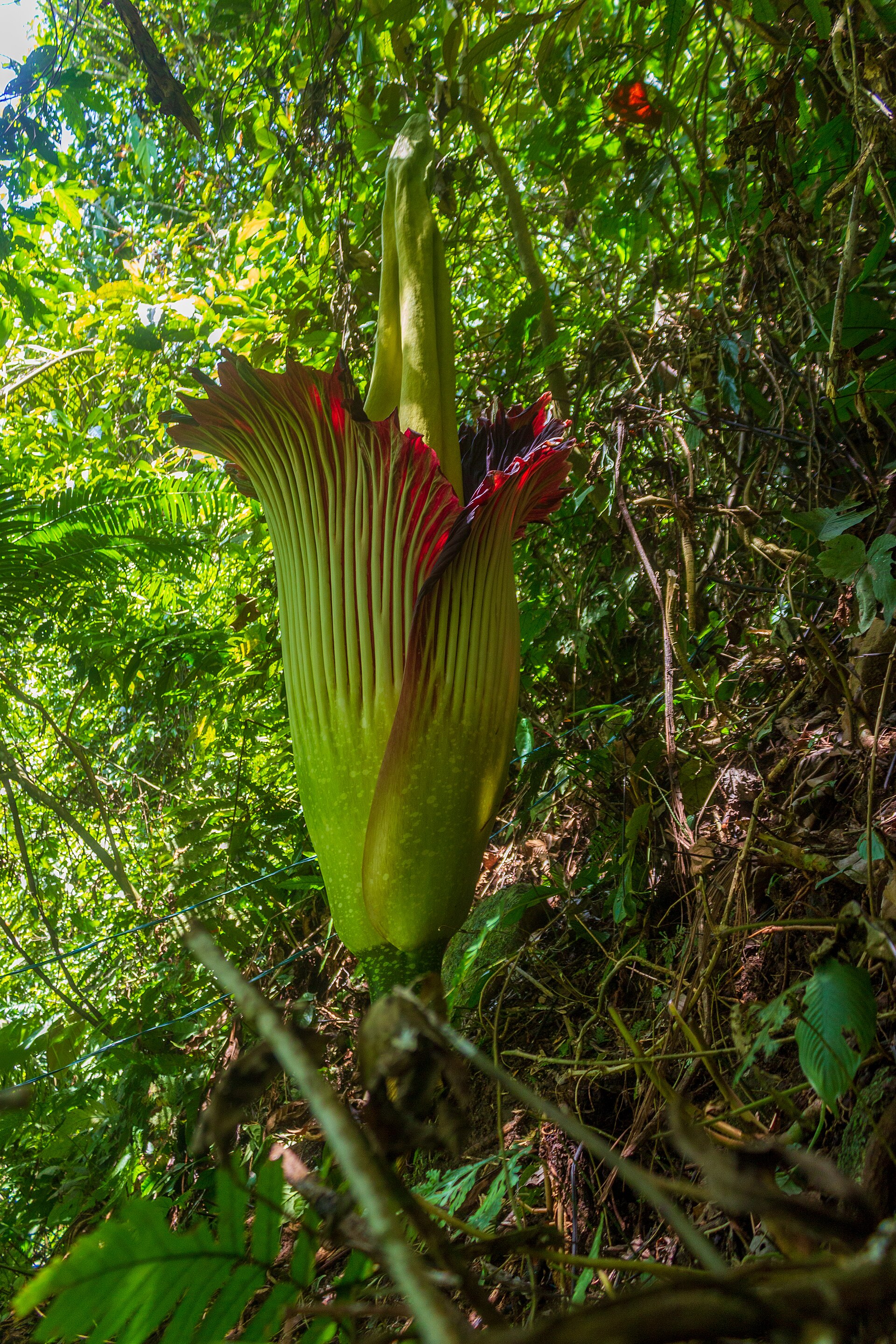
Amorphophallus titanum is native to the rainforests of Sumatra, which makes Kebun Raya Bogor — on the island of Java, close to Sumatra in biogeographic terms, long established as a center for Sumatran flora study — a historically appropriate place for it. The plant produces what is considered the largest unbranched inflorescence in the plant kingdom: a spathe that can reach well over a meter in height, surrounding a spadix that generates heat and emits a sulfurous, carrion-like odor for the roughly 24 to 48 hours the flower is open.
Blooming events at botanical gardens draw crowds because the flowering is genuinely rare and genuinely unpredictable. A corm may take many years between flowerings, and the open-flower window is short. Kebun Raya Bogor has recorded multiple Amorphophallus titanum bloomings over its history, and when one opens, word spreads through the botanical community with the speed of something that doesn't happen often enough to be taken casually.
For the aroid collector, the Titan arum is an extreme case of what the family does — spathe, spadix, thermogenesis, chemical signaling — but it is also a clarifying one. Every Anthurium or Philodendron inflorescence in your collection is a smaller, quieter version of the same architecture. Seeing the maximum expression of a form you know well is not just spectacular. It is genuinely instructive about the family you grow.
The Colonial Weight and the Living Collection
Any honest account of Kebun Raya Bogor has to hold two things at once. The garden was founded as an instrument of Dutch colonial science and economy. The crops trialed here — rubber, cinchona, oil palm — were developed in service of a system that extracted enormous wealth from the Indonesian archipelago at enormous human cost. That history is present in the garden's bones, in the old Dutch names on some of the pathways, in the institutional structure that Reinwardt imported wholesale from European models.
Since Indonesian independence, the garden has been an Indonesian institution, and its mission has shifted toward conservation, native flora research, and public education. The Herbarium Bogoriense remains one of the most significant plant reference collections in Asia. The work being done here now — cataloguing, conserving, understanding the equatorial flora of a biodiverse archipelago — is the work of Indonesian scientists. The colonial founding is part of the garden's history, not its present identity.
What persists across both eras is the plants. The collections accumulated over two centuries are irreplaceable. The old specimens, the mature canopy trees, the orchid lineages, the aroid plantings — these outlast the ideologies that put them in the ground and now belong to the discipline of botany as a whole and to the country that holds them.
What to See and How to Use Your Time
If you are making a deliberate visit, build your time around the orchid house and the aroid plantings first, while your attention is fresh. The palm avenues are best walked slowly, in the early morning before the equatorial heat peaks. The Victoria lily pond requires no planning — it announces itself. If there is a Titan arum in bloom during your visit, that determines your schedule. Everything else waits.
The garden is large enough that a single visit won't exhaust it. Serious collectors often return multiple times over a trip to Bogor, circling back to sections seen in different light. The herbarium is accessible to researchers through appropriate institutional channels rather than casual drop-in visits, but the living collections are the primary experience for most visitors.
Bogor itself is worth the journey from Jakarta: the cooler air, the market near the station selling local produce, the way the garden's green weight is visible from the streets surrounding it. The garden sits beside the Presidential Palace, and the sight lines between formal colonial architecture and two centuries of tropical growth make the whole site feel like a compressed argument about what the equatorial world actually is, and what it produces when left to itself — or tended with appropriate obsession.