You buy a seedling Anthurium clarinervium from a grower in Florida. It arrives the size of a coaster, leaves round as river stones, the venation a faint chalk-line tracing. Six months later it pushes a leaf that is suddenly cordate, the sinus deeper, the silver veins thickening into something closer to the photographs that made you want the plant in the first place. A year after that, a leaf emerges so different in proportion you find yourself checking the tag, briefly convinced a label got swapped at the nursery.
Nothing got swapped. The plant is doing what anthuriums do: arguing with itself, slowly, leaf by leaf, until it lands on the adult form. Botanists call this heteroblasty. Collectors call it the reason a juvenile papillilaminum and an adult papillilaminum look like distant cousins. It is one of the most under-discussed mechanics in the genus, and one of the most useful to understand if you spend money on small plants.
What heteroblasty actually means
Heteroblasty is the term for a stepwise change in leaf morphology — and sometimes stem and petiole anatomy — as a plant transitions from its juvenile to its adult phase. It is distinct from simple growth. A juvenile leaf is not a smaller draft of the adult leaf; it is a structurally different organ produced under a different genetic program. The plant moves between programs gradually, and the leaves in between are often the strangest looking ones it will ever make.
In anthuriums the shifts can be dramatic. Anthurium pedatoradiatum begins life with simple, lobed leaves and ends with the deeply digitate, almost hand-shaped foliage that gives it its common name. Anthurium polydactylum does something similar, only more so. Velvets like crystallinum, magnificum, and clarinervium keep the same general silhouette throughout, but the proportions, the venation density, and the texture of the lamina all change. Petiole geometry — the famous D-shape, the winged margins of magnificum — usually does not fully express until the plant is a few leaves into its adult phase.
The change is not on a calendar. It is on a count. A plant tends to flip phases after producing some threshold number of leaves, or once its root system and caudex reach a certain mass. Light it well, feed it well, and you compress the timeline. Starve it and it can stay juvenile for years.
A juvenile leaf is not a smaller version of the adult. It is a different solution to a different problem, made by the same plant.
Why a rainforest plant bothers
The evolutionary logic is not mysterious once you picture the habitat. A young anthurium germinates on the dim forest floor or on a low mossy trunk, in deep shade, with limited airflow and high humidity. The leaves it needs there are different from the leaves it will need once it has climbed, or once its root mass has muscled it into a brighter microclimate higher on a host tree. Juvenile leaves tend to be thinner, rounder, and held closer to the substrate — efficient at scavenging weak light without losing too much water.
Adult leaves do other work. They are larger, often pendant, with thicker laminae and more pronounced venation. In velvets, the iridescent papillose surface that collectors prize is partly a light-harvesting adaptation: a way to bounce scarce photons around inside the leaf rather than let them pass through. That structure costs the plant something to build, so it does not build it until the rest of the plant can support it.
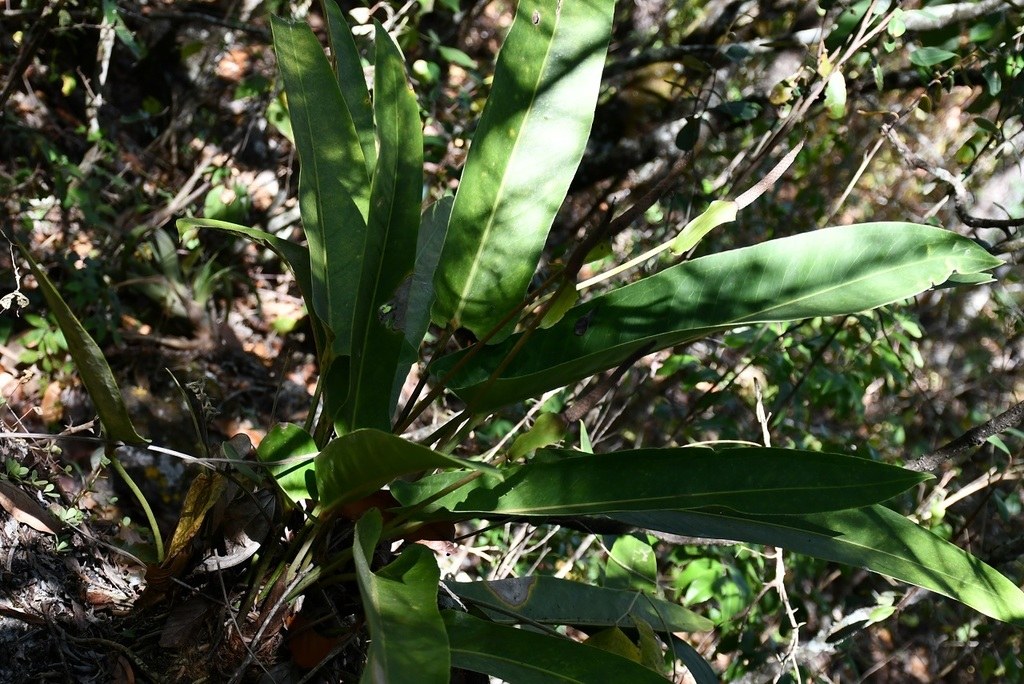
Section Cardiolonchium, which contains most of the famous velvets, shows this especially clearly. So does section Pachyneurium, the bird's-nest types, whose juveniles look almost nothing like the strap-leaved adults that fill a one-meter rosette. Once you know to look for the pattern, you see it everywhere in the genus.
Reading the leaves you have
For a collector this matters in two practical ways. First, identification. A juvenile willifordii and a juvenile warocqueanum can look confusingly similar in a grower's flat, narrow and strappy and unhelpfully green. The adult forms are unmistakable, but the babies require trust in the seller and patience in the buyer. The same goes for hybrids: a juvenile cross of papillilaminum × luxurians will not show its luxurians-side bullation until the plant has put on size.
Second, expectations. If you buy a small velvet and the next leaf comes in matte and a little plain, you have not been swindled. You are watching the in-between phase. The plant is reallocating resources, often building a much larger root system before it commits to expensive adult foliage. Many growers see two or three unremarkable leaves after a repot, then a sudden jump in quality on the fourth.
The instinct to panic at a disappointing leaf is the single most expensive mistake new anthurium collectors make. They cut, they repot, they change the substrate, they move the plant — and they reset the clock on the very transition they were waiting for.
How to push a plant toward its adult form
You cannot rush heteroblasty, but you can stop sabotaging it. Anthuriums shift phases fastest when their roots are unbothered and their canopy is well lit. That means a coarse, airy mix — chunky orchid bark, perlite, pumice, a little charcoal, maybe a small fraction of sphagnum if your humidity is low — and a pot that drains in seconds, not minutes. Wet feet do not just rot roots; they keep the plant juvenile by limiting the root expansion that triggers the adult program.
Light is the other lever. Most velvets want bright, diffuse light — somewhere in the range of 150 to 250 µmol/m²/s at the canopy, for those who like numbers, or a position where a hand held above the plant casts a soft, defined shadow. Too little light and the plant idles. Too much and you get bleached, stalled leaves that abort early. Humidity in the 65–80% range with steady airflow encourages the larger, thinner adult leaves to expand without edge burn.
Feeding matters more than people admit. A starved anthurium will hold in its juvenile form indefinitely. A weak, consistent fertilizer regimen — a quarter to half strength balanced feed at every watering, flushed monthly — keeps the plant building. The transition leaf, when it comes, is almost always preceded by a visible flush of new roots.
The collector's trap: buying photos, not plants
Aroid auctions and Instagram sales are full of glamour shots of adult leaves attached to plants that, when they arrive, produce three juvenile leaves in a row. This is not always deception. A cutting taken from an adult mother plant can revert toward juvenile morphology when it roots, especially if it loses leaves in transit or sits in stagnant media while it recovers. The genetics are adult; the expression is not.
This is why provenance matters and why experienced sellers will tell you, unprompted, how many nodes back the cutting came from and what the mother looks like now. A node from deep in the adult section of a climbing warocqueanum will hold its form better than a tip cutting from a stressed plant. Seed-grown plants, of course, start at the beginning and walk the whole road.
The honest version of the transaction sounds like: this is a juvenile of an adult mother; expect two to four transitional leaves before it resembles the parent. The dishonest version sells you the photograph.
Patience as a horticultural skill
There is a particular satisfaction in watching a plant become itself. The third leaf is rounder than you hoped. The fifth is longer, the venation a shade more defined. By the eighth or ninth leaf the petiole has thickened and taken on its proper cross-section, and the lamina hangs with the weight of an adult organ. You did not do this. The plant did. You only kept it alive long enough to let it.
Most of the skill in growing anthuriums is the skill of not interfering. Stable conditions, consistent water, a pot you do not keep disturbing, a substrate you trust enough to leave alone for a year. The plants that transition fastest in my collection are not the ones I fuss over. They are the ones I have, in some quiet way, forgotten about — checked weekly, watered when dry, left to figure out their own argument.
Heteroblasty is a useful reminder that an anthurium is not a static object you have purchased. It is a slow process you have agreed to host. The leaf on the plant today is a draft. The plant is the writer. Your job is to keep the lights on.