Somewhere in a greenhouse in the Philippines, or in a converted spare room in the Netherlands, or under T5 banks in a suburb of Jakarta, a grower takes a brush to a spadix. The pollen comes from one plant, the stigma from another, and what results — after months of berry ripening, seed cleaning, germination, and years of grow-out — might be a seedling with leaves that do something none of its parents managed alone. If it does, it gets a name. Not a catalog number. A human name.
The named anthurium hybrid is a peculiar artifact of this particular moment in the hobby. It sits at the intersection of plant breeding, personal branding, and collector psychology — and it carries, in the syllables of whoever christened it, a whole compressed history of technique, access, and taste. To understand why Anthurium 'Ace of Spades' or A. 'Warocqueanum × magnificum' clones command what they command, you have to understand what a name is actually doing on a label.
The Parents Behind the Label
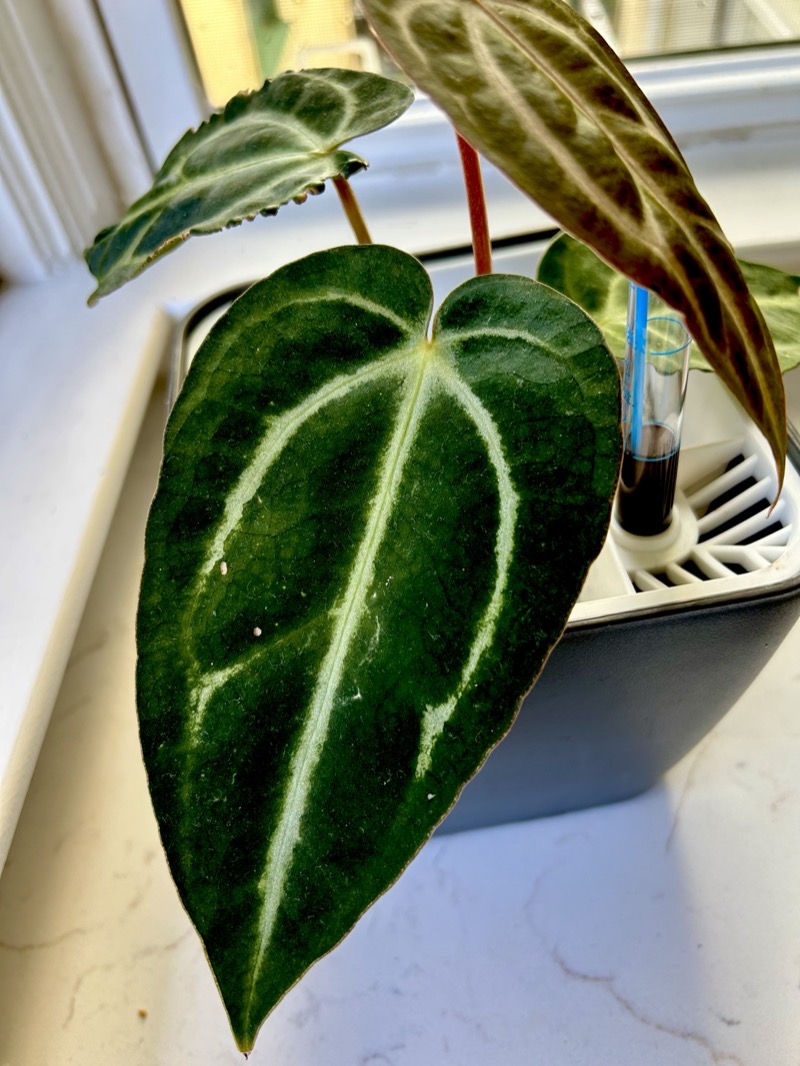
Anthurium hybridizing at the collector level is almost always driven by velvet. A. warocqueanum, the queen, brings enormous blade length, silvery primary venation, and that olive-green velvet surface that shifts color as you move around it. A. crystallinum contributes broader, more heart-shaped blades and silver veins so pronounced they look embossed. A. magnificum adds a different texture — thicker, quilted, with a petiole that runs square-edged in cross section. Breeders choose these species because each contributes a distinct trait legible to the eye, which matters when you are selling to buyers who will pay more for something demonstrably better than what they already own.
The cross behind a named hybrid is sometimes printed in full — 'warocqueanum × crystallinum' — but the name layered on top does additional work. It signals a specific grower's hand and, implicitly, their selection standards. A seedling batch from a deliberate cross might yield two hundred plants. If the grower has a reputation, 'selected' means something: they grew all two hundred out and picked one. That one becomes the named clone.
What gets elided in the label is everything that happened before the selection: the dozens of failed or unremarkable siblings, the cost of the grow-out space, the years it took to see mature leaf expression. The name compresses all of that. It also transfers it — when you buy a division or a tissue-culture offset of a named clone, you are buying the result of that entire process without having to run it yourself. That convenience is part of what the price reflects.
The name is not decoration. It is provenance, promise, and in the right hands, proof of work compressed into a few syllables.
How a Grower's Name Becomes a Brand
Consider what happened with breeders operating out of Southeast Asia in the early 2020s. Growers with consistent Instagram documentation — detailed spadix shots, close-ups of seed berries, multi-year progression photos of the same clone — built credibility before they ever sold a plant. When a named hybrid from one of those growers appeared on a marketplace, buyers already had a mental file on the source. The name on the label pointed back to that file.
This is not unique to anthuriums — orchid breeding has operated this way for more than a century, with grex names like Rhynchostylis 'Sakhon Nakhon' or clonal names appended to meristemed Cattleyas — but the anthurium world is younger and moves faster. Social media collapsed the timeline that used to separate breeders from collectors. A grower in Mindanao could show a seedling at six months, document its juvenile leaf, and build demand for a plant that would not be dividable for another two years. The name functioned as a futures contract.
Reputation compounds. A grower who named three or four hybrids that grew out well — whose documented clones matched the photos buyers received — found that subsequent named releases carried an automatic premium. The market was not just buying a plant; it was buying confidence in a track record.
Selection Pressure and What It Actually Means
The word 'selected' appears constantly in named hybrid listings, and it is worth being precise about what it can and cannot guarantee. A selected clone from a large seedling batch is, in principle, the best expression the breeder found. In practice, selection criteria vary enormously. Some breeders select at juvenile stage, when leaf shape is still forming. Others wait for the third or fourth adult leaf, when velvet texture, venation density, and blade-to-petiole ratio have stabilized. The latter is more expensive and more reliable.
What selection cannot do is guarantee uniformity across propagation. Tissue culture of a named clone should produce genetically identical plants, but tissue culture introduces its own variables — cultures can revert, juvenilize, or throw off-types. A division is truer to the original, but divisions are slow and stress the mother. This is why named hybrids from reputable tissue culture labs trade at different prices than named hybrids available only as divisions: the propagation method is part of the value stack, even when the clone name is the same.
There is also the question of what happens when a name detaches from its origin. Once a named clone circulates widely, cuttings get sold by people who received them second- or third-hand, sometimes without documentation. The name persists; the provenance verification does not. Buyers buying 'Ace of Spades' from an unknown reseller are buying a name more than a confirmed clone.
The Price Mechanics of a Syllable
A unnamed seedling from the same cross as a famous named hybrid might sell for a tenth the price. That gap is not irrational, even if it sometimes looks like it is. The named clone has a known phenotype — you can look at photos of a mature plant and know roughly what you are growing toward. The unnamed seedling is a probability distribution. You might get something spectacular; you might get something unremarkable. The premium on the named clone is, in part, a payment for certainty, or at least for narrower variance.
The dynamics shift depending on how widely the clone has been distributed. In 2020 and 2021, access was the binding constraint — tissue cultures were limited, divisions were limited, and the number of people who wanted a given named hybrid outstripped supply sharply. Prices for some named velvet anthurium clones reached levels that now look almost inexplicable: single rooted divisions of selections like A. 'Metallicum' going for four figures in some markets. That was a supply squeeze as much as a quality premium.
As tissue culture scaled and supply caught up, prices on widely distributed clones compressed significantly. What remained elevated were names attached to clones that were still difficult to propagate, or that came from breeders who maintained deliberate scarcity — releasing only divisions, never tissue-culturing, keeping stock small. The name, in those cases, remained a proxy for physical rarity.
Species Integrity and the Hybrid Question
Not everyone in the anthurium hobby is enthusiastic about named hybrids. A persistent current of collector opinion holds that species specimens — a true warocqueanum from verified provenance, a documented dressleri — are inherently more meaningful than any hybrid, however spectacular. The argument is partly about genetic preservation and partly about the reproducibility of natural form: a species plant expresses an evolutionary solution, while a hybrid expresses a human preference.
This is a genuine tension, not a tribalism to dismiss. Anthurium dressleri, collected from Darién Province in Panama, represents a population with a specific ecology, a specific pollinator relationship, and a gene pool of limited size. A hybrid between dressleri and warocqueanum may produce a leaf that is visually arresting, but it contributes nothing to the species' continuity and, if it crowds out collector interest in the species itself, might indirectly reduce pressure to maintain verified stock.
The counterargument is that hybrids bring collectors into the hobby who eventually develop interest in species, and that the financial energy around named hybrids has funded the infrastructure — labs, grow-out space, distribution networks — that also moves species plants. Both things are probably true. What is certain is that the named hybrid occupies a different ethical and horticultural register than a species specimen, and pricing them as equivalent confuses the market.
Reading a Name with Clear Eyes
When you encounter a named hybrid, the useful questions are not 'is this expensive' or 'is this worth it' in the abstract. They are: who made this selection, at what stage of leaf development, and how has the clone been propagated since. If a seller cannot answer those questions — or if the name is attached to a plant whose origin has become untraceable — the name is doing less work than it appears to.
Reputable sellers document their sources. The best ones can tell you the cross generation (F1 from the original breeder, or further removed), the propagation method, and whether the plant has been grown to show at least one adult leaf before sale. That last point matters more than almost anything else: velvet anthuriums in particular can look dramatically different at juvenile and adult stages, and a plant sold as a rooted seedling labeled with a famous hybrid name is making a promise it cannot yet keep.
None of this means named hybrids are a bad purchase. A well-documented, tissue-cultured offset of a genuinely outstanding selection from a breeder with a verifiable track record is a reasonable thing to pay a premium for. The name earns its price when it functions as actual information: here is who made this, here is what it looked like at maturity, here is how it was reproduced. When it functions instead as atmosphere — a glamorous label on a plant whose lineage is hazy — it is selling you something else entirely.
What the Label Is Really Selling
Every named anthurium hybrid that moves through a collector market is, in part, a small argument about what plant keeping is for. The argument encoded in a name is that individual expression matters — that among two hundred seedlings from the same cross, one is worth distinguishing, worth preserving as a clone, worth enough to carry a word that sticks to it through every propagation cycle forward.
That is not a trivial argument. Plant breeders have been making it for centuries. What changes in the current moment is the speed and reach of the naming, and the degree to which a name can accrue financial weight before the plant behind it has been widely grown and assessed. The early valuation of a named anthurium hybrid is partly speculation — a bet that the clone will perform the way the breeder's photos suggest.
Sometimes it does. Sometimes a named clone circulates for three or four years and the consensus sharpens: yes, this one really does hold its velvet texture under average humidity, really does push blades at that width, really does look the way the original documentation suggested. When that happens, the name has been earned. It has become, finally, information rather than assertion — and information, in a market built on trust between people who cannot touch the plants they are buying, is exactly what the price is meant to reflect.