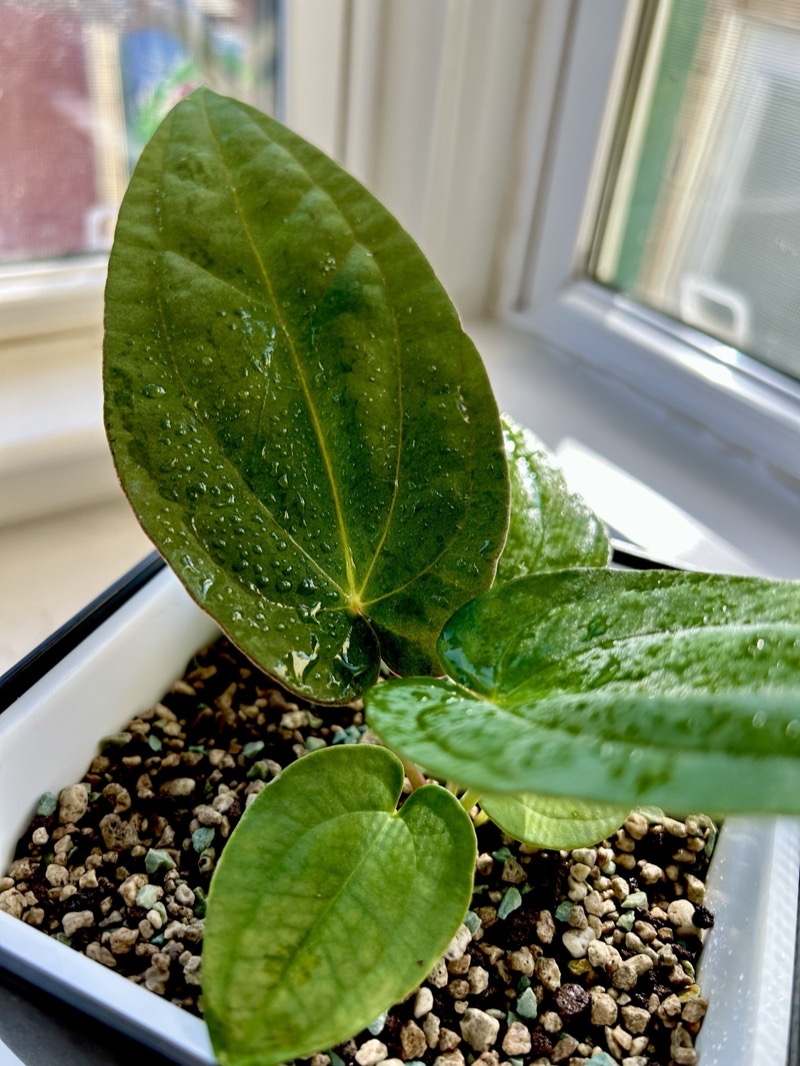
There is a plant on a shelf in a spare bedroom in Bogotá that most North American collectors have never heard of. It has elliptic leaves, maybe eighteen centimeters at maturity, with a matte upper surface somewhere between sage and deep malachite and a venation pattern that catches light at an angle you have to earn by moving your face close to the leaf. The petiole is geniculate, the midrib pale, the texture unmistakably velvet. It is not crystallinum. It is not magnificum. Its name honors a living person — a grower, not a Linnaean botanist dead two centuries — and that fact alone is worth pulling on.
The anthurium hobby runs on spectacle: the blinding silver tessellation of a well-grown A. crystallinum, the sheer mass of a magnificum leaf going dinner-plate wide, the almost mythological scarcity of a confirmed dressleri. But taxonomy keeps producing species that land quietly, species that reward attention rather than announce themselves, species whose names carry a story about who is doing the work of describing plants right now. Those are the ones worth understanding.
What It Means to Describe a Species
A formal species description is a legal document in the language of botany. Under the International Code of Nomenclature for algae, fungi, and plants, a new species requires a Latin or English diagnosis, a designated type specimen lodged in a recognized herbarium, and publication in a peer-reviewed outlet with an ISSN or ISBN. Miss any element and the name is invalid, a ghost in the literature. The process is meticulous and slow, and for a genus as large as Anthurium — somewhere north of a thousand accepted species, with dozens more awaiting description — it is perpetually backlogged.
What has changed in the last decade is who initiates that process. Historically, field botanists collected specimens during funded expeditions, pressed and dried them, shipped them to institutions in Europe or the United States, and the description emerged from a herbarium drawer years later. That pipeline still exists, but it now runs in parallel with a second one: cultivated plants, grown by hobbyists or small nurseries in Colombia, Ecuador, or Peru, observed across multiple growth cycles, photographed in living detail that a pressed specimen cannot capture. Growers are noticing things. Some of them are documenting those observations rigorously enough that taxonomists are listening.
The result is a small but meaningful shift in who gets acknowledged. When a new species is named for a living grower — an eponymous epithet, in the technical term — it is the botanist's way of saying: this person contributed something real. That contribution might be a specimen, a photograph series, a cultivation record spanning years, or simply the sustained attention that allowed a plant to show what it was.
Taxonomy used to honor the dead. Naming a species for a living grower is a small argument about who plant knowledge actually belongs to.
The Anatomy of an Overlooked Plant
Velvet anthuriums in the section Cardiolonchium are characterized by their trichome-covered adaxial surfaces — those fine hairs that scatter light and produce the matte, tactile quality collectors call velvet. Within that group, the plants that attract maximum collector attention share a few traits: large mature leaf size, high-contrast venation, and a certain drama in the sinus, the gap between the basal lobes. Crystallinum delivers all three. Magnificum amplifies the size. Regale, when you can find a true one, approaches the theatrical.
What gets passed over are the species that are more restrained: leaves topping out at twenty-five centimeters rather than sixty, venation that is refined rather than electric, overall habit compact enough to fit a two-gallon nursery pot without dominating the shelf. These are not inferior plants. They are plants that require closer looking, and in a hobby increasingly mediated by four-second Instagram reels, closer looking is not always what the algorithm rewards.
A species named for a contemporary grower often falls into this category. It arrives in the hobby attached to a person's name rather than a spectacular photograph, which means its reputation has to be built the slow way — through the experience of people who have actually grown it through several leaf cycles and noticed what it does. That slow reputation is, paradoxically, more reliable than hype.
Eponymy and Its Politics
Taxonomy used to honor the dead almost exclusively. Linnaeus named plants for patrons, for expedition companions, occasionally for rivals he wished to needle with an unattractive genus. The tradition of naming for the living existed but carried risk: the honoree might later disgrace themselves, and the name, once published, cannot be changed for that reason alone. Taxonomists were cautious.
That caution has loosened somewhat as the field has broadened. Botanists working on neotropical aroids today operate in a community that includes professional researchers at institutions like the Missouri Botanical Garden or the Universidad Nacional de Colombia alongside independent growers with no institutional affiliation but with years of documented cultivation experience. When someone in that second category has grown a plant through a hundred leaf cycles, photographed every ontogenetic stage, and made those records available to the taxonomist preparing a description, naming the species for that person is not sentiment — it is citation.
The politics are not entirely clean. Eponymy can be a form of flattery, a way of building goodwill in a community the taxonomist needs access to. It can also inadvertently reinforce existing status hierarchies within the hobby: the growers who get named species tend to be the ones already visible, already networked, already producing plants that move through the upper tier of the collector market. The sleeper species — the one that is not yet a status object — named for a grower who is not yet famous is a different kind of acknowledgment. It is riskier and, arguably, more honest.
How a Living Grower Gets Into the Literature
The path is rarely dramatic. A grower acquires a plant from a Colombian nursery or a field collector, grows it out, notices that it does not match any described species — the petiole cross-section is wrong, the spathe color is off, the leaf texture is finer than clavigerum or coarser than warocqueanum. They photograph it carefully: adaxial and abaxial surfaces, petiole cross-section, inflorescence if it blooms, scale bar included. They post it to a species identification group or send it directly to a botanist they know.
The botanist compares it against type specimens — physically, if they have herbarium access, or digitally through databases like JSTOR Global Plants or the Kew Herbarium catalogue. If the plant is genuinely novel, the process of formal description begins. The grower may contribute live material for DNA extraction, may provide cultivation notes that inform the ecology section of the description, may be thanked in the acknowledgments or honored in the epithet itself. The paper eventually appears in a journal like Phytotaxa or Willdenowia, open-access or not, and the species has a name.
What the grower does not get is commercial protection. The name is scientific and public. Anyone can propagate the plant, sell it, rename it in trade under a catchier label. The gap between the botanical record and the collector market is wide, and it is where a lot of confusion — and a fair amount of fraud — lives.
Growing the Understated Velvet
A compact velvet anthurium named for a contemporary grower will, in most cases, want conditions close to what works for crystallinum: bright indirect light, humidity above 70 percent, a substrate that drains within two days of watering. Where these smaller-leaved species sometimes differ is in their tolerance of air movement. Several of the recently described Colombian species come from ridge forests where mist and airflow coexist, which means stagnant high humidity is not necessarily better than moderate humidity with a fan running. Rot risk at the crown drops noticeably when air moves.
Substrate matters more than many growers admit. A mix of fine orchid bark, perlite, and a small fraction of worm castings — nothing heavier than twenty percent organic material — gives roots enough structure to anchor without sitting wet. These plants are not forgiving of compacted media. The roots are fine and prone to browning if the mix stays saturated for more than three or four days. Terracotta over plastic; bottom weight over top-heaviness; repot before the plant is rootbound, not after.
New leaves on a compact velvet species often emerge with a bronzed or reddish cataphyll that splits cleanly as the leaf expands. The velvet quality on the new leaf is frequently more pronounced than on older leaves, which can flatten slightly as they harden. If you want to photograph the texture at its best, the window is the first week after the cataphyll opens.
Why the Name Is the Point
Collectors sometimes treat the formal epithet as trivia — useful for provenance verification, less important than the plant's look or its lineage within a specific grower's stock. That is understandable. The market does not reward botanical literacy directly. But the name carries information that the trade name does not.
A species epithet tells you when the plant was formally described, which places it in a lineage of botanical knowledge. It tells you who described it and, if it is eponymous, who was worth honoring. It connects the plant in your collection to a type specimen in a herbarium that will still exist in a hundred years, a fixed reference point against which every subsequent plant called by that name can be compared. Trade names float free of that anchor. A plant sold as 'Silver Blush' or 'Velvet Dream' is a name invented for a market, not a coordinate in a shared scientific record.
When the epithet honors a living grower, it makes that person part of the permanent record. Their name goes into Phytotaxa, into the Kew World Checklist, into every downstream database that indexes accepted species. That is not nothing. For someone who has spent years growing plants in a spare room, learning to read petiole cross-sections and spathe angles, contributing observations that helped a botanist see what they were looking at — having a species named for you is the field's acknowledgment that amateur expertise is real expertise, documented and credited in the only ledger that does not reset.
The Collector's Obligation
The sleeper species — compact, quietly beautiful, named for someone you may never have heard of — asks something of the collector that the spectacle species does not. It asks you to look carefully enough to see what is actually there rather than what is immediately obvious. It asks you to learn the name, use it correctly, and pass that habit on when you sell a division or recommend the plant to someone else. That is a small discipline, but it matters.
Misidentification in the aroid hobby is endemic and largely consequence-free for the seller. A plant sold as magnificum that is actually a hybrid, a plant called dressleri that is something else entirely — these errors circulate for years, acquiring the weight of repetition until they feel like fact. Using formal epithets consistently, including for the unspectacular species that no one is faking because no one is paying a premium for them yet, is a form of record-keeping. It keeps the signal clean.
The botanists describing new anthuriums right now are working in conditions that are not improving: reduced herbarium funding, political instability in source countries, a trade market that can strip a cloud-forest population before a species is even formally described. The growers they collaborate with are often the first humans to document what a living plant looks like over time. Paying attention to those names — growing the sleepers, using their epithets, knowing whose name the plant carries and why — is the minimum contribution a serious collector can make to a process that is larger than any single shelf of velvet leaves.