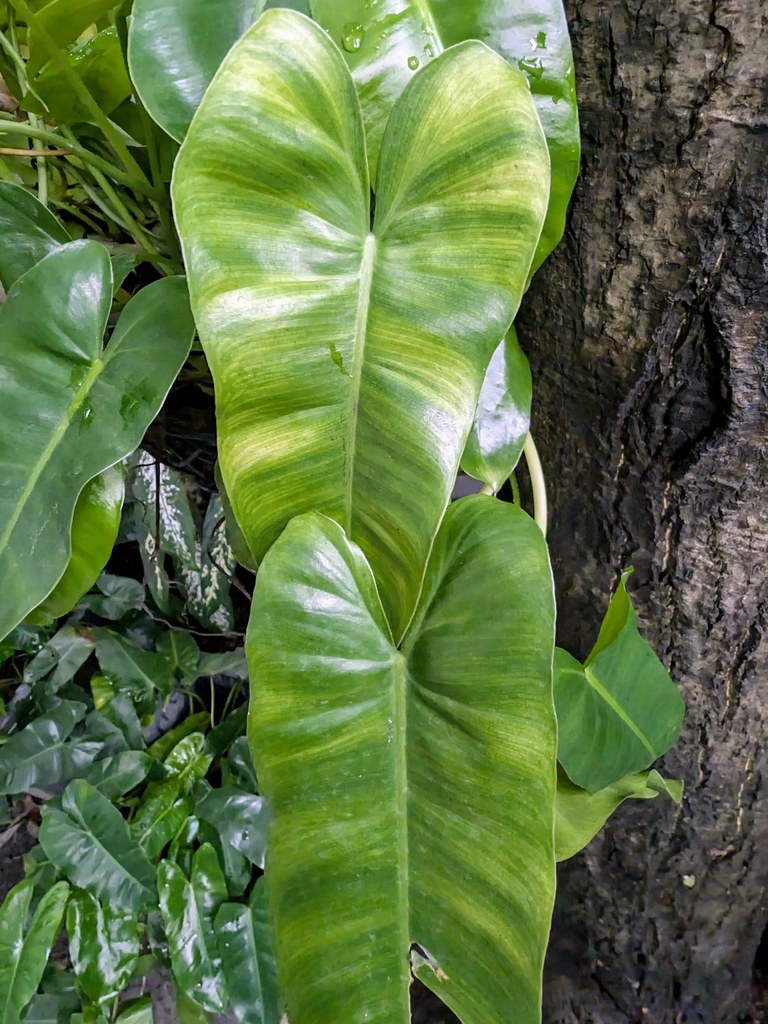
📷 no rights reserved / iNaturalist (CC0)
Field Guide · Philodendron
An Ecuadorian climber with leathery, leather-grained leaves that look stitched rather than grown — and the close relatives worth keeping beside it.
The type species for this guide, endemic to a small slice of Ecuadorian cloud forest and listed as Near Threatened in the wild. Mature leaves are deeply puckered and oddly hide-like — heart-shaped, glossy, and stiff enough to feel structural in the hand. It climbs slowly compared to faster Philodendron, rewarding a tall, damp pole with progressively larger blades. Keep it cool and humid; it sulks in dry apartment air.
The iconA naturally occurring leaf-shape variant in cultivation, with longer, more lance-shaped blades that retain the bullate, leathery texture of the type. It tends to be a touch faster than standard rugosum and shows the rugose surface earlier on juvenile leaves. Provenance matters here — many plants sold under this label are simply juvenile typical rugosum. Buy from a grower who can show mature foliage.
Collector formNot rugosum, but the species most often grown alongside it and from a similar Andean cloud-forest band. Velvety dark-green leaves with pale primary veins and a famously bristly red petiole. Care overlaps almost exactly: cool nights, high humidity, airy substrate, a damp pole. If you can keep verrucosum unblemished, rugosum will be content next to it.
Best pairingAn Ecuadorian creeper rather than a climber, with broad heart-shaped leaves marbled in silver over matte green. Useful in a rugosum collection because it thrives in the same cool, humid, high-airflow conditions but occupies the floor of the display rather than the pole. Wandering rhizomes appreciate a wide, shallow pot of chunky mix. Forgiving once established.
Easy companionA Panamanian climber with enormous bronze-to-black velvet leaves and pale veins, often grown by the same people who chase rugosum and verrucosum. It tolerates slightly warmer conditions than the Ecuadorians, which makes it a sensible third plant for a mixed cabinet. Give it a sturdy pole — mature leaves can exceed 60 cm. Worth the space.
Statement climber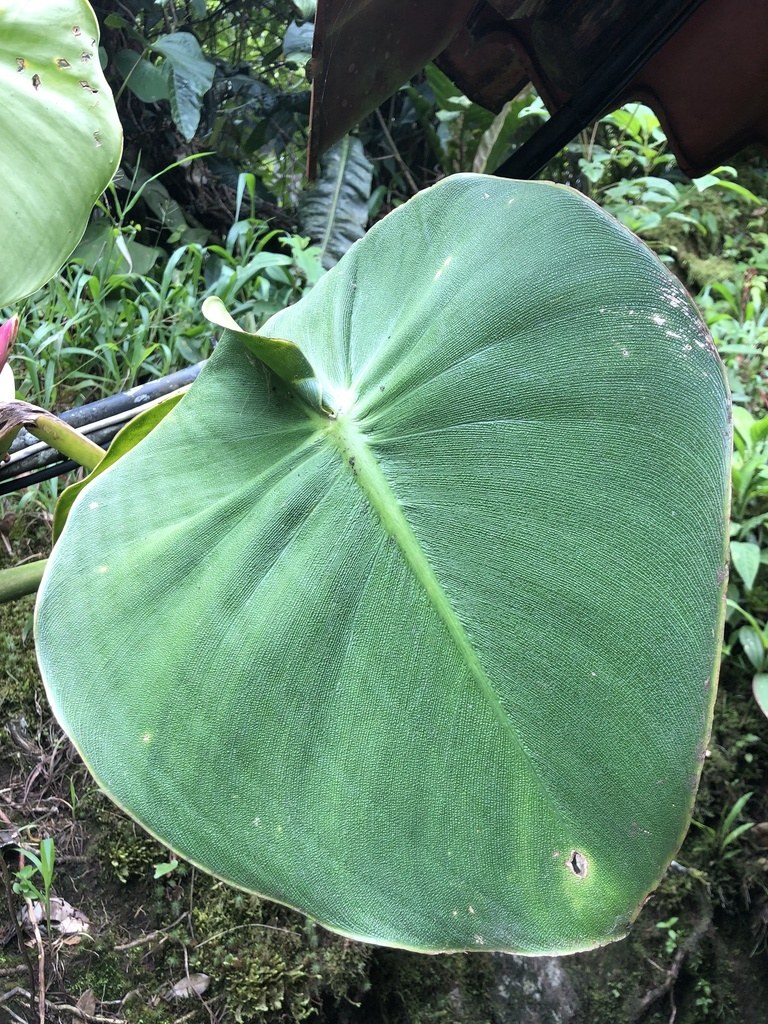
Most Philodendron forgive a missed watering, a too-bright window, a week of dry air. Philodendron rugosum does not, quite. It comes from a narrow elevation band in western Ecuador, roughly 1,500–2,000 m, where days sit in the high 60s to mid-70s °F and nights drop into the upper 50s. Humidity rarely falls below 80%. That climate is not exotic so much as specific, and the plant reads any departure from it on its next leaf.
The good news is that rugosum is not fussy in the way an Anthurium warocqueanum is fussy. It does not spite-root or collapse overnight. It simply stops pushing leaves, or pushes small, pale, undersized ones, until conditions improve. Treat a stall as data: something in light, airflow, root health, or humidity is wrong, and the plant will resume once it's corrected. Growers who keep it well usually keep verrucosum well too — the requirements are nearly identical.
Build an airy, chunky mix that drains in seconds and stays evenly damp. A workable base is roughly equal parts orchid bark, perlite or pumice, and coco chips, with a smaller fraction of sphagnum or high-quality coir to hold moisture. Avoid peaty bagged 'aroid mix' that packs down — rugosum wants oxygen at the roots more than it wants nutrients.
Pot size should be conservative. These are not vigorous root producers, and a too-large pot stays wet in the middle and rots the crown. Step up one size at a time, and only when roots are visibly circling. A damp sphagnum pole or a tree-fern slab gives the climbing stem something to grip and feeds aerial roots directly — leaf size increases markedly once aerial roots make sustained contact with a moist surface.
Top-dress with live sphagnum if you can keep it alive. It buffers humidity at the soil line, signals when the pot is drying, and looks the part.
Bright indirect light, no direct sun past early morning. In practical terms that's around 150–250 µmol m⁻² s⁻¹ at the leaf, or a few feet back from an unobstructed east window. Direct midday sun bleaches the leathery surface to a dull khaki within a week and the damage doesn't reverse.
Water when the top inch of mix is just shy of dry. With a chunky substrate that usually means every 4–7 days indoors, more often in a cabinet with strong airflow. Use rainwater, RO, or filtered tap if your water is hard — rugosum shows tip burn from chloramine and salt buildup faster than most Philodendron. Flush the pot thoroughly every couple of months.
Humidity is where most failures happen. 70% and up is the comfortable range; 60% is the floor, and below 50% you'll get small, crumpled new leaves and crisping margins. A grow tent or IKEA-style cabinet with a small clip fan solves this for almost everyone. Airflow is not optional — stagnant high humidity invites bacterial blight, which rugosum is notably susceptible to. Move the air, always.
Treating it like a heartleaf. Rugosum is not hederaceum. It will not climb a moss pole in a dry living room and reward you with bigger leaves. Without humidity and cool nights, it shrinks.
Overpotting after purchase. Imported or freshly rooted plants arrive with minimal root mass. Put them in a 4-inch pot of chunky mix, not a 6-inch, and resist the urge to bump them up until you see real root development.
Misreading a stall. New collectors panic when rugosum pauses, then change everything at once — repot, fertilize heavily, move it to brighter light. The plant usually wants one variable corrected (often humidity or a wet pole), not five. Change one thing, wait three weeks, observe.
Buying without provenance. Rugosum is Near Threatened in the wild and there is no legitimate reason to buy wild-collected stock. Reputable nurseries propagate from established mother plants. Ask.
The Field Guide from Leaf People.