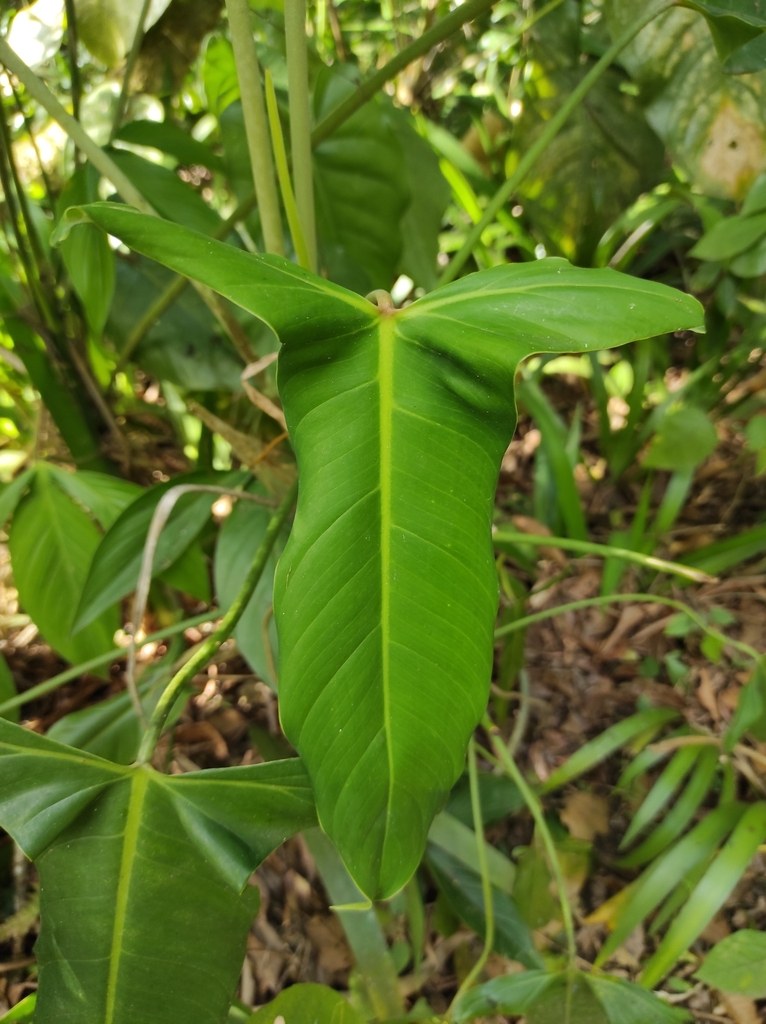
📷 Hersson Ramírez / iNaturalist (CC BY 4.0)
Field Guide · Philodendron
A bicolor climber from the cloud forests of southern Mexico, plus four cousins that share its bold, three-lobed silhouette.
The signature species: long, three-lobed leaves with a glossy green face and a maroon-to-bronze underside that flashes when light rakes across it. Native to wet forests from Veracruz down into Central America, it climbs hard once it finds a slab and rewards the effort with leaves pushing 18 inches on a mature plant. The petioles are subtly geniculate, the new growth nearly black. Easier than its looks suggest.
Top pickSometimes sold as P. laciniatum, this is the philodendron that morphs as it ages — juvenile leaves are simple arrowheads, mature ones split into five or seven fingers. Wild across Venezuela, the Guianas, and northern Brazil. It tolerates a wider range of conditions than mexicanum and recovers quickly from neglect. A good gateway to lobed philodendrons.
Most forgivingA hybrid (likely pedatum × squamiferum) prized for chalky, blue-green new growth that hardens to a softer sage. The lobes are pronounced but less dramatic than pedatum, and the petioles carry faint pubescence. Faster than most lobed types and content in a 5-gallon pot with a moss pole. Variegated forms exist but command absurd money.
Best valueThe lobes are secondary here — the draw is the petiole, dense with soft red hairs that look almost mammalian up close. Native to the Guianas and northern Brazil. Leaves reach four or five lobes at maturity and sit on long, arching stems that want vertical support. Sensitive to stale air; give it a fan.
Character pickOften confused with bipennifolium (the true horsehead philodendron), panduriforme has a more compact, fiddle-shaped leaf with rounded basal lobes. Ecuadorian and Peruvian lowlands. The leaf substance is thicker than mexicanum and the plant handles drier apartment air better than most of this group. An underrated species that rarely shows up at big-box retailers.
Sleeper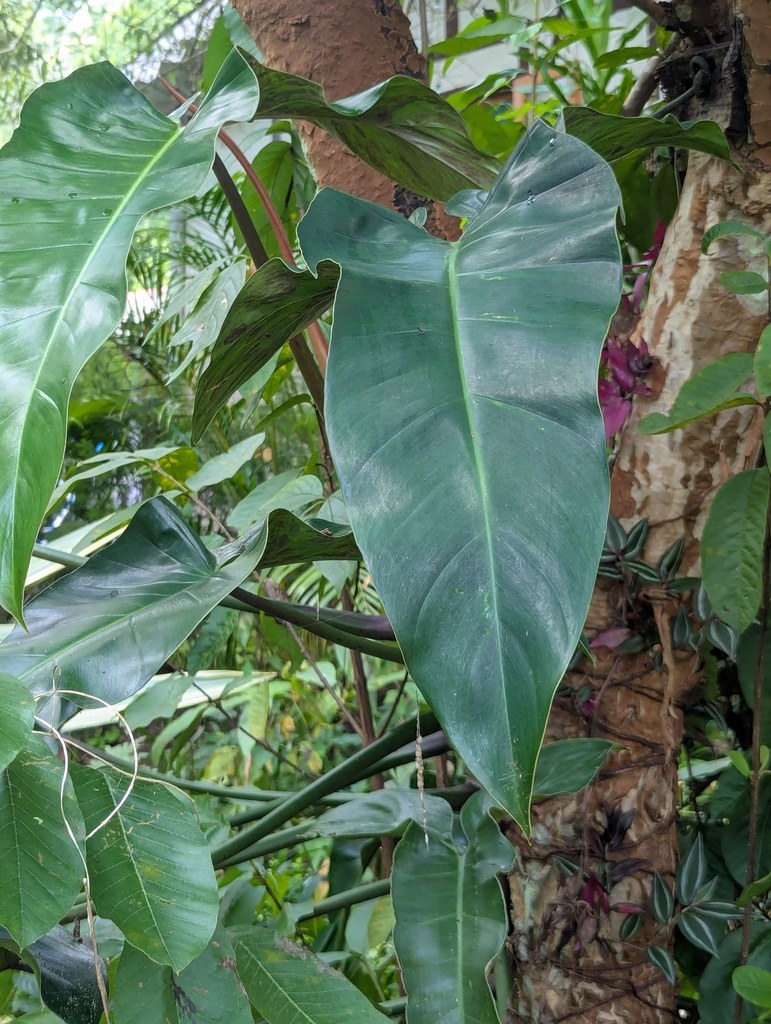
Philodendron mexicanum wants an airy, chunky mix that drains in seconds and still holds some moisture between waterings. A working recipe: 40% orchid bark (medium grade), 25% perlite or pumice, 20% coco chips, 10% sphagnum, and 5% horticultural charcoal. Skip dense peat-heavy houseplant soil — the roots are thick, oxygen-hungry, and will rot in anything that compacts.
Pot choice matters more than people admit. A tall, narrow pot suits the climbing habit and lets you anchor a moss pole or cedar slab deep into the medium. Terracotta is fine if you're a heavy waterer; plastic or glazed ceramic if you tend to forget. Repot every 18 to 24 months, or when you see roots circling the drainage holes — mexicanum doesn't sulk after repotting the way verrucosum does, so don't overthink the timing.
Give it something to climb. This is non-negotiable. Mature leaf size and the full three-lobed shape only emerge when the plant is climbing with aerial roots locked into a damp substrate — a sphagnum pole kept consistently moist, or a slab of cork bark misted daily. On a stake or trellis, leaves stay small and juvenile-looking for years.
Bright indirect light, full stop. An east window, or two to three feet back from a south or west window filtered by a sheer. Direct midday sun bleaches the green out of the leaf and dulls the maroon underside to brown. Too little light and the plant stretches, internodes lengthen to four or five inches, and new leaves come in undersized.
Water when the top inch of substrate is dry but the deeper mix still feels cool and barely damp. In a chunky mix that usually means every five to seven days in summer, ten to fourteen in winter. Mexicanum telegraphs thirst — petioles droop slightly before any leaf damage shows. Use that as your cue and you'll never overwater. Tap water is fine unless yours is heavily chlorinated or above 200 ppm; rainwater is better if you have it.
Humidity above 60% gives you the best leaves, but the species is more tolerant than its cloud-forest cousins. It will hold steady at 50% with good airflow. Below that, expect smaller leaves and crispy edges on new growth. A small clip fan running low, eight hours a day, does more for leaf quality than any humidifier — stagnant humid air invites bacterial leaf spot, which on a bicolor leaf is heartbreaking.
Treating it like a heart-leaf philodendron. P. hederaceum will climb a wall in a dim hallway. Mexicanum won't. Give it real light or accept stunted leaves.
No climbing support. The single most common reason a mexicanum looks nothing like the photos: it's being grown as a trailer or on a thin bamboo stake. The aerial roots need something damp and substantial to grip.
Misidentifying it. P. mexicanum is regularly sold as P. sagittifolium or generic 'silver sword' lookalikes. Check the underside — a true mexicanum leaf is distinctly maroon to bronze beneath, with a slight sheen. The petiole is also geniculate (kneed) near the leaf base, a small but reliable tell.
Fertilizer timidity. This is a fast grower in good conditions. A balanced liquid feed at quarter strength with every watering, or a slow-release pellet topped up quarterly, keeps leaves large and color saturated. Underfed plants go pale and stall.
The Field Guide from Leaf People.