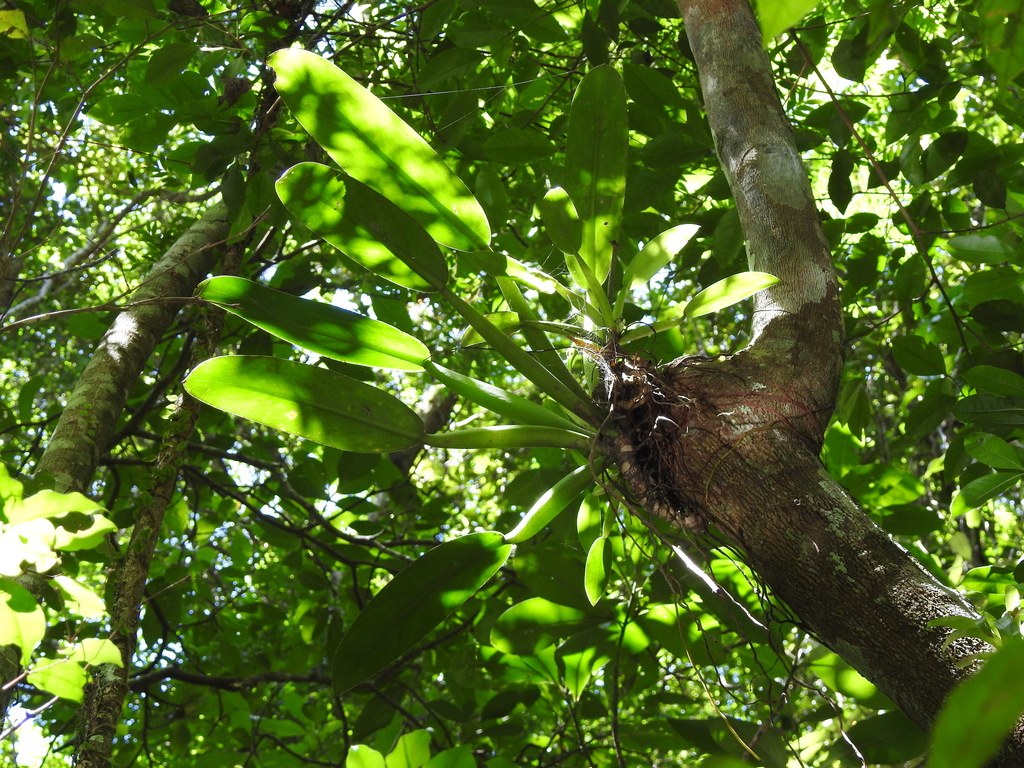
📷 Fabrício Mil Homens Riella / iNaturalist (CC BY 4.0)
Field Guide · Philodendron
The bulbous, water-storing petioles of 'Fat Boy' make it one of the strangest terrestrial philodendrons you can grow — and one of the most rewarding.
The cultivar name refers to the dramatically inflated petioles — spongy, pale-green cylinders that function as water reservoirs and give the plant its unmistakable silhouette. Leaves are glossy, dark green, and broadly elliptic, held nearly upright from the rosette. Growth is slow but steady when given warmth and a loose, nutrient-rich substrate. Because it doesn't climb, it suits a wide, shallow pot rather than a moss pole.
Best overallThe straight species from southeastern Brazil grows with the same compact rosette habit as 'Fat Boy' but with modestly thickened rather than dramatically bulbous petioles. Leaves reach 30–40 cm on mature plants and stay a clean, deep green with a subtle sheen. It's slightly more tolerant of lower humidity than the cultivar and a good reference point if you want to understand what 'Fat Boy' is exaggerating. Care is identical: airy substrate, consistent moisture without waterlogging, and 65%+ humidity.
Reference speciesA terrestrial crawler from Colombia whose white-veined, velvety leaves can exceed 60 cm across on established plants. The rhizome creeps horizontally, so a long, shallow tray pot suits it far better than a standard round container. Gloriosum needs similar humidity to martianum but is less forgiving of wet feet — a very open, chunky mix is non-negotiable. It grows slowly enough that each new leaf feels like an event.
Most dramaticAnother South American terrestrial with heavily ruffled, ridged petioles and broad, bicolored leaves that show pale sage on the underside. It's often confused with gloriosum in photos, but the deeply corrugated petioles and more olive-toned leaf surface distinguish it. Plowmanii tolerates slightly lower humidity than either martianum or gloriosum, making it a practical gateway into terrestrial philodendrons. Mature leaves can reach 50 cm and develop a subtle silver feathering along the midrib.
Good starterFrom Ecuador and Peru, mamei produces large, heart-shaped leaves with irregular silver-grey blotching that varies widely between individuals — a good reason to buy from photos rather than blind. The petioles are ribbed and D-shaped in cross-section, a useful ID character. It grows faster than gloriosum or plowmanii and is somewhat more adaptable to lower humidity, though it still sulks below 55%. An underrated species that earns more shelf space than it typically gets.
Best value
Philodendron martianum grows terrestrially in the leaf-litter layer of the Atlantic Forest in southeastern Brazil. Replicating that means a substrate that holds some moisture but never becomes anaerobic — standard houseplant potting soil alone will compact, exclude oxygen, and rot the roots that do the actual work. A mix of roughly 40% high-quality potting mix, 30% perlite or pumice, 20% orchid bark (medium grade), and 10% worm castings gets close. The castings provide slow-release nutrition without the salt load of synthetic fertilizers; the bark and perlite keep macropores open long-term.
Because 'Fat Boy' doesn't climb, it develops a wider, denser root mass than most philodendrons. Choose a pot that's only slightly larger than the root ball — terrestrial aroids pushed into oversized containers tend to sit in wet media between waterings, which is exactly the condition that triggers petiole rot at the base. Shallow, wide azalea-style pots work well. Unglazed terracotta is useful if your ambient humidity is high; plastic retains moisture longer if your space runs dry.
Repot every 12–18 months or when roots begin circling the drainage holes. Spring and early summer, when the plant is putting out new leaves, is the lowest-stress window. Disturb the root ball as little as possible — these plants establish slowly after repotting, and a stressed martianum will stall for months.
Bright, indirect light is the correct prescription, but 'indirect' needs precision here. Martianum will tolerate moderate light — 800 to 1,500 foot-candles — without complaint, but it pushes larger, darker leaves with consistent bright filtered light in the 1,500–2,500 fc range. An east-facing window or a position 1–2 metres from a south or west window with a sheer curtain covers it. Direct sun bleaches the leaf surface and causes irreversible pale patches; full shade produces small, thin leaves and very slow growth.
Temperature between 18 °C and 28 °C (65–82 °F) suits the plant year-round. Below 15 °C growth stops; below 10 °C you risk cellular damage. Drafts from air conditioning vents are more damaging than low ambient temperature because they desiccate leaves and crash local humidity instantly — keep the plant away from HVAC airflow.
Humidity is where many growers lose 'Fat Boy'. The practical floor is 60%; the plant performs noticeably better at 65–75%. Below 50%, leaf margins brown and new growth emerges smaller and with less vigour. A room humidifier running in the same space is more effective than pebble trays. If you grow in an enclosure or grow tent, add a small USB fan to maintain airflow — stagnant humid air invites fungal issues on the petioles, which are dense enough to hold moisture against the base.
Water when the top 3–4 cm of substrate has dried out. For a well-draining mix in a 20 cm pot at moderate room temperature, that typically means every 5–8 days in summer, every 10–14 days in winter. The swollen petioles are a genuine indicator: a well-hydrated 'Fat Boy' petiole feels firm and slightly turgid; a plant that has been dry too long will show slightly flaccid, softer petioles before the leaves themselves show any wilt. This makes overwatering a greater risk than underwatering for most growers, because the plant masks mild drought stress until it becomes severe.
Feed with a balanced liquid fertilizer (roughly 3-1-2 NPK ratio) at half the recommended dose every two to three weeks during active growth. Avoid heavy feeding in winter when light levels drop — unused nitrogen accumulates as salts and can burn roots in a mix that's already moisture-retentive. Every three to four months, flush the pot thoroughly with plain water to clear salt buildup, particularly if you're using municipal tap water.
The most common mistake with martianum is diagnosing yellowing lower leaves as a watering problem when they're actually normal senescence. Terrestrial philodendrons drop the oldest leaves as new ones emerge; one or two yellowing outer leaves on a plant that's actively pushing new growth is not a crisis. A genuinely overwatered plant shows yellowing across multiple leaves simultaneously, soft dark spots at the petiole base, and a substrate that smells musty when you push a finger in.
The Field Guide from Leaf People.