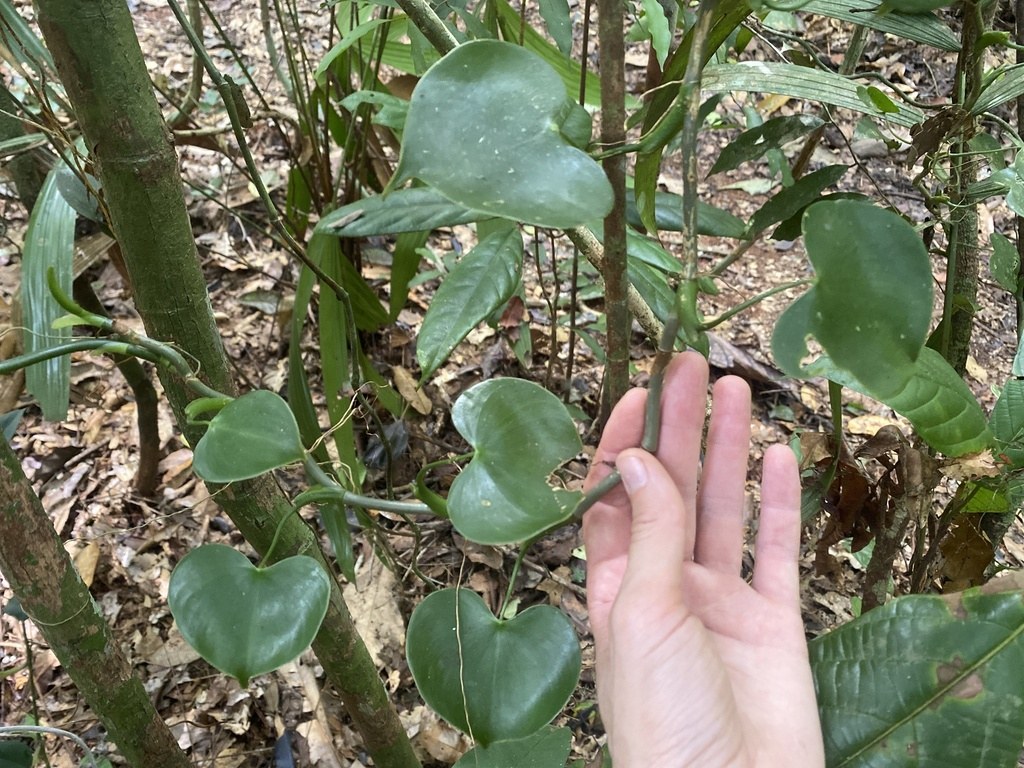
📷 fern Wildtruth / iNaturalist (CC BY 4.0)
Field Guide · Philodendron
Small-leaved, high-gloss, and utterly unassuming until you get close — grazielae rewards the collector who pays attention.
Native to Colombia, Ecuador, and Peru, grazielae climbs by producing tightly spaced, perfectly heart-shaped leaves with a lacquered finish that catches light like polished jade. Petioles are notably inflated — almost tubular — a reliable ID marker that separates it from similar small-leaved climbers. Given a textured pole or cork slab, it presses each leaf flat against the surface and moves steadily upward. Growth accelerates in summer; leaves stay compact even on mature specimens.
Top pickA widespread species across Mexico, the Caribbean, and northern South America, micans offers iridescent bronze-green velvet foliage with a purple reverse that deepens under lower light. It climbs readily and tolerates somewhat lower humidity than most climbing philodendrons, making it an honest gateway plant before you commit to a climate-controlled grow tent. Petioles are slender and often pink-flushed when new. The leaf texture is the opposite of grazielae — where one is glass, the other is suede.
Best contrastFrom Bolivia and Brazil, brandtianum produces olive-green leaves overlaid with irregular silver blotches between the veins — the pattern shifts as leaves harden off. It climbs aggressively on a support and can reach a substantial size in good conditions, with mature leaves exceeding 15 cm. The silver markings and heart-shaped base make it a natural companion piece to grazielae in a display. Care requirements overlap almost entirely, which simplifies growing both together.
Good companionA cultivar of hederaceum selected for its chartreuse-and-green variegation, 'Brasil' is stable, vigorous, and widely available without the price volatility of rarer aroids. It climbs or trails, adapts to a range of humidity levels, and produces new leaves quickly enough that any single imperfect leaf is soon replaced. The contrast between the lime center and dark green margins is consistent across nodes. Useful as a benchmark — if 'Brasil' is struggling, the conditions aren't right for grazielae either.
Benchmark plantThe broad scandens complex includes several closely related climbing forms with classic heart-shaped, mid-green leaves and a matte to semi-gloss surface. Often sold simply as 'heartleaf philodendron,' these plants are forgiving of inconsistent watering and moderate humidity — real-world conditions that kill fussier species. Growing one alongside grazielae makes the difference in gloss and petiole structure immediately visible. Think of the scandens complex as the reference point from which grazielae departs in interesting directions.
Reference species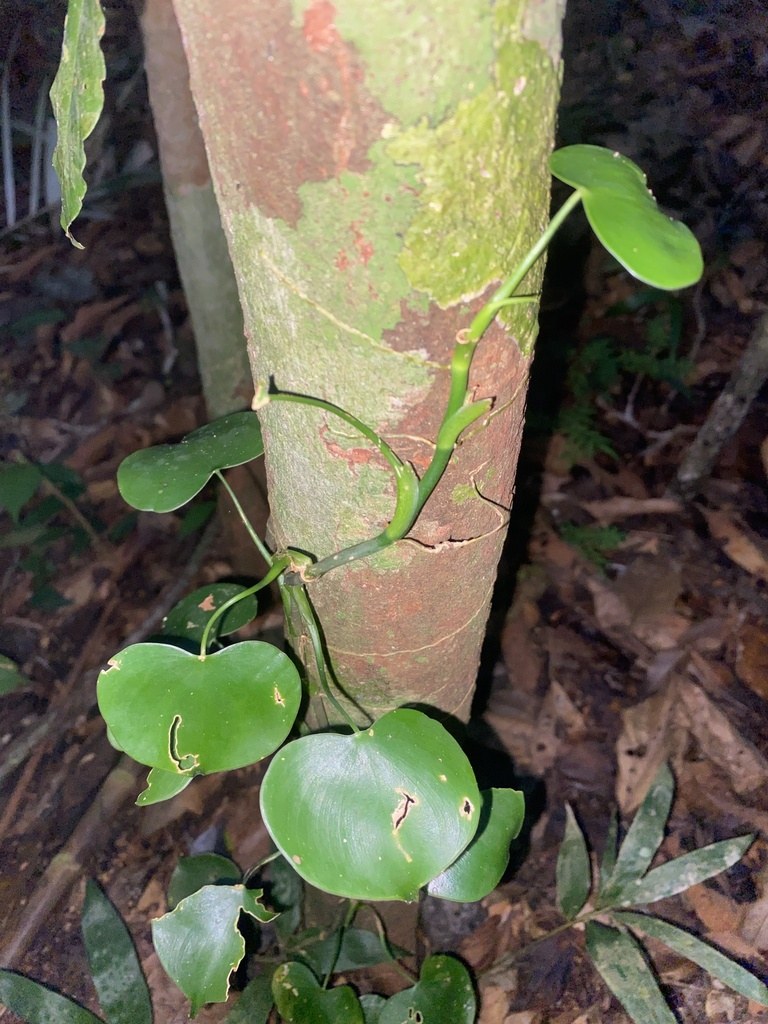
Philodendron grazielae does not want to sit in dense media. In its native range across the lowland and mid-elevation forests of Colombia, Ecuador, and Peru, it climbs rough bark and accumulates whatever organic debris falls around its roots — loose, airy, fast-draining material by default. Replicate that at home with a chunky mix: roughly 40% orchid bark (medium grade), 30% perlite, 20% coco coir, and 10% worm castings or quality compost. The exact ratio matters less than the outcome — water should move through freely, and the mix should feel barely damp 48 hours after a thorough watering.
Avoid peat-heavy potting soils. They compact over time, retain too much moisture around the roots, and tend to dry unevenly — bone dry on the surface, wet in the center. That asymmetry leads directly to root rot, which in grazielae often presents as yellowing of otherwise healthy-looking leaves before you notice any root damage. If the only mix available is a standard potting soil, amend it aggressively: at minimum, add 40–50% perlite by volume.
Pot size matters more than most growers expect. Grazielae has a relatively modest root system for a climber; an oversized pot holds excess moisture the roots can't access quickly. Move up one pot size at a time — typically 2 cm in diameter — and only when roots are actively circling the drainage hole or emerging from the bottom. Terracotta helps buffer against overwatering and is worth using if your ambient humidity allows it.
Bright indirect light produces the best gloss and the most compact internodal spacing. An east-facing window with direct morning sun for one to two hours is close to ideal; a few meters back from a south- or west-facing window also works if no shading curtain intervenes. Direct afternoon sun bleaches the leaves — that lacquered surface that makes grazielae distinctive turns matte and yellowish before burning outright.
Minimum usable light is around 1,500–2,000 lux measured at the leaf surface. Below that, growth slows to near zero and internodes stretch, producing widely spaced leaves on a leggy stem. If you're growing under artificial light, a full-spectrum LED panel at 10,000–15,000 lux for 12–14 hours per day replicates a bright tropical ambient well. Keep the photoperiod consistent — erratic light cycles disrupt growth rhythm without any upside.
Temperature tolerance is reasonable for a tropical climber. The comfortable range is 18–30°C (64–86°F); brief dips to 15°C (59°F) won't cause immediate damage but will slow growth noticeably. Below 13°C the plant stresses and becomes susceptible to fungal issues. Cold drafts from air conditioning vents are a more common problem than low ambient temperature in most homes — position grazielae away from direct airflow, both cold and hot.
Water when the top 3–4 cm of the mix has dried out. That translates to roughly every five to seven days in summer under good light and every ten to fourteen days in winter — but tracking the actual dryness of the mix beats any schedule. When you do water, water thoroughly: pour until it runs freely from the drainage hole, then stop. Empty saucers within 30 minutes; standing water under the pot is one of the fastest routes to root problems.
Humidity in the 60–75% range produces the largest, most glossy leaves. Below 50%, leaf edges may begin to desiccate before they fully harden off, and new growth sometimes emerges smaller than preceding leaves. A small ultrasonic humidifier in the grow space is more effective than misting, which raises humidity only briefly and can promote fungal spots on the glossy leaf surface if water lingers. Airflow — a small fan running on low — helps counteract the increased moisture and keeps fungal pressure down.
The most common mistake with grazielae is treating it like a trailing plant and leaving it in a hanging basket without any support. Without something to climb, growth is slower, leaves stay smaller, and the plant never develops the pressed, shingling habit that makes it worth growing. Even a modest moss pole or a section of rough cork bark makes a visible difference within a few months. The second most common mistake is repotting into a pot that's too large too soon — check the roots before you move up, not the calendar.
The Field Guide from Leaf People.