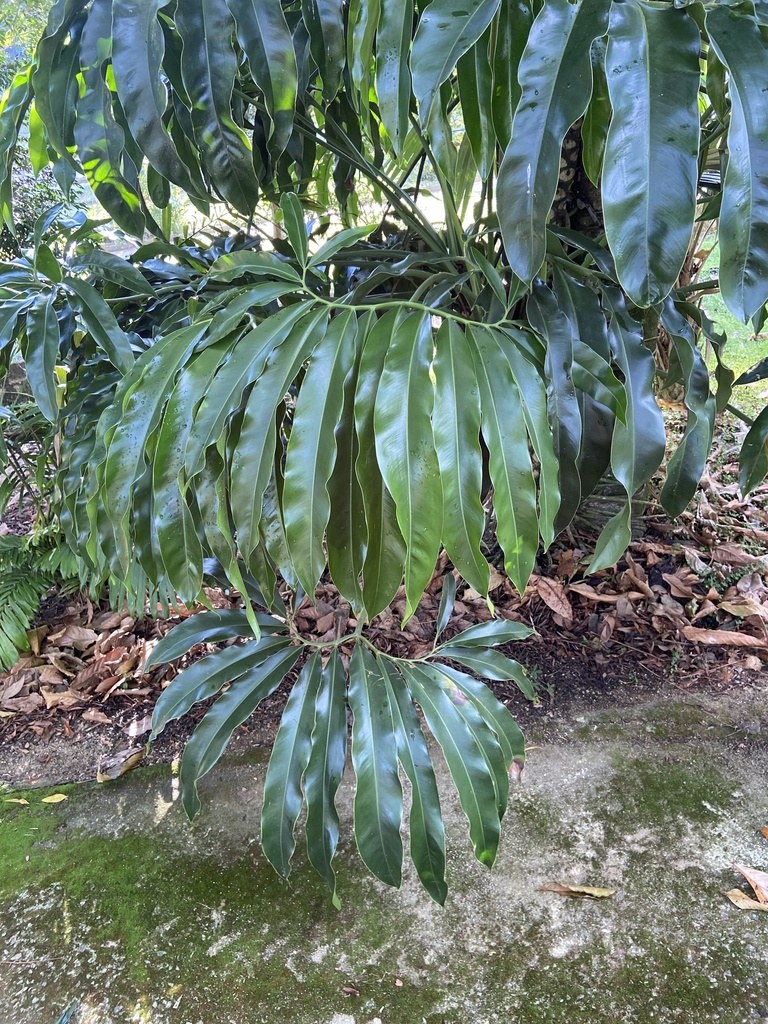
📷 Alexandre Magno / iNaturalist (CC BY 4.0)
Field Guide · Philodendron
The only philodendron that arranges its deeply-lobed leaves in a self-heading spiral, goeldii rewards growers who get the airflow and drainage right.
Formerly shuffled into the genus Thaumatophyllum, goeldii produces a ground-level rosette of deeply palmate leaves, each divided into 10–16 lanceolate leaflets radiating from a central point. Mature specimens develop a stout aerial trunk as lower leaves shed, eventually looking more like a small cycad than a conventional philodendron. Growth is deliberate — expect one full whorl every four to six weeks in good conditions. The structural silhouette alone justifies the shelf space.
Best overallClosely related to goeldii and also reclassified into Thaumatophyllum by some authorities, bipinnatifidum grows into a large, trunking specimen with deeply pinnate leaves that can exceed a meter across at maturity. It tolerates lower humidity than most aroids and adapts to a range of indoor substrates without throwing a tantrum. Leaf sinuses deepen dramatically as the plant matures, so juvenile specimens give almost no hint of what they will become. A useful reference point for understanding how the self-heading growth form scales up.
Most forgivingWidely sold as a compact alternative in the bipinnatifidum complex, Xanadu stays substantially smaller — leaves typically top out around 40 cm — making it practical for spaces where a full bipinnatifidum would eventually become a problem. The lobing is shallower than goeldii's, with a glossier surface texture and a denser, clumping growth habit. It is tolerant of brighter indirect light and dries out more gracefully than many aroids, meaning brief lapses in watering won't cause immediate collapse. Good entry point before committing to the slower, pricier goeldii.
Best for small spacesLess commonly stocked than its relatives, polypodioides produces elongated, strap-like leaf segments arranged around a central rachis in a way that reads as almost skeletal from a distance. It shares the trunking habit of the broader Thaumatophyllum group but maintains a narrower overall profile than bipinnatifidum. Leaf color is a consistent deep matte green with minimal surface sheen. Worth seeking out if you want a whorled philodendron with a distinctly different silhouette from goeldii without sacrificing the architectural quality.
Best specimen plant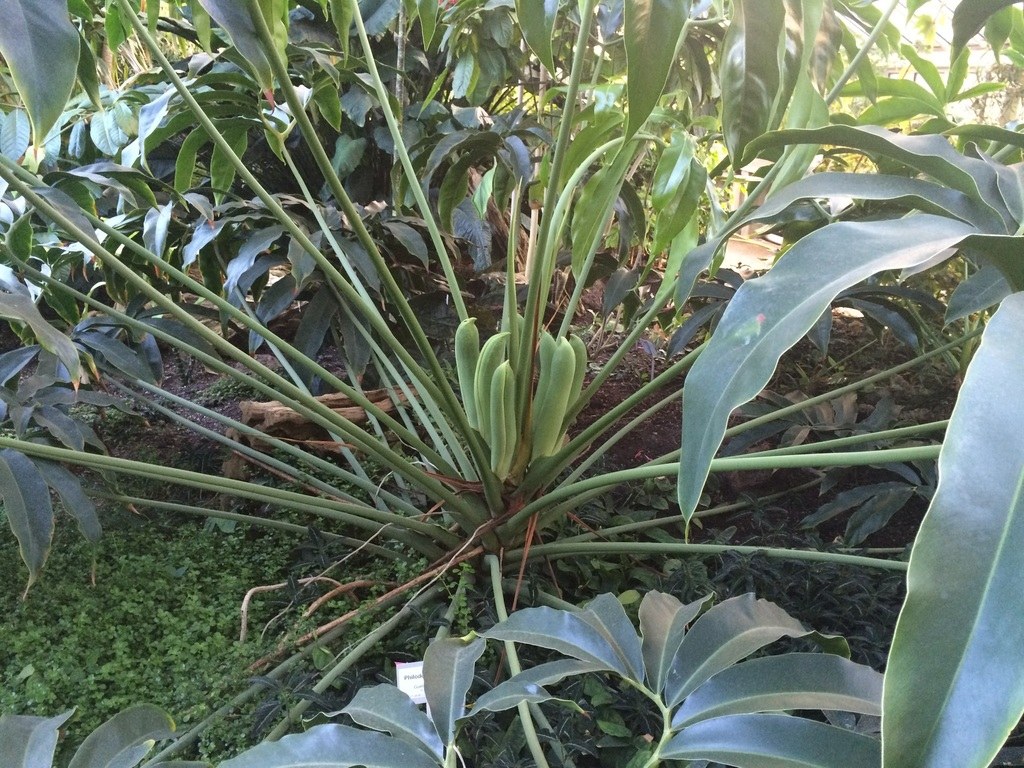
Goeldii's roots demand oxygen as much as moisture. A dense, peat-heavy mix holds too much water against the roots and invites rot at the base of the trunk — the one place on this plant that is genuinely difficult to recover from. Build a mix around a chunky base: orchid bark at roughly 40%, perlite or pumice at 30%, and a quality coco coir at 30% gives adequate moisture retention without staying soggy. If you're in a humid climate or a humid grow tent, weight the ratio further toward bark and pumice.
Pot selection matters. Terracotta pulls moisture from the medium faster than plastic or glazo ceramic, which works in goeldii's favor if your ambient humidity is already high. Size up only when roots are circling the base or emerging from drainage holes in quantity — overpotting a self-header invites the same standing-moisture problems as the wrong substrate. Because goeldii eventually develops a visible aerial trunk, avoid burying the base deeper than it wants to sit; the trunk is ornamental and functional, not a stem to be covered.
Top-dress with worm castings once in spring and once in early summer. Goeldii responds to a steady, dilute liquid feed during the growing season — a balanced formula at half the recommended dose every two weeks keeps growth consistent without pushing soft, vulnerable new leaves.
Bright indirect light is the standard advice for aroids and it applies here, but goeldii leans toward the brighter end of that range. An east-facing window with a few hours of direct morning sun, or a spot two to three feet from a large south or west window, produces the tightest, most symmetrical whorls. Dim conditions don't kill it, but internodes stretch, leaflet count per whorl decreases, and the plant loses the compact architectural quality that makes it interesting.
Water when the top two to three centimeters of medium have dried out. In a well-aerated substrate, that might be every five to seven days at room temperature in summer, and every ten to fourteen days in winter. The exact interval matters less than the logic: check the medium rather than the calendar. Goeldii will flag slightly before going into real drought stress, which gives you a usable warning window, but don't use wilt as the regular signal — repeated cycles of drought stress slow the whorl production noticeably.
Humidity between 60% and 70% is the target. Goeldii originates from humid lowland forest in Brazil and French Guiana, and while it tolerates brief drops into the 50s without visible damage, sustained low humidity produces brown leaflet tips and slows the emergence of new whorls. A room humidifier positioned nearby, a pebble tray, or placement in a bathroom with good indirect light all work. Airflow is equally important: passive, stagnant humidity encourages fungal issues at the base of the whorl where dead leaf bases accumulate.
The most common error is treating goeldii like a climbing philodendron and giving it conditions optimized for a vining plant — a moss pole, deep shade, and constant moisture at the roots. Self-heading philodendrons in the Thaumatophyllum group have different needs: they want more light, faster-draining substrate, and no support structure to climb. A moss pole does nothing useful here and can hold excess moisture against the trunk.
Yellowing of the oldest, outermost whorl leaves is normal as the plant matures and sheds lower leaves to build its trunk. Yellowing of mid-whorl leaves, or yellowing that progresses inward rapidly, usually points to overwatering or a substrate that has broken down and compacted over time. If your mix is more than 18 months old and drains slowly, repot rather than adjusting your watering schedule around a failing medium.
New leaflets emerging distorted, fused, or with asymmetrical lobing are occasionally a sign of thrips feeding on developing tissue inside the whorl, where the damage is invisible until the leaf expands. Pull back the emerging whorl gently and inspect with a hand lens. Thrips on goeldii respond to spinosad-based treatments applied weekly for three cycles, but you have to reach inside the whorl to contact the population — surface sprays on expanded leaves miss the majority of the infestation.
The Field Guide from Leaf People.