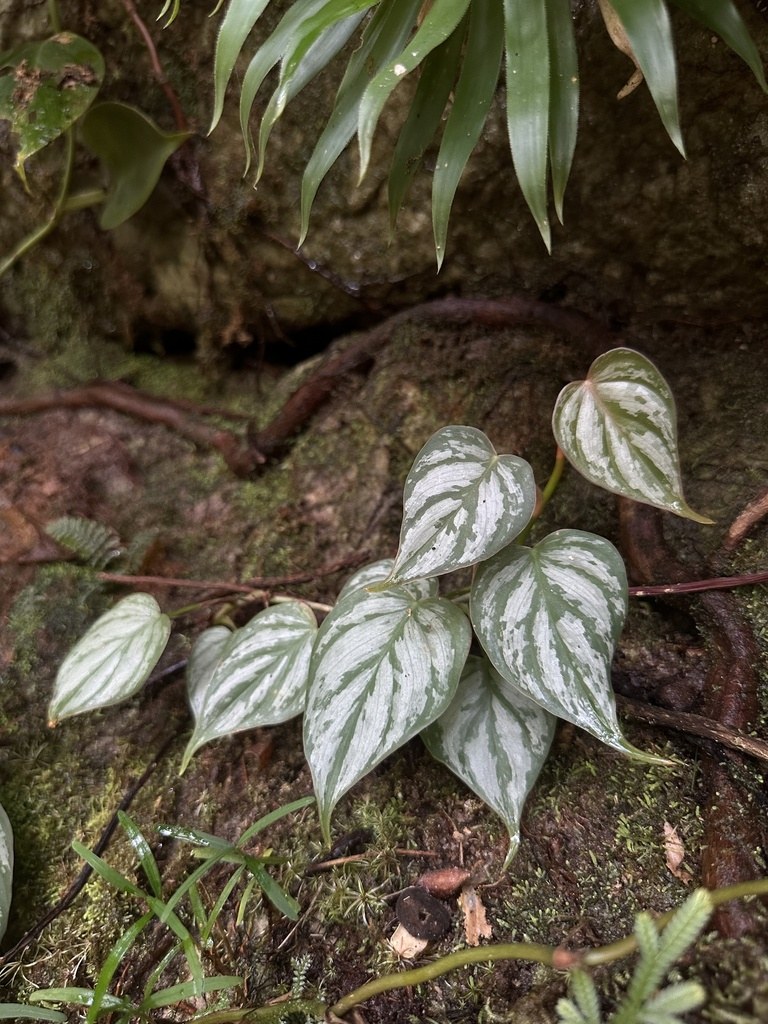
📷 Nicolás Baresch Uribe / iNaturalist (CC BY 4.0)
Field Guide · Philodendron
The silver leaf philodendron is faster, tougher, and more forgiving than the rare velvets it gets compared to — and it still puts on a real show.
Heart-shaped olive leaves splashed with silver between the secondary veins, held on wiry petioles. Native to Peru, Bolivia, and western Brazil, it climbs hard once it finds something to grip. Mature leaves on a pole can double or triple in size and lose some of the juvenile silvering. The best beginner silver-patterned Philodendron by a wide margin.
Editor's pickA terrestrial Ecuadorian creeper with broad cordate leaves marked by irregular silver brushstrokes and a slightly quilted texture. Unlike brandtianum, it runs along the ground on a thick rhizome rather than climbing. Wants a wider, shallower pot and a chunkier mix. Slower, but the mature leaves easily clear a foot.
Trophy creeperHeart-shaped silver leaves with a leathery feel and sharply defined silver bands following the veins. The true sodiroi is still uncommon in cultivation and frequently confused with look-alikes like P. brandi and aff. forms. Slower than brandtianum but more dramatic at size. Worth the patience if you can source a verified clone.
Collector's grailA trade name applied to a compact climbing Philodendron with thick, matte silver-gray leaves and a tight internode. Lineage is murky, but it behaves like a slower, sturdier brandtianum with less olive tone. Excellent on a short moss pole or in a cabinet. Tolerates lower humidity than most silver species.
Most forgiving
Philodendron brandtianum is a hemiepiphyte from the western Amazon basin. In habitat it germinates on the forest floor, finds a trunk, and climbs into brighter light, getting larger leaves the higher it goes. Everything you do in cultivation should nudge it toward that arc: something to climb, enough light to justify the climb, and roots that can breathe.
Light is the single biggest lever. Give it bright indirect light — an east window, a few feet back from a south window, or roughly 200–400 µmol/m²/s under LEDs for 10–12 hours. Too little light and the silver pattern flattens out, internodes stretch, and new leaves come in smaller than the last. Direct midday sun will bleach the silver to a papery cream and scorch the margins.
Substrate should drain fast and hold structure for at least a year. A working mix is roughly one part coco chips or fine orchid bark, one part perlite or pumice, one part high-quality potting soil or coco coir, with a handful of charcoal. The roots are fine and a little brittle, so they don't punch through dense peat — they suffocate in it. If your mix stays wet more than four or five days in a 4-inch pot, it's too heavy.
Water when the top inch is dry and the pot feels noticeably lighter. Brandtianum is more drought-tolerant than gloriosum or mamei but less so than a pothos — err on the side of slightly dry rather than evenly moist. Yellowing lower leaves with black petiole bases means the mix stayed wet too long. Crispy edges and curling new growth mean the opposite.
Humidity above 60% gives you bigger leaves and faster rooting into a pole, but the plant will live and grow at 45–50% if airflow is good and you're not also pushing it with cold drafts. A moss pole or slab is not optional if you want adult foliage. Keep the moss damp — a weekly top-water with a long-spout watering can is enough — and the aerial roots will dig in within a few weeks. Once they grip, leaf size jumps noticeably.
Fertilize lightly and constantly rather than heavily and occasionally. A balanced synthetic at quarter strength every watering, or a slow-release prill refreshed every three months, both work. Flush the pot with plain water once a month to keep salts from building up; Philodendron roots are sensitive to fertilizer burn and you'll see it as brown leaf tips before anything else.
The first is treating it like a velvet Philodendron. Brandtianum is not gloriosum or melanochrysum — it doesn't want the same heavy, moisture-retentive mix, and it climbs rather than crawls. People pot it deep in dense soil, the roots rot, and they blame the plant.
The second is buying a tiny tissue-cultured plug and expecting the catalog photo immediately. Juvenile leaves are small, thin, and often less silver than adult foliage. Give it a year on a pole in good light before deciding whether you like it.
The third is confusing it with P. sodiroi, P. brandi, or various aff. forms sold under either name. Brandtianum has thinner, more olive-toned leaves with silver concentrated between the veins; sodiroi is stiffer, more silver overall, with banding that follows the veins. Buy from a seller who knows the difference, and your collection stays honest.
The Field Guide from Leaf People.